
Brand Guidelines vs Style Guide: How Their Roles and Coverage Differ
Brand guidelines usually govern the broader brand system—including strategic, verbal, visual, and application direction—while a style guide usually codifies narrower visual or editorial rules for applying an established direction. Because organisations use these labels inconsistently, classify the document by its scope, purpose, and contents rather than by its title alone.
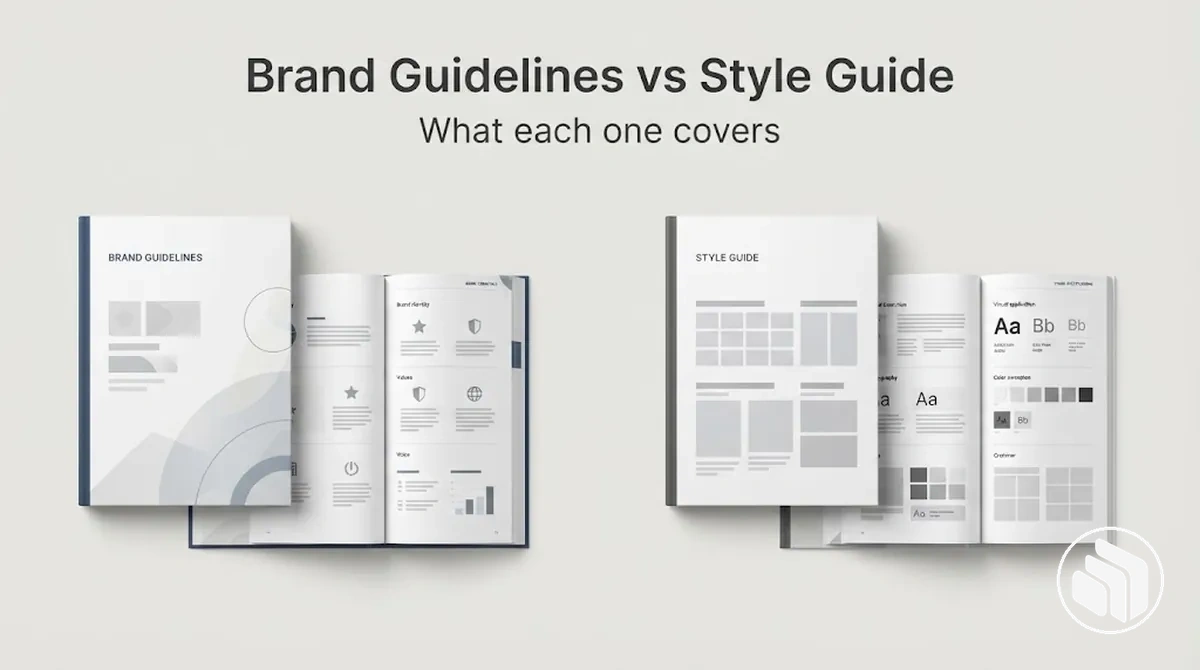
Brand guidelines vs style guide at a glance
Use the document's function as the primary classifier. The same label can describe different levels of guidance in different organisations.
Brand guidelines
- Typical scope
- Broader brand system: strategy, voice, visual identity, and application guidance.
- Main decision
- How the identity should be understood and expressed across contexts.
- Best fit
- When teams, partners, or channels need shared identity direction, not only execution rules.
Style guide
- Typical scope
- Focused visual and/or editorial rules such as typography, colour, imagery, terminology, capitalisation, tone, and formatting.
- Main decision
- How an established direction should be applied consistently in recurring work.
- Best fit
- When identity direction is already established and specific execution choices need codifying.
Use both when broader identity direction and detailed operational rules need separate layers; use one combined document when both can be governed clearly together.
Within Brand Identity Design, both document types can support consistent brand expression. Their practical difference is usually the breadth and level of decisions they govern, not a universal naming hierarchy.
Table of Contents
How Brand Guidelines and Style Guides Differ in Scope and Purpose
Brand guidelines usually govern a broader set of brand identity decisions, while a style guide usually governs more specific application rules.
The main difference is therefore one of scope, purpose, and decision scope rather than a fixed hierarchy between the documents.
Brand guidelines may provide wider strategic context for how an identity should be expressed, whereas style guides often provide more prescriptive visual or editorial usage guidance.
These distinctions are typical rather than universal because organisations use the labels inconsistently.
The same criteria can be applied to both documents to clarify their typical roles: breadth, governing purpose, strategic context, level of prescription, decision scope, and primary use.
Within Brand Identity Design, these criteria distinguish broader identity guidance from more focused application guidance.
The comparison describes common functions rather than mandatory document standards.
| Comparison criterion | Brand guidelines | Style guide |
|---|---|---|
| Breadth | Usually covers a broader identity system and how it is expressed. | Usually covers a narrower set of visual or editorial application rules. |
| Governing purpose | Guides broader decisions about maintaining and expressing the brand identity. | Guides more specific decisions about applying established visual or editorial choices. |
| Strategic context | May connect application decisions with wider considerations such as strategy, voice, and visual identity. | Often operates within an established direction and focuses on how particular choices are applied. |
| Level of prescription | May combine broad identity principles with rules for particular applications. | Often provides more specific usage guidance within its narrower area of application. |
| Decision scope | Can inform broader decisions about how the brand should be represented. | Usually informs narrower decisions about how established elements should be used. |
| Primary use | Provides broader guidance for interpreting and applying the brand identity. | Provides a focused reference for applying defined visual or editorial conventions. |
The practical distinction is the type of decision each document is intended to support.
Broader brand guidelines can provide context for interpreting an identity system, while a narrower style guide can translate established choices into specific application rules.
Greater breadth does not necessarily mean greater prescription: a focused style guide may provide highly specific guidance within its narrower scope.
The document name alone cannot establish its function because terminology may overlap between organisations.
A document called a brand style guide may perform a broader identity role in one organisation and a focused application role in another.
Scope and purpose are therefore more reliable indicators of function than the label.
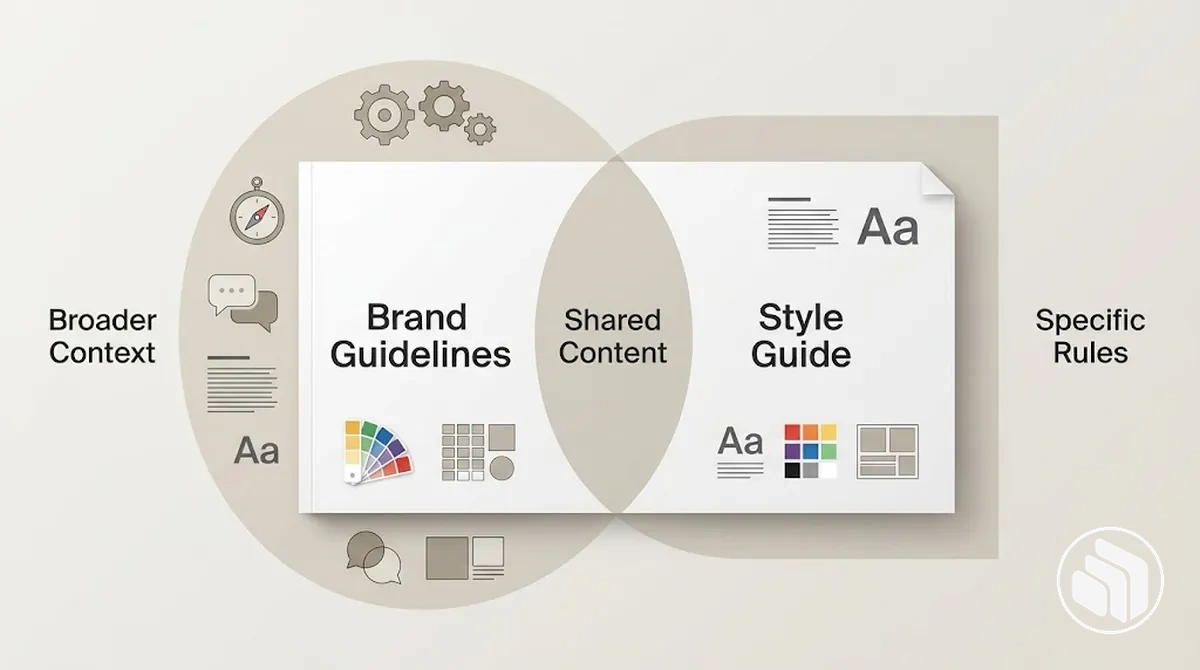
The accompanying visual illustrates how the two document types can operate at different levels within a brand system, showing their relative decision scope and the areas where their functions may overlap rather than repeating the individual comparison criteria.

Brand Guidelines Usually Cover the Broader Brand System
Brand guidelines often function as an identity-level reference because their scope can connect several parts of the brand system rather than documenting one category of usage rules.
Depending on the organisation and purpose, that breadth may include strategic foundations, verbal identity, visual identity, and application guidance.
These attribute groups provide context for both what the brand represents and how that identity is expressed, without implying that every brand guide contains the same components.
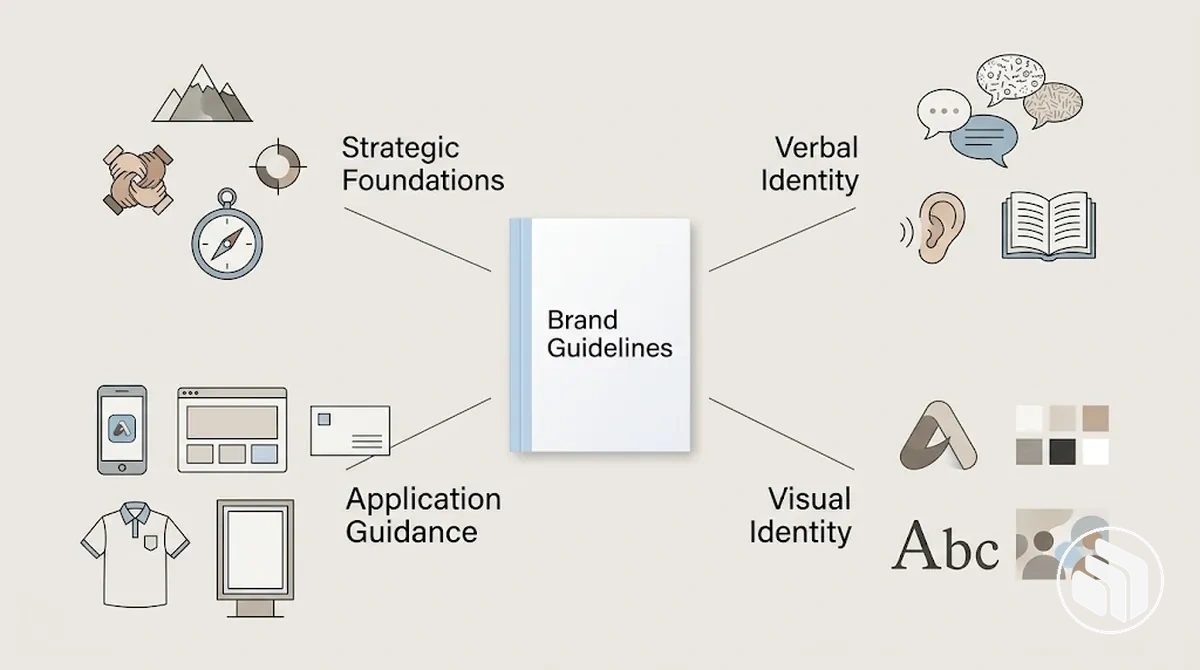
The breadth of brand guidelines can be understood through four attribute groups and the function each serves:
- Strategic foundations: Mission, values, positioning, and related strategy can establish the context used to interpret broader brand decisions.
- Verbal identity: Voice and tone guidance can connect the brand's intended character with its verbal expression.
- Visual identity: Logo, colour, typography, and imagery guidance can define how core visual elements are recognised and applied.
- Application guidance: Usage across relevant channels can coordinate how strategic, verbal, and visual elements are expressed in practice.
The relative emphasis of these groups varies with the organisation and the intended purpose of its guidelines, so they represent common areas of breadth rather than required sections.
The accompanying diagram shows how these dimensions can connect within a broader brand system without replacing the attribute-level guidance above.
Style Guides Usually Focus on Specific Usage Rules
A style guide commonly translates an established direction into specific usage rules for producing content or design.
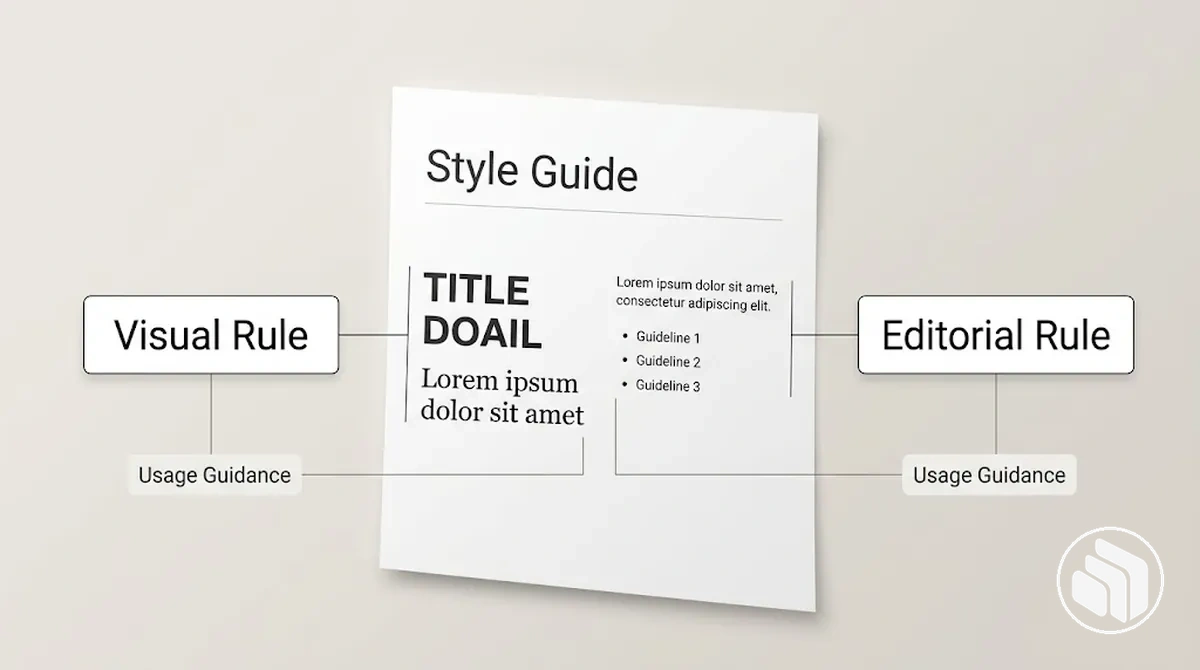
It can specify visual rules for choices such as typography, colour use, imagery treatment, and spacing, or editorial rules for choices such as grammar, terminology, capitalisation, and tone.
The exact scope depends on the organisation and purpose, because the term style guide does not have a universal definition.
Focused application guidance can govern concrete execution decisions such as:
- Typography: visual rules can specify how type choices, hierarchy, or formatting are applied.
- Colour and imagery: visual rules can guide how established colours and imagery treatments are used in specific applications.
- Formatting: guidance can specify recurring presentation conventions so content follows an established structure.
- Grammar and capitalisation: editorial rules can define how recurring language and capitalisation decisions are handled.
- Terminology and tone: editorial rules can guide preferred terminology and how an established voice is expressed in content.
The label itself does not guarantee a narrow scope; the rules and application decisions covered by the document are more reliable indicators of its function.
The accompanying annotated example shows rule-level specificity on a simplified document page, using one visual-rule annotation and one editorial-rule annotation to illustrate focused usage guidance without repeating the full set of rule domains.
What Brand Guidelines and Style Guides Typically Include
Brand guidelines and style guides can share many content domains even when the depth and emphasis of their coverage differ.
Both may address voice and tone, logo rules, colour, typography, imagery, editorial conventions, and application examples, while strategic foundations are more commonly developed as broader context in brand guidelines.
Inclusion still depends on the organisation, document purpose, and intended users, so these areas are representative rather than fixed requirements.
The comparison groups shared content domains by their typical level of coverage.
“Broad” indicates wider identity or strategic context, “specific” indicates focused usage rules, “optional” indicates that inclusion depends strongly on scope, and “outside usual focus” indicates that an area is less characteristic of that document type rather than excluded.
| Content domain | Brand guidelines | Style guide |
|---|---|---|
| Strategic foundations | Broad | Optional or outside usual focus |
| Voice and tone | Broad or optional | Specific when editorial guidance is in scope |
| Logo rules | Broad within visual identity | Specific when visual usage is in scope |
| Colour | Broad within visual identity | Specific when visual usage is in scope |
| Typography | Broad within visual identity | Specific when visual usage is in scope |
| Imagery | Broad or optional | Specific or optional |
| Editorial conventions | Optional, often within verbal identity | Specific when editorial usage is in scope |
| Application examples | Broad or optional across brand touchpoints | Specific or optional for defined usage rules |
The overlap means a document's contents cannot be inferred reliably from its title alone.
Similar domains can appear in both documents while receiving different depth or emphasis, and an organisation may combine broader context with specific rules in one document.
The subordinate sections separate these groups further by showing how brand guidelines can combine strategic, verbal, visual, and application material while style guides can concentrate on visual or editorial rules.
The accompanying visual shows this overlap at a high level without repeating the table's individual content domains.
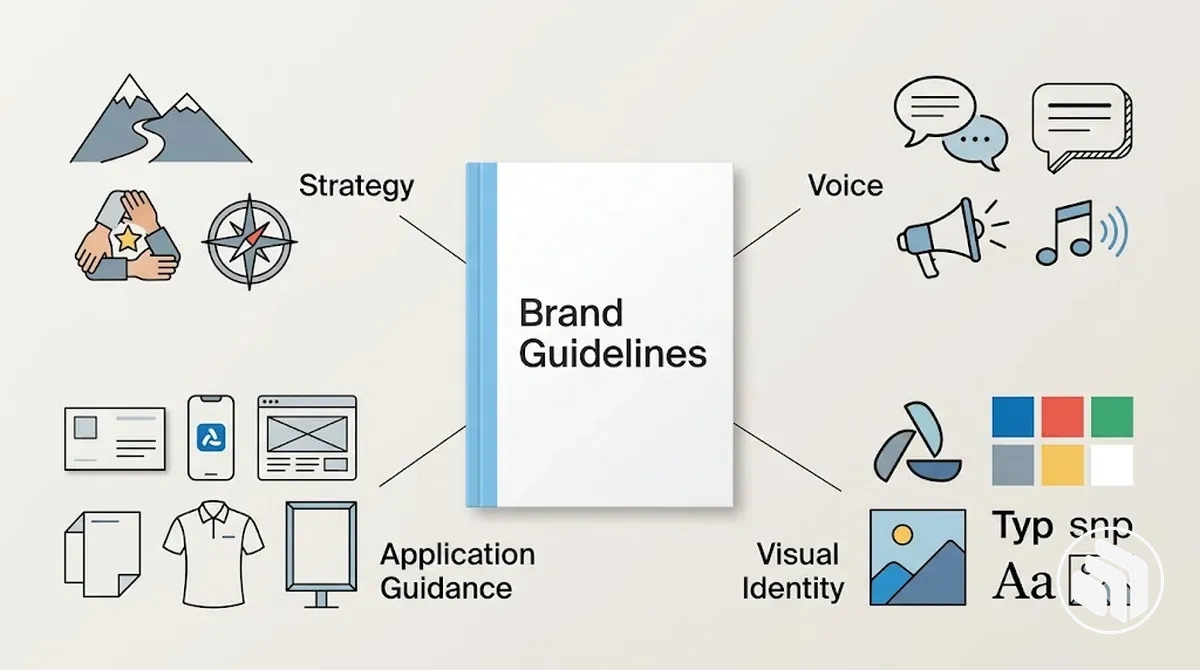
Brand Guidelines: Strategy, Voice, Visual Identity, and Application
Brand guidelines commonly organise identity guidance into four connected content groups: strategy, voice, visual identity, and application guidance.
Strategy can establish context through elements such as mission, values, and positioning, while voice defines how that identity is expressed verbally.
Visual identity covers recognisable elements such as the logo, colour, typography, and imagery, and application guidance connects those elements to practical usage across relevant touchpoints.
These groups can be understood by the function each serves within coordinated brand expression.
Their exact contents and level of detail depend on the organisation and purpose, so the examples represent common areas rather than required sections.
- Strategic foundations: Mission, values, positioning, and related strategy provide context for interpreting what the brand represents and how broader identity decisions should align.
- Verbal identity: Voice and tone guidance describes how the brand's intended character can be expressed through language and messaging.
- Visual identity: Logo, colour, typography, and imagery guidance identifies the visual elements and provides context for their coordinated use.
- Application guidance: Usage examples across relevant channels show how strategic, verbal, and visual elements can be coordinated in practical brand expression.
Detailed construction of these elements and their implementation sit beyond this comparison and belong within the separate process of building brand guidelines.
The accompanying visual shows how the four content groups connect within broader brand guidance without reproducing their detailed rules.
Style Guides: Visual or Editorial Rules for Consistent Application
A style guide can govern visual design, editorial writing, or a defined combination of both.
Visual rules address decisions such as typography, colour, imagery, spacing, and layout, while editorial rules address language decisions such as grammar, terminology, capitalisation, tone, and formatting.
The mix depends on the guide's intended application, so the two rule families are not mutually exclusive.
The accompanying graphic shows these two application domains under one style-guide concept without reproducing their individual rules.
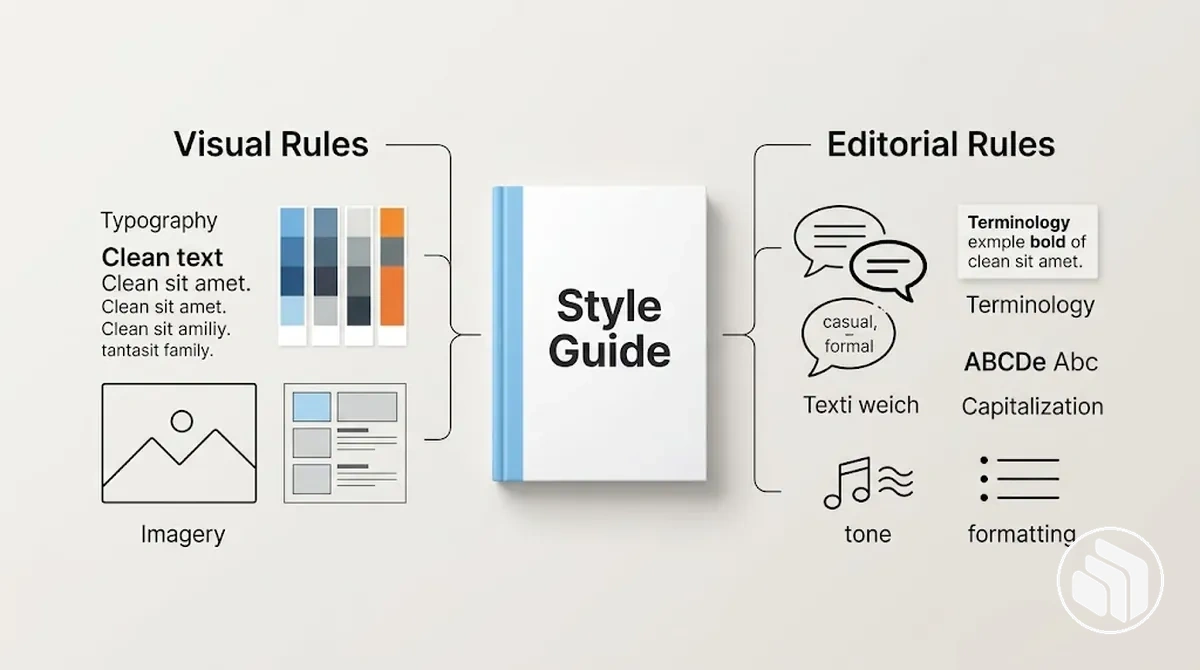
The two rule families provide focused usage guidance for different execution decisions; the examples below remain at the application level rather than defining a complete design system or general writing manual.
- Visual rules:
- Typography: governs choices such as type hierarchy, styles, and text treatment.
- Colour: governs how defined colours are used in visual applications.
- Imagery: governs the treatment or selection of photography, illustration, or other visual assets.
- Spacing and layout: governs recurring spatial and layout conventions in design execution.
- Editorial rules:
- Grammar: governs recurring grammatical and language-style choices.
- Terminology: governs preferred words, expressions, or naming conventions.
- Capitalisation: governs how recurring names, headings, or terms are capitalized.
- Tone and formatting: governs how written expression and presentation conventions are applied.
Why Brand Guidelines and Style Guides Are Sometimes Used Interchangeably
Brand guidelines, brand style guide, brand guide, and brand manual can be used as overlapping labels for documents that govern how a brand is expressed. A style guide can also refer to a more focused document containing visual guidance or editorial guidance.
Because organisations and publishers use these terms differently, two documents with similar functions may carry different names, while documents with the same label may have different scope.
Classify the document by function, not title
- Scope
- What areas the document covers: brand-level direction, visual execution, editorial execution, or a combination.
- Authority
- Which decisions the document is intended to guide and who is expected to follow those decisions.
- Contents
- The actual strategic, verbal, visual, editorial, and application rules contained in the document.
- Printed title
- A secondary naming signal because organisations use overlapping terms differently.
The terms should not be treated as interchangeable in every case because a style guide may be deliberately limited to a particular application domain. Interpret scope, authority, and contents first; treat the printed title as secondary.
Brand Style Guide Can Be Another Name for Brand Guidelines
A brand style guide is often another label for brand guidelines when the document has brand-level scope and governs how the brand is expressed.
In that context, both labels can describe guidance that coordinates the brand's visual and verbal expression rather than a narrowly defined set of rules.
The supporting attributes can include visual identity rules, voice guidance, and usage examples that show how brand elements should be applied.
When those elements operate together at brand-level scope, the document can perform the same broad function as brand guidelines, although naming varies between organisations and publishers.
Style Guide Can Also Mean Visual or Editorial Guidance
A style guide can refer to narrower visual guidance or editorial guidance rather than guidance for the full brand system.
In this usage, the document label describes rules for a defined area of application, with its scope determined by the contents it governs.
A visual style guide can govern presentation choices such as typography, colour, imagery, spacing, and layout, while an editorial style guide can govern language choices such as grammar, terminology, capitalisation, formatting, and tone.
The document's scope and contents therefore provide the practical basis for interpreting which meaning of style guide applies.
When to Use Brand Guidelines, a Style Guide, or Both
The appropriate document structure depends on the breadth and application specificity of the decisions that need governance.
Use brand guidelines when broader identity direction needs to be defined or governed, a style guide when established direction mainly needs focused execution rules, and both when those rule layers need different levels of detail.
The decision criteria are strategic scope, application specificity, coordination across teams and channels, and the level of detail required for visual or editorial governance.
If strategy, voice, or visual identity still requires broader direction, the need extends beyond execution rules alone.
If identity direction is already established, focused guidance may be sufficient for recurring application decisions.
The number of teams or channels does not create a fixed threshold; the relevant condition is whether coordination requires broader context, more specific rules, or both.
Choose by what still needs governance
- If identity direction still needs broader governance: use brand guidelines to connect strategy, voice, visual identity, and their application.
- If identity direction is established and only execution rules need codifying: use a style guide focused on the relevant visual or editorial decisions.
- If broader identity direction and detailed execution rules need distinct treatment: use both, with brand guidelines providing the broader context and a style guide providing focused application guidance.
- If broader context and execution rules can be governed clearly together: use one combined document rather than creating separate documents without a practical need.
The flow routes the situation according to what must be governed rather than according to a preferred document label.
As teams and channels apply the chosen guidance, the neighbouring concern becomes maintaining brand identity consistency across those applications.
Separate documents are useful when distinct rule layers add practical clarity; otherwise, one combined document can cover the required governance without unnecessary separation.
Use Brand Guidelines for Broader Identity Direction
Brand guidelines are useful when broader identity direction needs to guide decisions across multiple forms of brand expression.
They can provide a central identity reference when multiple teams, external partners, or channels need shared principles alongside voice guidance, visual rules, and clear application boundaries.
- Multiple teams: when different teams make brand-related decisions, broader guidelines can give them shared principles for interpreting the same identity direction.
- External partners: when agencies, freelancers, or other external partners apply the identity, a central identity reference can clarify the voice guidance, visual rules, and application boundaries they are expected to follow.
- Varied channels: when the brand is expressed across different channels, broader guidance can connect channel-specific execution with a shared identity direction.
- Broader decision scope: when governance must cover both strategic direction and expressive decisions, broader guidelines can connect shared principles with verbal and visual application rather than addressing isolated execution rules.
Organisation size alone does not determine whether broader brand guidelines are useful; the relevant condition is the breadth of coordination and identity decisions that need shared direction.
Use a Style Guide for Focused Application Rules
A style guide can be sufficient when the defined identity direction is already understood and the main governance need is focused application rules for repeatable execution.
In that situation, focused guidance can govern specific visual execution or editorial output without reopening broader identity decisions.
- Defined design language: when the visual direction is established, rules for typography, spacing, or related treatments can guide recurring visual execution.
- Established editorial voice: when the verbal direction is established, terminology and writing rules can guide recurring editorial output.
- Recurring production: when the same production decisions arise repeatedly, focused usage rules can provide a consistent reference for those specific execution choices.
- Channel-specific needs: when a particular channel requires repeatable treatment, channel-specific guidance can govern the relevant visual or editorial decisions without extending into broader identity direction.
The relevant test is the scope of the rules that need governance rather than the document label itself; focused guidance fits when established direction leaves a defined set of application decisions to codify.
Use Both When Broad Direction and Detailed Rules Need Separate Layers
Separate brand guidelines and style guides can be useful when broad direction and detailed rules have genuinely different governance needs.
In that arrangement, brand guidelines establish shared identity boundaries, while focused style guides translate those boundaries into operational rules for particular forms of execution.
- Specialist teams: when different specialist teams apply the same identity in distinct areas, separate layers can keep shared direction central while giving each team focused operational rules.
- Complex channel requirements: when channels require materially different execution decisions, separate layers can preserve common identity boundaries while allowing channel-specific rules to address those requirements.
- Frequent production: when recurring production creates many detailed execution decisions, separate layers can keep operational rules distinct from the central brand reference.
- Separate visual and editorial standards: when visual standards and editorial standards require different levels of detail, separate layers can govern those operational rules while brand guidelines retain the shared identity direction.
Separate layers are useful when they reduce ambiguity between shared direction and operational rules rather than duplicate the same governance; in simpler contexts, one well-structured document may be sufficient when both can be governed clearly together.
How Brand Books Fit Into the Terminology
A brand book is a label commonly associated with a broader brand document that gives strategic or narrative context to how a brand is understood and expressed. Its emphasis can extend beyond identity guidance to the purpose, story, values, positioning, and personality behind the identity.
The term is not standardised, and an organisation may use brand book interchangeably with brand guide, brand guidelines, or brand manual.
Common brand-book attributes
- Purpose and story
- Why the brand exists and the narrative used to explain its identity.
- Values
- The principles associated with the brand and used to frame its behaviour or expression.
- Positioning
- How the brand is intended to occupy a place in its market or audience context.
- Personality
- How the brand is characterised and presents itself.
- Identity guidance
- May also include visual rules, voice guidance, or other expression principles.
A narrower visual or editorial style guide can concentrate on specific application rules, while a brand book may provide broader strategic and narrative context from which those rules are interpreted.
This is a terminology boundary rather than a universal document hierarchy: the document's actual scope and contents are more informative than its label.