
Brand Identity Consistency Audit Checklist
A brand identity consistency audit compares current brand applications with approved standards across representative touchpoints. Classify each observed use from the governing rule, not from visual similarity alone, then interpret deviations by recurrence, severity, reach, and evidence confidence.

Brand identity audit decision model
Use one evidence sequence throughout the audit: establish the approved source of truth, sample current use, compare expected and observed states, classify the result, then interpret its significance.
- BaselineConfirm the current approved rules, master assets, versions, and documented exceptions.
- SampleSelect representative current assets across the touchpoints included in the audit scope.
- CompareRecord the expected or permitted state beside the observed application.
- ClassifyAssign the verification status supported by the governing rule and evidence.
- InterpretAssess severity, reach, recurrence, and evidence confidence without inferring cause.
- Compliant
- The observed state conforms to the applicable approved rule.
- Approved variation
- The difference is explicitly permitted under a documented condition or exception.
- Ambiguous
- The available evidence does not establish the applicable rule or approval state.
- Inconsistent
- The observed state conflicts with an applicable approved requirement or permitted condition.
- Undefined rule
- No approved rule governs the treatment; record the documentation gap separately rather than treating it as non-compliance.
Key boundary: a visible difference is not proof of inconsistency. The decision depends on the approved condition that governs the observed use.
Scope boundary: this audit tests adherence to established visual and verbal identity standards; it does not judge brand positioning, audience perception, or commercial performance. Start with the baseline and scope because every later judgement depends on knowing which approved rule applies to which sampled asset.
Table of Contents
Establish the Baseline and Scope for the Brand Identity Audit
The audit baseline defines the reference point against which observed brand identity use will be judged, while the audit scope defines what evidence is included in that comparison.
Establishing both before evaluation keeps later findings comparable because the same source of truth and assessment boundary apply to the assets under review.
The scope should identify the approved reference sources, the audit period, the touchpoints or asset classes included, and any documented exceptions that alter how a standard applies.
The governing references should be the materials authorised for the identity under review rather than rules inferred from repeated use.
Within Brand Identity Design, these references provide the documented basis for distinguishing intended identity treatments from observed variations.
Consistent scope makes later findings comparable, so record the evidence boundary before evaluating individual assets.
The audit frame can be recorded through a compact set of scope variables, moving from the identity being assessed to the evidence that can legitimately be compared.
- Identity under review: specify the brand, sub-brand, product identity, or other defined identity system included in the audit.
- Governing reference: identify the approved guidelines, master assets, specifications, or other documented source of truth used as the baseline.
- Audit period: define the period from which observed applications and live assets are being assessed.
- Touchpoint coverage: record the included channels or touchpoints so findings are interpreted within that stated coverage.
- Asset classes: identify the types of brand assets included, such as digital, print, environmental, or communication materials where applicable.
- Reference recency: record which approved version applies during the audit period rather than assuming an older or newer version governs every asset.
- Documented exceptions: record approved variations or conditions that legitimately change how a standard applies to a particular asset or context.
The relationship between the governing references and the sampled assets is easier to interpret when the baseline, coverage, and documented exceptions are visible together.

Missing, outdated, or contradictory reference sources are evidence limitations or audit findings rather than permission to select a preferred rule.
Until the conflict is resolved or an authoritative reference is identified, comparability and confidence in the affected judgement are limited; a usable source of truth is therefore required before a deviation can be classified reliably.
Identify the Approved Brand Identity Standards
Approved brand identity standards are the audit's source of truth: use approved, current, and governing materials to determine the required or permitted state of each identity element.
A treatment that appears frequently across brand assets is not evidence of approval by itself when no governing rule or documented permission supports it.
The authority check should move from the governing reference to current master assets, permitted variants, documented exceptions, and version control.
For each approved rule, compare the required or permitted state with the observed application and retain the relevant compliance evidence; missing approval evidence creates ambiguity rather than automatically proving non-compliance.
The hierarchy of approved references should make the governing rule and its current version distinguishable from repeated but undocumented usage.

- Governing document: verify that the guideline, specification, or other authoritative reference is approved for the identity element being assessed.
- Current master asset: verify the observed asset against the approved master file or asset set that applies to that use.
- Permitted variant: confirm that any alternative treatment is explicitly allowed by the approved standards rather than inferred from frequent use.
- Documented exception: record any approved exception and the condition or context in which it applies before judging compliance.
- Effective version or date: use version control or an effective date, when documented, to determine which approved rule governs the observed application.
- Conflict status: record whether approved sources agree; conflicting governing references prevent an unqualified compliance judgement until the applicable rule is clarified.
If two approved sources conflict, record the conflict rather than choosing a preferred rule or rewriting the standard during the audit.
The affected finding should remain a qualified judgement because the compliance evidence cannot establish which state governs until the source-of-truth conflict is resolved.
Gather Representative Brand Assets Across Touchpoints
A representative sample should show how the brand identity appears in current live brand assets across relevant touchpoints, rather than relying only on source files or collecting every historical asset.
Select sampled assets that expose normal current use as well as meaningful variation across channels and formats.
Use recency to favour assets that reflect the audit period, visibility and frequency of use to capture applications people regularly encounter, and audience exposure to include externally visible uses where relevant.
Channel differences also matter because the same identity can appear across websites, social media, email, print, signage, packaging, or other applicable formats.
For each sampled asset, record the touchpoint, asset type, current version or date where available, identity elements present, and the reason the asset is representative.
A varied touchpoint sample makes the relationship between current brand applications and the audit evidence easier to inspect across digital and physical contexts.

- Website and digital properties: sample current, visible pages or interface assets that show how core identity elements are applied in routine digital use.
- Social media and email: include current or frequently used communications where format constraints can produce different applications of the same identity.
- Print and physical materials: sample relevant printed collateral, signage, packaging, or other physical applications to capture differences between digital and physical execution.
- Recency and frequency: favour assets within the defined audit period and include frequently used materials so the sample reflects current recurring use rather than isolated historical examples.
- Visibility and audience exposure: include prominent or audience-facing assets where applicable because these provide evidence of how the identity is presented in visible real-world use.
- Format and edge-case variation: include enough channel and format variation to expose plausible edge cases without turning the sample into an exhaustive archive.
Limited coverage reduces sampling confidence for conclusions that extend across touchpoints, so record important gaps rather than treating a narrow sample as complete evidence.
Representative sampling aims to capture sufficiently varied current use for consistency assessment; it does not require exhaustive collection of every historical brand asset.
Audit Each Core Brand Identity Element Against Its Standards
Audit all core identity elements with the same verification method: identify the approved standard, establish the expected state, record the observed state, assign a verification status, and retain supporting evidence.
Applying the same evidence sequence to each identity component makes findings comparable without turning the audit into a subjective assessment.
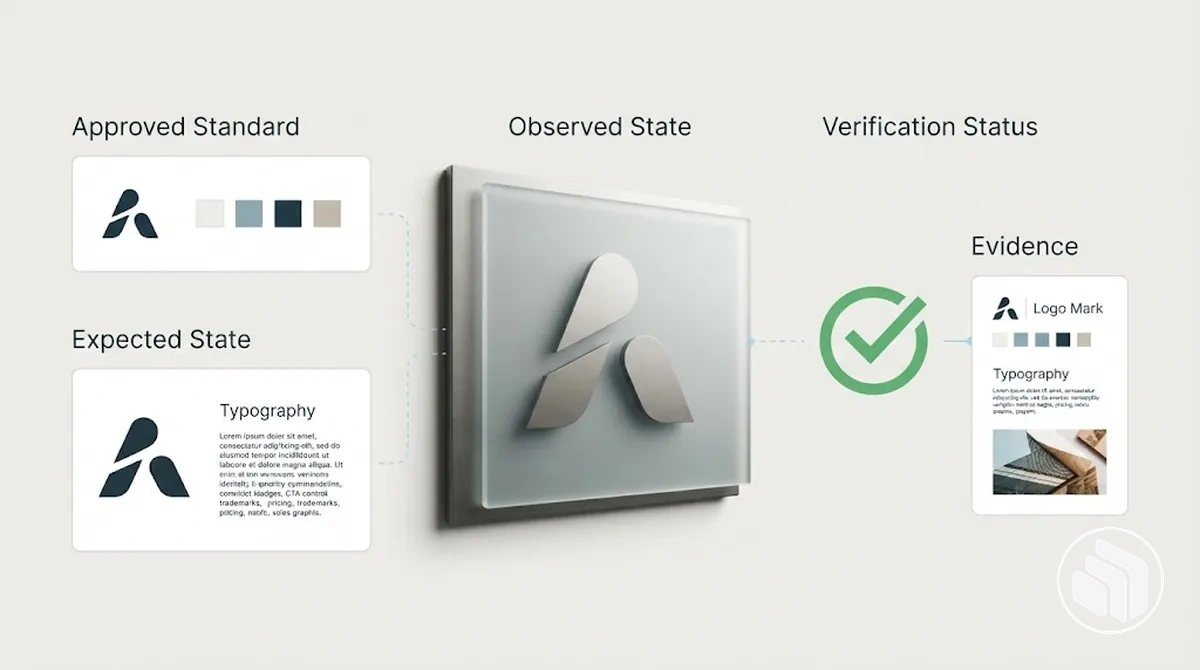
The verification checklist records what each approved standard requires and what the sampled asset actually shows, keeping the expected state and observed state separate.
Use the same fields for each core identity element so the status can be traced back to the governing rule and supporting evidence.
| Verification field | Record |
|---|---|
| Identity element | The logo, colour, typography, imagery, messaging, or other approved identity component being checked. |
| Expected state | The required or permitted treatment defined by the applicable approved standard. |
| Observed state | The treatment visible in the sampled live asset. |
| Verification status | Compliant, approved variation, ambiguous, inconsistent, or undefined rule. |
| Supporting evidence | The governing reference, approved asset, documented exception, or other evidence supporting the status. |
Use compliant when the observed state conforms to the approved standard, and approved variation when a documented permission supports the difference.
Use ambiguous when available evidence does not establish whether the observed state conforms, and inconsistent when the observed state conflicts with an applicable approved standard.
Record undefined rule separately when no approved rule governs the treatment, because a documentation gap does not by itself establish non-compliance.
Keep this audit focused on conformity between approved standards and observed use rather than redesign, aesthetic scoring, or broader analysis of common identity design mistakes.
Detailed checks for logo, colour, typography, imagery, and messaging belong to their respective element-level criteria, while this shared method keeps their findings evidence-led and comparable.
Logo Use and Variations
Check each sampled logo application against an approved logo asset and the documented conditions for its use.
A different lockup or logo variant is a permitted variation only when the governing standards allow that treatment; an undocumented difference should be recorded as a deviation for assessment rather than treated as an aesthetic preference.
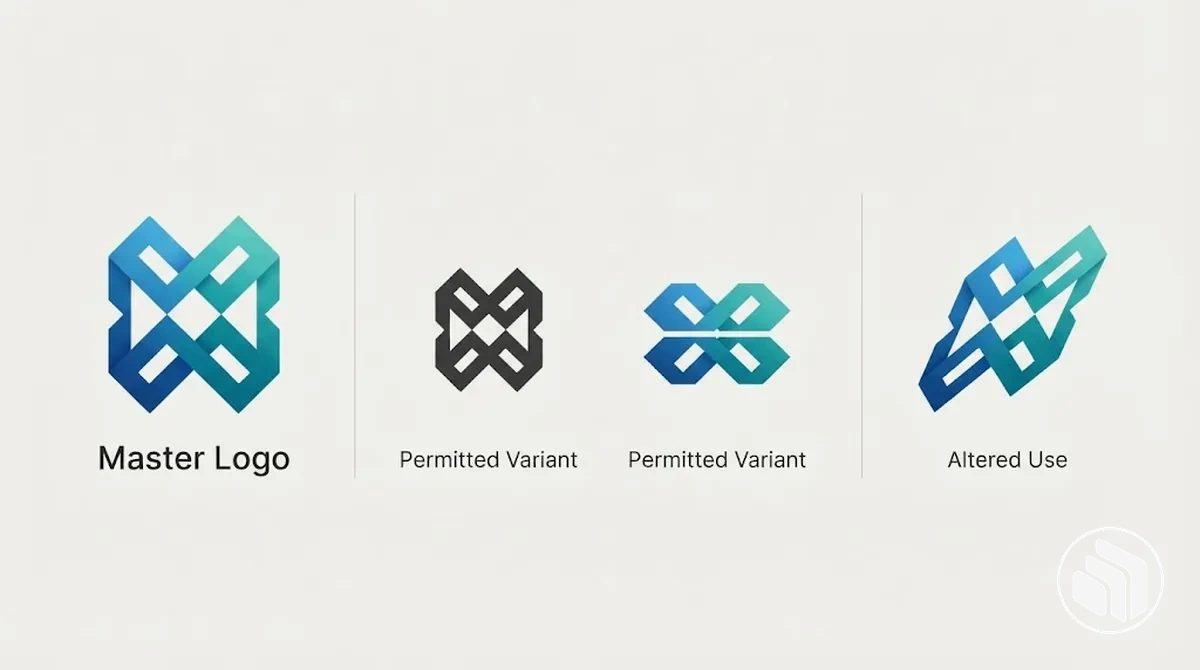
- Approved asset or version: confirm that the logo application corresponds to an approved logo and, where documented, the current master file rather than an obsolete or unsupported asset.
- Lockup: verify that the observed arrangement of the mark, wordmark, tagline, or other lockup components matches a documented permitted variant.
- Proportions: compare the observed state with the approved proportions and record stretching, compression, or other distortion as a deviation when the standard prohibits that alteration.
- Colour treatment: verify that the applied logo colours or documented single-colour treatment match the permitted condition for that logo variant.
- Background suitability: check whether the selected approved logo variant is permitted for the observed background condition, including any documented light, dark, or contrast-specific treatment.
- Clear space and placement: compare spacing and placement with documented clear-space or placement rules when those rules exist; do not create a violation from an undocumented preference.
An approved variant that follows its documented usage conditions remains a permitted variation, while an altered, stretched, outdated, or otherwise unsupported application may indicate inconsistency when it conflicts with an applicable approved rule.
The diagnostic implication should therefore identify the specific documented deviation and its supporting evidence rather than infer non-compliance from visual difference alone.
Colour System Application
Judge each colour system application against the approved palette, its documented colour role, and the conditions defined for that use.
Consistency means the observed colour follows the applicable approved value or range and contextual specification; it does not require digital and print applications to render identically when the identity standard documents different treatments.
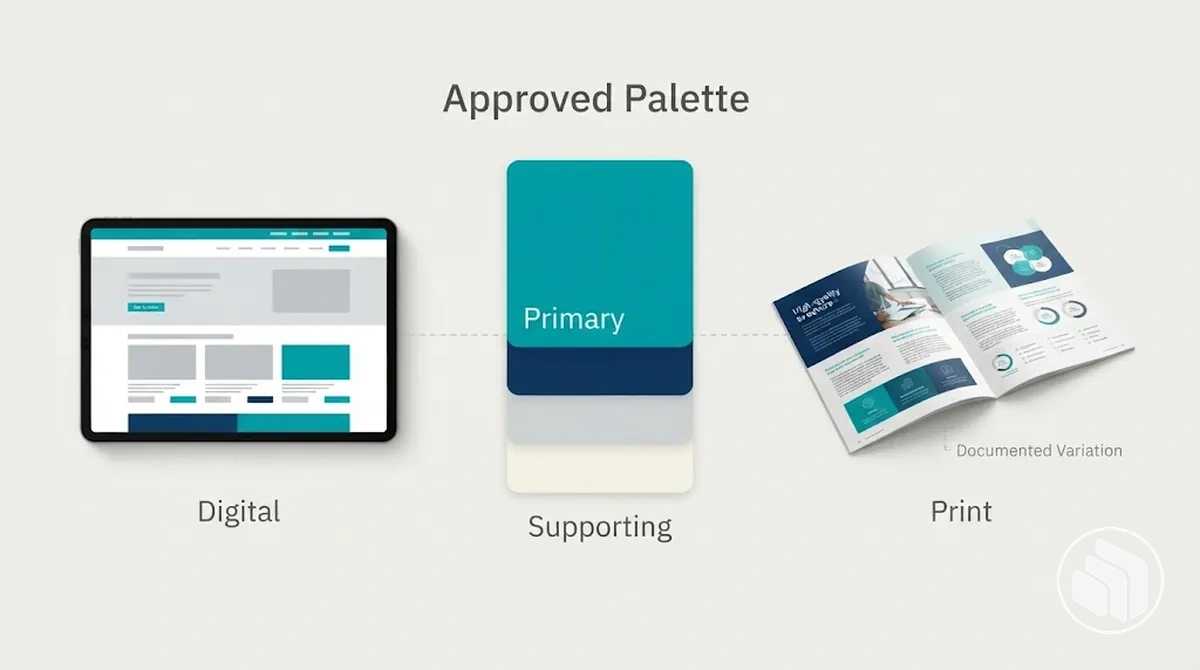
- Palette role: verify that primary and supporting colours are used in the colour roles assigned by the approved palette.
- Approved value or range: compare the observed value with the documented colour specification or approved range that applies to that role and medium.
- Permitted combination: confirm that colours appear together only in combinations permitted by the audited standard where combination rules are documented.
- Background treatment: check whether the colour application follows documented conditions for the observed background rather than judging the treatment independently of its context.
- Medium-specific specification: apply the documented digital or print specification for the medium being audited instead of assuming one value must govern every reproduction method.
- Documented adaptation: record an approved medium-specific variation as a permitted application when the standard supports it; treat an observed value outside the applicable specification as a deviation rather than an automatic inconsistency without that comparison.
A documented adaptation can therefore produce different digital and print values while preserving the same governed colour role and permitted relationship within the approved palette.
A true consistency concern arises when the observed value, combination, background treatment, or medium-specific application conflicts with the approved condition that applies to that use.
Typography System and Hierarchy
Check each typography application against the approved type system and the documented hierarchy role for the text being reviewed.
The observed treatment should use the approved font family, weight, style, and role-specific conventions, or a documented alternative such as an approved fallback.
- Font family: verify that the observed text uses the approved font family for its documented role, or an approved fallback where the standard permits one.
- Weight and style: compare the observed weight and style with the approved treatment for that text role, including documented bold, italic, or other permitted variants.
- Hierarchy role: confirm that headings, subheadings, body text, captions, or other defined roles retain the typographic distinctions assigned to them by the type system.
- Casing and treatment: check documented conventions such as uppercase, lowercase, title treatment, emphasis, or other role-specific treatments only where the audited standard defines them.
- Approved fallback: classify a substitute font as an approved variation when the standard explicitly permits that fallback under the observed condition; an undocumented substitution should instead be recorded for assessment against the governing rule.
A documented fallback or role-specific variation can remain consistent with the typography system even when its observed treatment differs from the primary font treatment.
By contrast, changing the font family, weight, style, casing, or hierarchy role without an applicable approved condition is a deviation when it conflicts with the established standard, and the finding should identify that specific conflict rather than judge typographic taste.
Imagery and Graphic Style
Check photography, illustration, iconography, and each graphic treatment against the approved visual direction and its documented style attributes.
Alignment should be based on observable criteria such as subject matter, composition, cropping, filters, graphic motifs, and other specified treatments rather than subjective aesthetic preference.
- Photography: compare subject matter, composition, cropping, and any documented photographic treatment with the approved visual direction for that imagery type.
- Illustration: verify that the observed illustration style follows documented attributes such as form, line treatment, level of detail, or other defined characteristics where these are part of the standard.
- Iconography: check the observed icon style against documented conventions for shape, stroke, fill, proportion, or related attributes when those rules are defined.
- Filters and image treatments: confirm that filters, overlays, tonal treatments, or other applied effects remain within the documented graphic treatment rather than introducing an unsupported style.
- Graphic motifs: compare patterns, shapes, framing devices, textures, or other recurring graphic motifs with the documented direction and any permitted variation.
- Composition and cropping: assess whether the observed framing and crop follow documented composition rules or boundaries that materially affect recognisability and consistency.
A documented variation can remain aligned when its imagery or graphic treatment stays within the approved boundary for that asset type.
By contrast, an observed treatment is inconsistent when evidence shows that it departs from a documented visual attribute; subjective preference for a different aesthetic is not sufficient audit evidence.
Messaging and Tone Consistency
Check recurring brand language and tone against the approved verbal identity, including documented voice characteristics and messaging conventions.
Consistency depends on whether the observed wording and tone align with the governing verbal rules for that context, not on whether every channel uses identical phrasing.
- Voice characteristics: verify that the observed brand voice reflects the documented traits or verbal characteristics defined by the approved verbal identity.
- Terminology: compare recurring terms, product or service naming, and other defined terminology with the approved wording where the standard specifies it.
- Recurring descriptors: check whether repeated descriptive language follows the documented descriptors associated with the brand rather than introducing conflicting characterisations.
- Tagline and boilerplate: confirm that any tagline, boilerplate, or standard brand statement uses the approved wording or an explicitly permitted variation.
- Message framing: assess whether the observed framing of core messages remains consistent with the documented verbal treatment for the relevant message context.
- Tone adaptation: allow a documented tone adaptation for a particular channel or audience when the governing standard permits it; record a change as inconsistent only when the observed wording or tone conflicts with that approved condition.
An approved tone adaptation can change formality, emphasis, or wording while remaining aligned with the same verbal identity.
By contrast, language that contradicts documented voice characteristics, terminology, approved wording, or message framing is a consistency issue when the governing standard applies to that context.
Check Brand Identity Consistency Across Touchpoints
Diagnose cross-touchpoint brand identity consistency by comparing how the same approved standard is applied across different sampled touchpoints. The comparison should allow documented channel adaptations while keeping every judgement tied to the governing rule.
For each touchpoint, compare the applicable approved standard with the observed application and record whether the treatment conforms directly, uses a permitted variation, remains ambiguous, or conflicts with the rule.
Cross-touchpoint decision rules
- Different appearance + documented permission
- Approved variation. A channel-specific logo variant, colour treatment, or tone adaptation can remain consistent when the governing standard explicitly permits it for that context.
- Same appearance + shared conflict with the baseline
- Inconsistent. Surface similarity between touchpoints does not establish conformity when both applications depart from the applicable approved rule.
- Observed use conflicts with the applicable condition
- Deviation. A difference becomes a consistency problem because it conflicts with the governing rule, not merely because it differs from another channel.
- One sampled occurrence
- Local finding. Keep the interpretation bounded to the observed asset or touchpoint unless the same or a related deviation is found elsewhere.
- Same or related deviation recurs across the sample
- Broader pattern. Recurrence across multiple current assets or touchpoints supports a cross-touchpoint pattern, but recurrence alone does not establish its cause.
Record the affected standard, sampled touchpoints, observed deviations, and recurrence so the diagnostic implication remains traceable to audit evidence and bounded by the stated scope.
Keep this stage focused on identifying and describing consistency patterns rather than prescribing corrective action. Once the audit has established documented adaptations, deviations, and recurring patterns, a separate process can address how to improve brand consistency.
Verify Whether Approved Standards Are Applied Consistently
Verify each sampled application against the approved baseline and its allowed condition before comparing it with other touchpoints.
The observed use receives a verification status based on the governing standard and supporting evidence, because similarity between applications does not establish conformity with the baseline.
- Compliant: assign this status when the observed use conforms to the applicable approved baseline and the supporting evidence establishes that required or permitted condition; the application can be treated as aligned in the cross-touchpoint assessment.
- Approved variation: assign this status when the observed use differs from the primary treatment but a documented exception or other allowed condition explicitly permits the variation; the difference remains consistent with the governing standard.
- Ambiguous: assign this status when the available evidence source does not establish the applicable rule, allowed condition, or approval state; keep the verification status provisional rather than forcing a compliant or inconsistent judgement.
- Inconsistent: assign this status when the observed use conflicts with an applicable requirement or permitted condition in the approved baseline; the deviation can then contribute to the cross-touchpoint assessment.
- Undefined rule: assign this status when no approved rule governs the observed treatment; record the documentation gap separately rather than treating the application as compliant or inconsistent.
Two touchpoints can match each other and still be inconsistent when both depart from the approved baseline, while a documented exception can differ visibly and remain an approved variation.
Where evidence is incomplete or conflicting, record the uncertainty and retain an ambiguous status until the governing rule can be established.
Identify Repeated and Isolated Inconsistencies
Separate an isolated inconsistency from a repeated inconsistency by examining recurrence, frequency, and distribution rather than treating every deviation as the same diagnostic signal.
Pattern comparison
Isolated inconsistency
- Distribution
- Confined to one asset, touchpoint, team, or observed time period within the audit sample.
- Diagnostic signal
- Supports a local finding rather than a wider identity-system conclusion.
- Next check
- Look for the same deviation elsewhere before expanding the interpretation.
Repeated inconsistency
- Distribution
- The same unapproved treatment recurs across multiple current assets, touchpoints, teams, or observed periods.
- Diagnostic signal
- Supports a broader pattern because the issue is not limited to one execution instance.
- Next check
- Map its frequency and spread across the representative audit scope.
Evidence boundary: neither an isolated nor a repeated pattern proves why the inconsistency occurred.
Do not describe a repeated inconsistency as systemic without representative evidence showing sufficient recurrence and distribution across the audited scope.
Root-cause interpretation belongs in a separate analysis of inconsistent brand identity causes; this stage should record the diagnostic signal, its frequency, distribution, pattern, and evidentiary limits.
Interpret Audit Findings by Severity and Scope
Interpret each audit finding through three separate dimensions: severity, reach, and evidence confidence.
Together they describe the significance of an observed deviation and its diagnostic implication without collapsing different forms of evidence into an arbitrary rating.
Severity describes the importance of the affected identity attribute and the magnitude of its departure from the approved standard.
A deviation involving a core identity attribute can warrant a different interpretation from a minor variation in a less consequential treatment, but visual prominence alone does not establish wider significance.
Keep severity, reach, and evidence confidence separate when interpreting finding significance.
- Severity: assess the importance of the affected identity attribute and the magnitude of its deviation from the approved condition.
- Reach: assess recurrence and touchpoint spread, distinguishing an isolated occurrence from a deviation repeated across multiple sampled assets or contexts.
- Evidence confidence: assess how clearly the governing standard, observed application, and supporting audit evidence establish the finding; incomplete or conflicting evidence increases uncertainty and requires a qualified interpretation.
Reach remains bounded by the sample: broader recurrence across sampled assets, touchpoints, teams, or time supports a broader pattern interpretation, while a finding confined to one observed application supports a narrower one. Evidence confidence qualifies either interpretation because missing, outdated, or conflicting governing references require a more cautious conclusion.
How severity and reach can diverge
High severity, narrow reach
A clear violation of a core identity rule appears in one current asset. The affected rule can make the deviation important, while its observed distribution remains limited.
Lower severity, broader reach
A smaller deviation in a supporting treatment repeats across many sampled touchpoints. Its reach is broad even though the deviation does not have the same severity as a core-rule conflict.
Keep the dimensions separate: severity, reach, and recurrence do not establish root cause by themselves, and incomplete evidence lowers confidence in the combined interpretation.
The audit can support prioritisation of findings by documented severity, reach, and evidence confidence while preserving uncertainty where the evidence is incomplete. Decisions about how to repair an inconsistent brand identity belong to the subsequent repair stage; this interpretation should not claim a root cause or prescribe corrective action that the audit evidence does not establish.
Assess the Severity and Reach of Each Inconsistency
Evaluate severity and reach separately before combining them into the diagnostic significance of an audit finding.
Severity concerns the importance of the affected identity element and the magnitude of deviation from the approved standard, while reach concerns how widely and repeatedly that deviation appears across the audited scope.
Apply the same criteria to each finding so prioritisation remains evidence-based rather than impressionistic.
Consider the affected identity element, the extent of the deviation, recurrence, touchpoints, audience exposure, recency, and evidence confidence before drawing a combined interpretation.
- Affected identity element: determine whether the inconsistency affects a core identity rule or a more limited supporting treatment; deviation from a core rule supports greater severity when the governing standard establishes that element as central.
- Magnitude of deviation: compare the observed treatment with the approved condition and assess how substantially it departs from that rule rather than assuming visibility alone indicates severity.
- Recurrence: record whether the same or related deviation is isolated or repeated across sampled assets; greater recurrence increases reach but does not automatically increase severity.
- Touchpoint spread: identify the number and type of touchpoints affected and whether the inconsistency is confined to one channel or distributed across several current applications.
- Audience exposure and recency: note whether the affected applications are current and exposed to relevant audiences within the audit scope; broader exposure or more recent use can increase the practical reach of the finding without establishing business impact.
- Evidence confidence: assess whether the approved standard, observed application, and supporting evidence clearly establish the finding; incomplete or conflicting evidence lowers confidence and requires a more qualified diagnostic significance.
A frequent minor deviation can have broad reach but relatively limited severity if it affects a supporting treatment, while a rare violation of a core identity rule can have high severity but narrow reach when confined to one current asset.
Frequency and severity are therefore separate variables, and their combined implication should be stated only after the underlying evidence for each has been recorded.
Distinguish Isolated Application Errors From Systemic Identity Gaps
An isolated application error is concentrated in a limited execution instance where a clear governing standard exists, while a systemic identity gap is supported by broader evidence such as repeated conflicts, missing rules, or contradictory standards across the audited scope.
The distinction depends on concentration, spread, governing-standard clarity, recurrence, and available evidence rather than on how visually large the mistake appears.
Assess whether the observed problem is confined to one asset or distributed across multiple current touchpoints, teams, or contexts.
A concentrated error against a clear governing standard supports a local execution classification, while wider spread can support a broader diagnostic classification when the same conflict recurs.
If the governing standard is missing, ambiguous, or contradicted by other approved references, the evidence may indicate a broader identity-system gap rather than a simple application mistake.
The comparison classifies the available evidence rather than prescribing a solution.
| Diagnostic pattern | Distribution | Governing standard | Recurrence | Diagnostic implication |
|---|---|---|---|---|
| Isolated application error | Concentrated in one asset or a narrow set of applications | Clear and applicable standard exists | Limited or no recurrence in the representative sample | Supports a local execution finding, subject to the available evidence |
| Systemic identity gap | Distributed across multiple current touchpoints or contexts | Rule may be absent, ambiguous, or contradicted by other approved references | Repeated conflicts appear across the sampled scope | Supports a broader identity-system diagnostic classification without establishing root cause |
For example, one incorrect current asset that conflicts with an otherwise clear governing standard supports an isolated application error, whereas the same conflict recurring across current touchpoints or appearing alongside contradictory standards provides stronger evidence of a systemic identity gap.
Recurrence alone does not prove cause, and confidence should remain limited when the sample is narrow, distribution is uncertain, or the governing references do not clearly establish which rule applies.
This diagnostic classification should stop at what the audit evidence supports and should not become a recommendation for a full repair programme, refresh, or rebrand.
A separate refresh or rebrand decision requires additional strategic evidence beyond the distribution, recurrence, and governing-standard conflicts identified by the audit.