Maintaining a Consistent Brand Identity Across Channels
To keep brand identity consistent across channels, keep the core visual and verbal identity rules stable and adapt only the execution required by a genuine channel constraint. Use current brand guidelines and approved assets as the baseline, verify the final execution against the applicable standard or approved exception, and track recurring deviations so operational causes can be corrected at their source.
Cross-channel consistency decision path
Use this sequence whenever a touchpoint needs a different execution. The identity rule stays the reference; only the execution variables required by a material channel constraint should change.
BaselineStart from the current brand guidelines and approved assets. Identify the governing logo treatment, colour roles, typography hierarchy, imagery direction, tone of voice, terminology, and message intent.
ConstraintName the material requirement that affects presentation: dimensions, media format, content length, interaction pattern, accessibility need, or a platform convention that genuinely constrains the execution.
Bounded adaptationChange only what the constraint requires—such as layout, permitted scale or placement, crop, spacing, or copy length—while preserving the underlying visual and verbal identity.
Verify and learnBefore release, compare the execution with the current standard or approved exception. If the same deviation recurs, investigate the operational source instead of repeatedly correcting isolated outputs.
Keep stable
Approved logo treatment
Colour roles
Typography hierarchy
Imagery direction
Tone of voice and recurring terminology
Message intent
May adapt when required
Composition and layout
Permitted placement or scale
Crop or orientation
Type size, spacing, and line length
Copy length and delivery
Interaction arrangement
A visible difference is not automatically brand drift: the key test is whether the difference is justified by a real constraint, stays within an established or approved boundary, and preserves the governing identity cues.
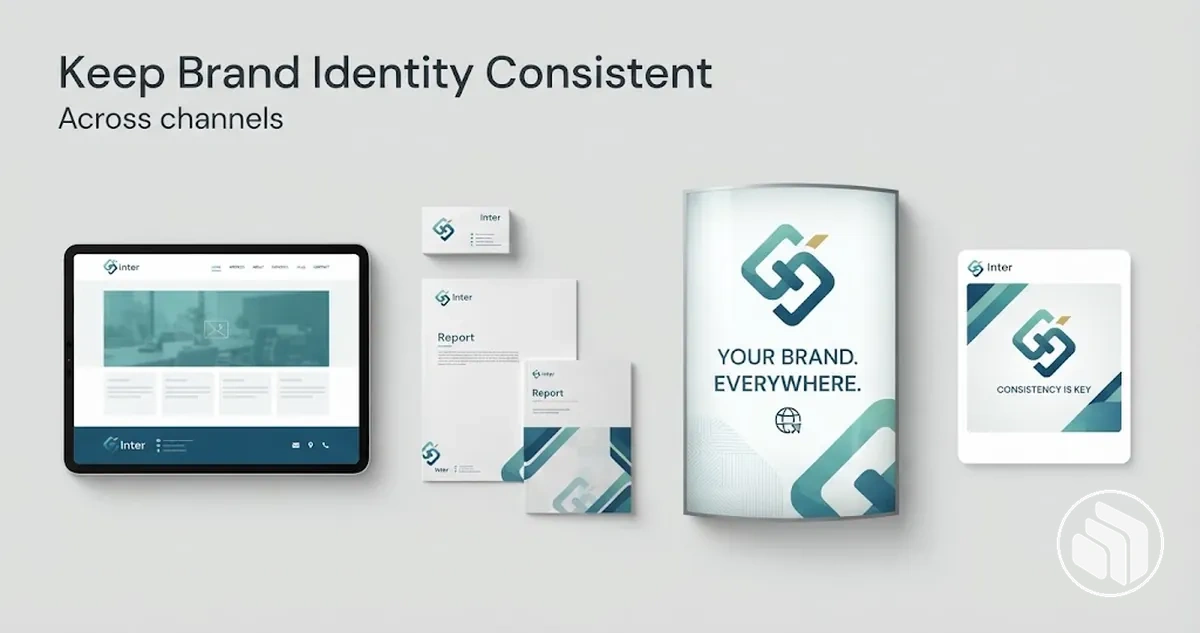
Cross-channel consistency is continuity in the identity rather than exact repetition. A website, email, and social post can use different compositions because their formats differ, provided the governing visual and verbal rules and message intent remain intact.
The current approved brand standards are the operational baseline for deciding what stays fixed, what may vary, who approves an exception, and how the final execution is checked.
Table of Contents⌄
Use Brand Guidelines as the Cross-Channel Baseline
Brand guidelines provide the shared reference point for cross-channel decisions when their standards are current, specific, accessible, and consistently applied.
They define which parts of the visual and verbal identity should remain stable and which decisions can adapt to a channel's requirements.
Their practical value therefore depends not only on documenting brand rules, but also on making those rules usable during planning, production, and review.
For day-to-day execution, teams should be able to recover the standards that govern the main identity decisions before content is produced.
The same baseline can guide different channel outputs without requiring those outputs to use identical layouts.
Logo treatment: specify approved logo use and the conditions that govern how the logo is presented.
Colour roles and typography: define how established colours and typographic roles should be applied so channel-specific layouts still follow the same underlying standards.
Imagery: define the visual direction used to judge whether photographs, illustrations, and other imagery fit the established identity.
Tone of voice and messaging: specify the verbal identity, recurring communication boundaries, and core messaging that should remain coherent even when copy changes by channel.
Approved assets: identify which materials are approved for use so teams can distinguish the intended brand resources from alternatives that have not been approved.
Documented standards alone are not enough to function as an operational baseline if they are outdated, ambiguous, difficult to access, or routinely ignored.
Detailed creation and maintenance of brand guidelines belongs to the dedicated guidelines process; here, the requirement is that the resulting rules are current and usable for cross-channel decisions.
For example, a website and a social post can use different layouts while following the same logo treatment, colour roles, typography, imagery direction, tone of voice, and messaging boundaries.
In that case, the executions differ by channel while the shared standards remain the reference point.
Keep Standards and Approved Brand Assets Accessible to Every Team
Every team needs easy access to the current approved standards and approved assets before production begins.
A shared source of truth should make the approval state and current version identifiable, while appropriate permissions and version control reduce the chance that outdated, duplicate, or unapproved materials are used.
Centralize approved materials: keep the standards and approved assets in one central reference rather than across disconnected team locations. Verify that each team knows where to access that source of truth.
Identify current versions: make the current version of each asset or standard distinguishable from older or duplicate files. Verify that the version presented for active use has the intended approval state.
Control access and ownership: assign ownership for maintaining the materials and use permissions that match each team's operational needs. Verify that people who need the assets can access them and that responsibility for changes is clear.
Retire obsolete assets: move outdated, superseded, or unapproved materials out of active-use locations so they are not mistaken for current files. Verify that obsolete assets are clearly separated from the materials available for production.
Approval state and version status should remain visible enough that a team can distinguish current and approved materials from outdated, duplicate, or unapproved alternatives.
Using an obsolete asset can carry an earlier logo treatment, colour choice, or typography decision into a new execution even when a current approved version exists.
For example, when one team hands a campaign to another, both teams can work from the same current files instead of relying on separate copies retained from earlier work.
Access and version control reduce avoidable misuse, but team behaviour and review still determine whether the approved materials are applied correctly.
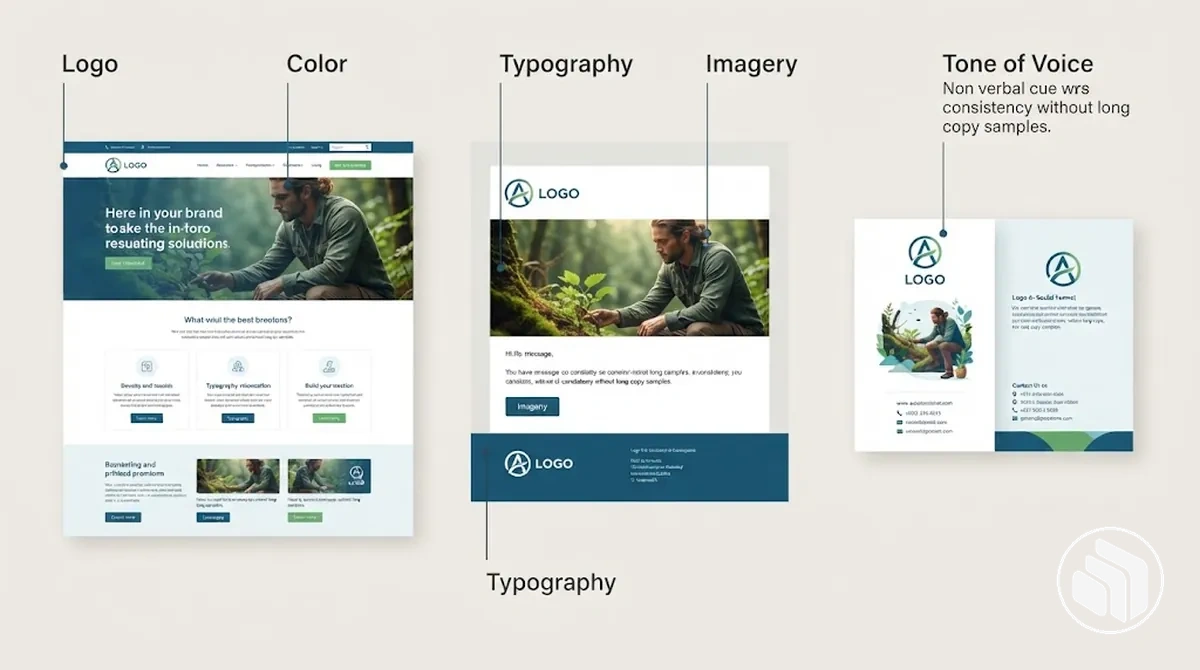
Apply Core Brand Elements Consistently While Adapting to Each Channel
Core brand elements should remain stable at the rule level, while their execution may adapt when channel requirements impose different formats, dimensions, or layout constraints.
Consistency therefore means preserving recognisable identity cues and message intent rather than making every touchpoint visually identical.
Adaptation is appropriate when it changes the execution without redefining the underlying identity rule.
The comparison separates the identity rules that remain stable from execution choices that can respond to channel constraints.
For colour, the brand colour system remains the reference for established colour roles even when a channel requires a simpler composition or different distribution of those colours.
Brand element
Stable rule
Channel adaptation
Consistency check
Colour roles
Established colours retain their assigned identity roles.
The amount, placement, or prominence of each colour may change with the format and available space.
Verify that adapted layouts still use colours according to their established roles.
Typography hierarchy
Established type roles and hierarchy remain recognisable.
Type size, line length, spacing, and arrangement may respond to the available format.
Verify that the relative hierarchy remains clear after adaptation.
Logo treatment
The approved logo treatment remains the identity reference.
Placement and scale may change when the available layout requires a different composition.
Verify that the channel execution still follows the approved treatment.
Imagery direction
The established visual direction remains consistent.
Cropping, orientation, or image selection may respond to the channel format.
Verify that the adapted imagery still fits the established visual direction.
Tone of voice
The established verbal character remains stable.
Sentence length and delivery may change with the communication context.
Verify that the wording still expresses the established tone of voice.
Message intent
The core communication purpose remains intact.
Copy length and emphasis may change to suit the available format.
Verify that adaptation has not changed the intended message.
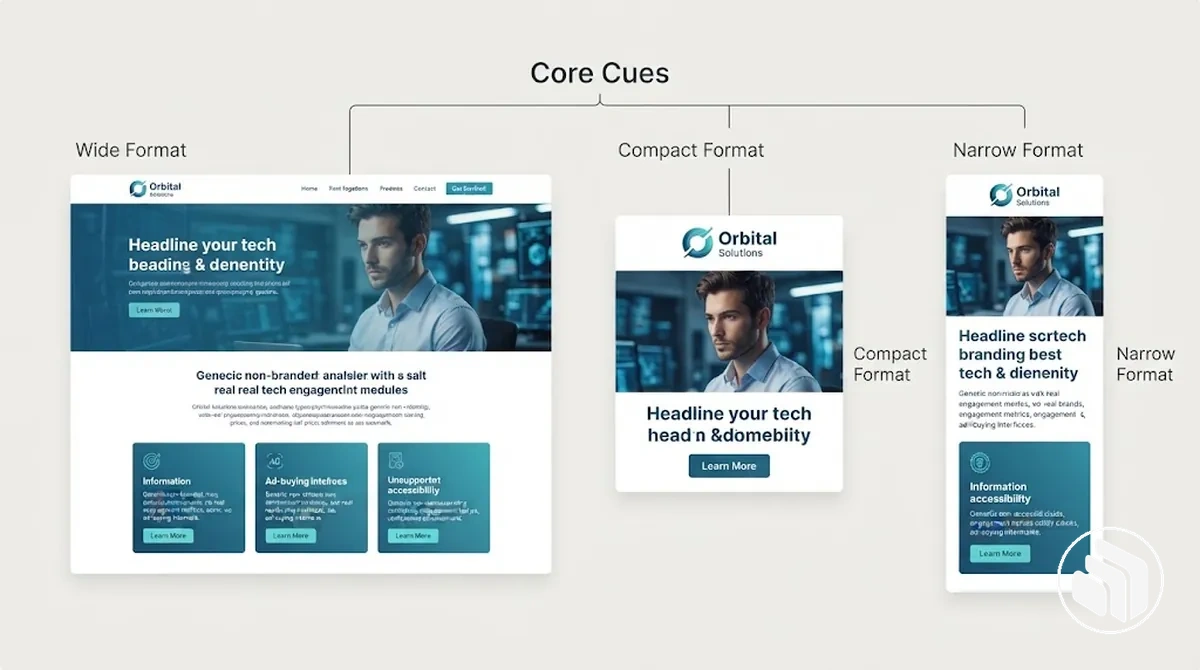
A website can provide more layout space while a social post uses a tighter crop and shorter copy, yet both can retain the same logo treatment, colour roles, imagery direction, tone of voice, and message intent.
An email may require a more compact typographic arrangement; the brand typography system remains the reference for preserving the established typography hierarchy within that layout.
These executions can differ in format while remaining consistent because the channel adaptation occurs within the existing identity rules.
Keep Core Visual and Verbal Identity Elements Stable Across Touchpoints
Visual and verbal identity elements support recognisability across touchpoints when their defining cues remain stable, including logo treatment, colour roles, typography hierarchy, imagery direction, tone of voice, terminology, and core message meaning.
Surface execution can vary where the underlying identity rule remains intact; a difference in layout, crop, or copy length does not by itself indicate inconsistency.
The table identifies the property that should remain recognisable for each identity element, the variation that can occur without changing that property, and the consistency risk when the underlying cue changes.
These distinctions keep the evaluation at attribute level rather than requiring exact sameness between touchpoints.
Identity element
What stays stable
Acceptable variation
Consistency risk
Logo treatment
The approved logo form and treatment remain the reference.
Placement or scale can vary where the approved treatment permits it.
Using an unapproved form or treatment changes a recurring visual cue.
Colour roles
Established colours retain their assigned identity roles.
The proportion or placement of those colours can vary with the composition.
Reassigning established colour roles can weaken continuity between touchpoints.
Typography hierarchy
Established type roles and their relative hierarchy remain recognisable.
Size, spacing, and line arrangement can vary to fit the available format.
Changing the hierarchy can make related touchpoints appear to follow different typographic rules.
Imagery direction
The established visual character and image-selection direction remain consistent.
Crops, orientation, and individual image subjects can vary with the context.
Using imagery with a conflicting visual direction can disrupt a recurring identity cue.
Tone of voice
The established verbal character remains recognisable.
Sentence length and degree of detail can vary with the communication context.
A conflicting verbal character can make the same brand sound inconsistent across touchpoints.
Terminology
Established names and recurring terms retain the same intended meaning.
Surrounding wording can vary to suit the message and format.
Conflicting terms for the same concept can create ambiguity across touchpoints.
Core message
The intended meaning and central communication point remain intact.
Length, emphasis, and supporting detail can vary with the available space and context.
A changed underlying meaning can create a substantive inconsistency even when visual cues remain aligned.
An aligned example is the same approved logo appearing at different permitted scales while retaining its established form and treatment; detailed logo usage rules define the criteria for those treatments.
A misaligned example is substituting an unapproved logo form that changes the underlying identity cue rather than merely adapting its placement or scale.
The distinction is whether the governing identity property remains stable, not whether every surface execution looks exactly the same.
Allow Controlled Variation for Channel Requirements
Controlled variation is justified when a material channel requirement constrains the execution and the brand's recognisable cues can remain within their established boundaries.
Dimensions, media format, content length, interaction pattern, accessibility needs, and platform conventions can permit format-specific adjustment, but a preference for a different treatment alone does not establish a need for a new identity rule.
The decision should connect each proposed variation to a specific constraint and identify what must remain stable before execution.
Hard format and usability constraints take precedence over softer platform conventions, which warrant adaptation only when they materially affect how the content must be presented.
Dimensions: when available space or proportions constrain the composition, layout, scale, or cropping may adapt while established logo treatment, colour roles, and typography hierarchy remain recognisable.
Media format: when the medium changes how content can be presented, image treatment or content arrangement may vary while the established visual direction and core message remain coherent.
Content length: when the format limits how much information can be presented, copy may be condensed while terminology, tone of voice, and core message meaning remain consistent.
Interaction pattern: when the touchpoint requires a different way of navigating or consuming information, the arrangement of content may change while recurring visual and verbal cues remain identifiable.
Accessibility: when readability, usability, or access needs require an adjustment, presentation choices may change while the identity remains recognisable within the applicable brand standards.
Platform conventions: when a convention materially constrains presentation, the execution may adapt to that condition while established identity cues remain intact; a convention that does not impose a relevant constraint does not by itself justify a new brand rule.
For example, the same campaign can use a wide image on a website and a tighter crop in a narrower format while retaining its established logo treatment, colour roles, typography hierarchy, and message meaning; detailed cropping and image-treatment boundaries belong to the brand imagery style.
The adaptation becomes drift when the crop or treatment abandons the established imagery direction or when other identity cues are changed without a channel requirement that justifies the variation.
Build Brand Consistency Into the Publishing Workflow
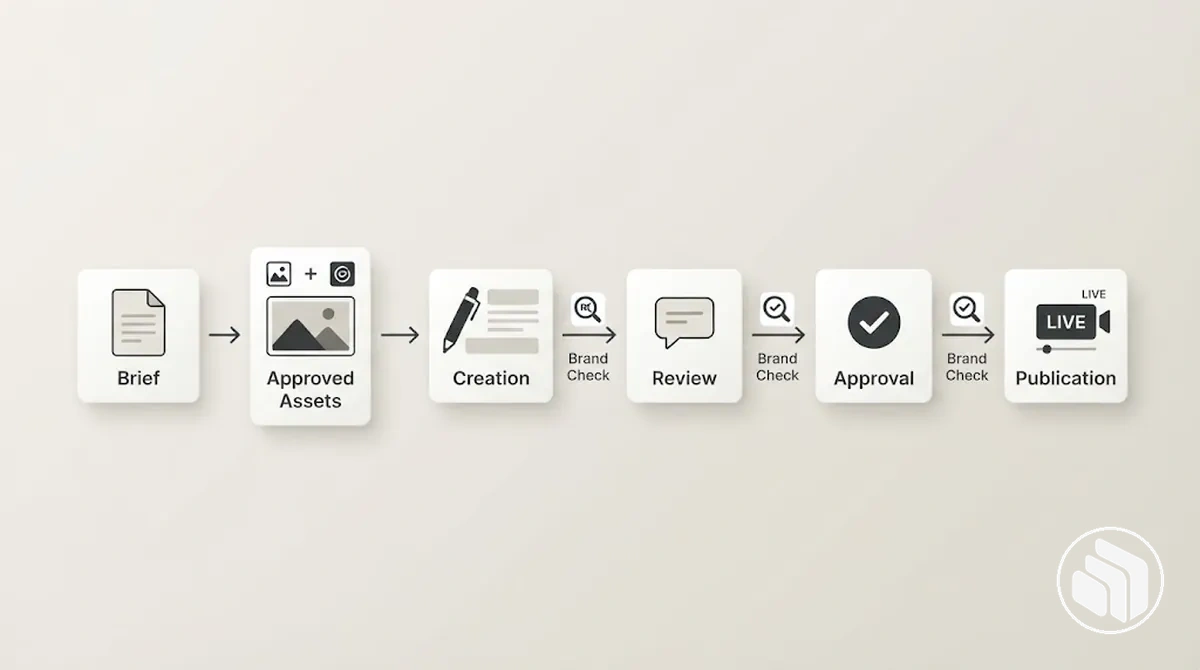
Brand consistency becomes more reliable when brand checks occur at defined workflow checkpoints instead of depending on memory or final-stage correction.
The process should begin with a clear brief and approved assets, continue through creation, review, and approval, and retain verification at publication and during post-publication observation.
Consistency improves when each checkpoint has a specific input or output to verify and an explicit response when an exception is found.
Set the brief: identify the applicable brand standards and intended message before creation begins. Verify that the brief gives the creator a clear baseline; an incomplete or conflicting brief should be clarified before production continues.
Select approved assets: choose the current approved logo, imagery, colour, typography, and other required brand inputs for the execution. Verify their approval state before use; an unapproved input should be treated as an exception rather than carried into creation by default.
Create within the approved inputs: produce the content using the brief, approved assets, and relevant visual and verbal standards. Verify significant departures against those inputs while changes are still being made instead of assuming they can be resolved after production.
Review the execution: compare the completed draft with the brief and applicable brand standards, checking whether its visual and verbal identity remains consistent. Verify any apparent exception before the draft advances rather than treating completion of creation as approval.
Approve for publication: resolve identified corrections and make an explicit approval decision on the version intended for release. Verify that the approved version is the version moving forward; unresolved exceptions should remain visible rather than being implicitly accepted.
Publish and observe: publish the approved version and observe the live execution for presentation changes or deviations that were not visible during review. Verify that the published output corresponds to the approved execution and route a material discrepancy back for correction.
Ownership should be clear at the decision points where a brief is accepted, approved assets are selected, an execution is reviewed, and publication is authorised.
Verification means checking the relevant input or output against the applicable brand standard rather than relying on familiarity with the brand.
When an exception is necessary, it should be identified as an exception and resolved or approved before the affected version advances.
These controls can reduce avoidable deviations, but their effectiveness still depends on the checks being performed consistently.
For example, a creator may select an outdated logo file during initial asset selection even though the current approved version is available.
Catching that mismatch at the asset-selection brand check allows the correct file to be used during creation, rather than repeating the outdated treatment through review-ready layouts and the final publication.
The verification logic is to compare the selected input with the approved source before downstream work depends on it, then advance only the corrected or explicitly approved version.
Align Teams Around Shared Standards and Responsibilities
Explicit responsibility, decision authority, and escalation paths reduce the chance that creators, reviewers, brand owners, and channel owners apply shared standards in conflicting ways.
Role names may vary between organisations, but when several people make brand-consistency decisions, each responsibility boundary should identify who applies the standard, who can approve a decision, and which exception requires escalation.
The table separates those decision rights without prescribing a universal organisational structure.
Role
Primary responsibility
Decision authority
Escalation trigger
Creator
Applies the relevant shared standards while producing the execution.
Decides routine execution details that remain within approved standards.
Escalates an exception when the required execution falls outside an established standard or approved boundary.
Reviewer
Reviews the execution against the applicable standards and identifies inconsistencies.
Accepts compliant execution decisions or returns identified deviations for correction within the assigned review responsibility.
Escalates when a deviation cannot be resolved by applying the existing standard or requires an exception decision.
Brand owner
Interprets the brand standard when an execution raises an unresolved brand-level exception.
Approves or rejects brand-level exceptions when that authority is assigned to the role.
Escalates when the proposed decision exceeds the role's assigned authority or requires a broader organisational decision.
Channel owner
Identifies channel requirements that affect how the execution can be presented.
Decides channel-specific implementation details that remain within established brand boundaries.
Escalates when a channel requirement conflicts with an established brand standard or requires an exception to it.
Decision authority should be explicit at handoffs where more than one team could interpret the same requirement differently, while approval responsibility should remain with the role assigned to that type of decision.
For example, a channel owner may identify a format constraint while a creator proposes an adaptation; if the adaptation exceeds the established brand boundary, the exception moves to the assigned brand owner instead of either team independently establishing a new rule.
This escalation keeps the channel decision and the brand exception distinct.
The exact role titles can differ, but the responsibility, approval authority, and escalation trigger should remain identifiable for each decision.
Review Brand Identity Use Before Release
A pre-release brand review should verify the execution against current, observable brand standards before it reaches the audience.
Check the approved assets and current version first, then verify the applicable visual rules, verbal rules, and any permitted channel adaptation; objective rule checks should determine readiness rather than subjective preference about whether the execution merely feels on brand.
Approved assets and current version: verify that every controlled brand asset used in the execution is an approved asset in its current version; flag any obsolete, superseded, or unapproved file for correction.
Logo treatment: confirm that the logo uses an approved form and follows the applicable treatment rules; flag any treatment outside those defined rules.
Colour roles: check that established brand colours retain their assigned roles in the execution; flag a colour application that conflicts with the current standard.
Typography: verify that type choices and hierarchy follow their assigned brand roles for the execution; flag any unapproved type treatment or conflicting hierarchy.
Imagery: confirm that image selection and treatment follow the established imagery direction; flag imagery or treatment that falls outside the applicable standard.
Tone of voice and terminology: check that the wording follows the established tone of voice and uses approved recurring terminology where applicable; flag wording that conflicts with those verbal standards.
Message: verify that the execution preserves the approved message meaning and intended communication; flag a change that materially alters that meaning.
Channel adaptation: confirm that any format-specific variation stays within the permitted boundaries for that channel or has an approved exception; flag an adaptation that exceeds those boundaries without approval.
A failed verification should identify the specific rule, asset state, or channel adaptation that needs correction rather than trigger an arbitrary redesign.
Correct the identified mismatch and check it again against the same applicable standard; where an exception is permitted, confirm that the execution matches the approved exception before release.
Distinguish Brand Drift From Intentional Channel Variation
An observed difference between touchpoints is not brand drift by itself.
Intentional variation is a controlled adaptation with a clear channel constraint or other governing rule, appropriate approval status, and recognisable cues that remain within established standards; brand drift is more consistent with repeated change or unapproved change that moves execution away from those standards.
The interpretation therefore depends on the rule, constraint, approval context, and effect on the identity rather than the visible difference alone.
A diagnostic comparison should check the governing rule or channel constraint behind each observed difference, whether the variation has the required approval status, and whether recognisable cues remain consistent with the established identity.
A documented constraint and permitted variation support an interpretation of intentional adaptation, while unexplained or unapproved departures—particularly when they recur across touchpoints—suggest brand drift but do not prove it from recurrence alone.
Observed difference
Rule or constraint
Approval status
Interpretation
Layout changes between a wide website page and a narrow channel format while core identity cues remain recognisable.
The channel constraint requires a different composition, and the governing rule permits layout adaptation.
The variation is within the established standard or approved boundary.
Consistent with intentional variation.
Image cropping changes to fit a channel format while the established imagery direction remains recognisable.
The format requires a different crop, and the governing rule permits that treatment.
The crop remains within the permitted variation.
Supports an interpretation of controlled adaptation rather than drift.
A recurring visual or verbal treatment differs from the governing rule without a documented channel constraint.
No applicable constraint explains the departure from the established standard.
The change is unapproved or its approval status cannot be established.
Suggests brand drift when the departure persists or recurs, but the difference alone is not definitive proof.
A recognisable identity cue is changed across several touchpoints without an applicable rule permitting the change.
The governing standard remains applicable and no channel constraint accounts for the repeated change.
The repeated change is unapproved.
Is more consistent with brand drift because the execution repeatedly departs from the established identity.
For example, using a tighter image crop because a narrow channel format requires it is intentional variation when the permitted imagery treatment and recognisable cues remain intact.
Using a different image treatment across touchpoints without a governing rule, channel constraint, or approval is instead an off-brand deviation and, if it becomes a repeated change, supports an interpretation of brand drift.
The distinction comes from the supporting checks, not from the fact that the executions look different.
Correct Repeated Deviations at Their Source
A recurring deviation justifies investigating a plausible operational source instead of repeatedly correcting individual outputs, but recurrence alone does not confirm a systemic issue or a particular cause.
An isolated mistake can be corrected as an isolated execution error, while a recurring pattern should be traced through an observable symptom, a likely source, a check that supports or rejects that hypothesis, and a corrective direction.
Trace a recurring deviation
Recurrence is a reason to investigate, not proof of a systemic cause. Move from the repeated symptom to a plausible source, verify that source, and correct only the condition the check supports.
Conflicting treatments
Likely source
The current standard may be unclear or interpreted inconsistently.
Check
Read the current rule for the affected element and test whether it states the required treatment clearly.
Corrective direction
Clarify the standard only when the check supports that explanation.
Obsolete assets reappear
Likely source
Outdated files may still be available alongside current approved assets.
Check
Compare the files available to the team with the current approved source.
Corrective direction
Retire or separate obsolete versions when their active availability is confirmed.
Deviations cluster at a handoff or channel
Likely source
Role ambiguity, a skipped review, or a recurring channel workaround may be involved.
Check
Trace the responsibility boundary, review checkpoint, and channel constraint associated with the repeated pattern.
Corrective direction
Clarify ownership, restore the missing review, or address the supported workflow condition.
Measure and Improve Cross-Channel Brand Consistency Over Time
Cross-channel brand consistency is best evaluated through repeated operational indicators tied to established standards and workflowrather than a single universal consistency score.
Consistency measurement can track whether approved identity rules are being followed, where recurring deviations appear, and whether process friction persists across touchpoints.
There is no fixed benchmark required for this process because the relevant indicators depend on the organisation's defined standards, workflow, channels, and recorded observations.
Comparing the same indicators over time provides a trend that can inform process adjustment without treating one measurement as proof of overall brand performance.
Useful consistency indicators connect an observable condition to an interpretation and a possible adjustment.
The framework below focuses on standards compliance, outdated asset use, recurring deviations, review rework, exception frequency, and cross-channel variation so that measurement remains tied to operational reliability rather than broader business outcomes.
Consistency variable
Observable indicator
Interpretation
Possible process adjustment
Standards compliance
Recorded executions that meet or depart from the applicable approved standards during review.
Repeated departures from the same standard may indicate that the rule is unclear, difficult to apply, or not consistently followed.
Review the affected standard and clarify its application where the observed pattern supports that need.
Recurring deviations
Repeated occurrences of the same type of off-standard execution across reviewed outputs or touchpoints.
A continuing pattern suggests that correcting individual outputs has not resolved the operational condition associated with the deviation.
Investigate the repeated pattern and adjust the relevant standard, asset access, responsibility, or review control when a supporting check identifies that source.
Outdated asset use
Observed use of obsolete or superseded assets where current approved assets should be used.
Repeated outdated asset use may indicate that current assets are difficult to identify or obsolete versions remain available for active use.
Improve access to current approved assets and separate or retire obsolete versions when asset availability supports that interpretation.
Review rework
Brand-related corrections repeatedly required during review before approval.
Recurring review rework can indicate friction earlier in creation, asset selection, standards interpretation, or review preparation.
Use the repeated correction category to identify which earlier input or workflow checkpoint needs clarification or reinforcement.
Exception frequency
Recorded cases in which an execution requires an approved exception to the normal brand standard.
A recurring exception pattern may suggest that a standard does not adequately address a repeated operating or channel condition.
Review the recurring exception context and refine the applicable standard or adaptation boundary when the pattern justifies a change.
Cross-channel variation
Observed differences in recurring identity cues across comparable touchpoints, assessed against the applicable standards and approved adaptations.
Increasing unexplained cross-channel variation may indicate weaker adherence, while documented channel-based variation can remain consistent with the established identity.
Investigate unexplained variation and adjust standards, governance, access, or review where the underlying checks identify an operational gap.
Trends in these operational metrics can indicate whether the consistency process is becoming more reliable or where recurring friction warrants further investigation, provided the measurement method remains comparable over time.
A process adjustment should follow the pattern identified by the relevant indicator: repeated asset problems can inform access changes, recurring interpretation problems can inform clearer standards, and persistent review issues can inform governance or review changes.
These indicators measure operational adherence and workflow behaviour; they do not by themselves establish changes in trust, recognition, loyalty, revenue, or other broader business outcomes.
Any relationship between consistency trends and those outcomes requires separate evidence rather than an assumption that correlation demonstrates causation.
Track Recurring Inconsistencies Across Touchpoints
Tracking recurring inconsistencies across each touchpoint makes patterns visible that isolated observations cannot establish.
Record the affected element and deviation together with its frequency, severity, likely source, and status so a one-off error can be distinguished from a recurring issue without treating recurrence as proof of cause.
The issue table keeps each observed pattern connected to the brand attribute and operating context in which it appears.
Touchpoint
Affected element
Deviation
Frequency
Severity
Likely source
Status
Website pages
Logo treatment
An obsolete logo treatment recurs on newly updated pages.
Repeated across multiple reviewed pages.
Assess against the applicable logo rule and visibility of the deviation.
May indicate outdated assets remain available for active use.
Source requires verification.
Email
Typography hierarchy
Heading roles repeatedly differ from the approved hierarchy.
Recurring in reviewed email executions.
Assess against the applicable typography standard and extent of the mismatch.
May indicate an unclear standard or inconsistent application during creation.
Image treatment repeatedly falls outside the established visual direction.
Repeated across comparable social touchpoints.
Assess against the applicable imagery standard and whether an approved channel exception exists.
May indicate a recurring channel workaround or an unclear adaptation boundary.
Channel condition requires verification.
Cross-channel campaign outputs
Tone of voice
Recurring wording differs from the established verbal identity across related executions.
Repeated across more than one participating touchpoint.
Assess against the applicable verbal standard and the significance of the changed wording.
May indicate workflow or ownership ambiguity when responsibility for verbal review is unclear.
Responsibility and review path require verification.
Reviewed publication outputs
Approved brand element
The same off-standard treatment continues to reach late review or publication.
Recurring at the same workflow stage.
Assess against the governing standard and the point at which the deviation should have been detected.
May indicate a skipped review or another workflow gap.
Review checkpoint requires verification.
Frequency records how often the same type of deviation recurs, while severity should be judged against the applicable brand standard and the practical significance of that deviation rather than an invented universal scale.
A one-off error can remain an isolated execution problem, whereas a repeated pattern may indicate a standards, assets, workflow, or ownership problem only after a relevant check supports that interpretation.
When the accumulated pattern persists across touchpoints, repeats at the same workflow stage, or leaves the likely source unresolved, a broader brand identity audit may be warranted to investigate the issue beyond the tracking record.
The tracked pattern justifies that diagnostic review; frequency or severity alone does not confirm the root cause.
Adjust the Consistency Process as Channels and Formats Change
Adjust the consistency process when a new channel, new format, or production constraint exposes a material gap that the current operational guidance does not cover, or when repeated evidence shows that the same gap is recurring.
A new channel by itself is not enough reason to change the rules; the adjustment should respond to a documented material constraint or a repeated pattern that affects how the existing identity can be applied consistently.
The decision flow should move from the new condition to the affected identity attribute, then to an allowable adaptation, an operational guidance update, and monitoring of the result.
Identify the new condition: document the new channel, new format, or production constraint and determine whether it creates a material limitation or a repeated operating gap rather than an isolated edge case.
Identify the affected identity attribute: determine which existing brand attribute the constraint affects, such as logo treatment, colour use, typography, imagery, tone of voice, or message presentation, while leaving unaffected identity attributes unchanged.
Define the allowable adaptation: determine whether the existing identity permits a bounded channel adaptation that addresses the constraint while preserving its established meaning and recognisable cues. If no adaptation fits within the current identity, treat the issue as outside routine process refinement rather than creating a separate channel-specific identity.
Update operational guidance: record the permitted adjustment, the condition that triggers it, and the boundary that keeps the adaptation within the existing standard so later executions can apply the same rule consistently.
Monitor the result: review later executions using the revised guidance to determine whether it addresses the documented constraint without introducing another inconsistency. If repeated evidence shows that the guidance remains inadequate, review the rule again rather than assuming the first adjustment resolved the gap.
Process refinement changes how the existing identity is applied under a documented condition; it does not automatically change the identity itself.
When the issue moves beyond operational guidance and raises a broader strategic question about changing the identity, the decision belongs to the separate refresh versus rebrand boundary rather than routine channel adaptation.
Keeping that boundary explicit prevents a material production constraint from being treated as automatic justification for broader identity change.