
Planning a Brand Identity Brief Before Design Begins
A brand identity brief should define why the identity project exists, who it must work for, how the brand should be positioned and perceived, what must be delivered, and which constraints and approval criteria govern the work. It is ready for design when those inputs are specific, internally consistent, and actionable enough to evaluate design directions without prescribing the final visual solution.
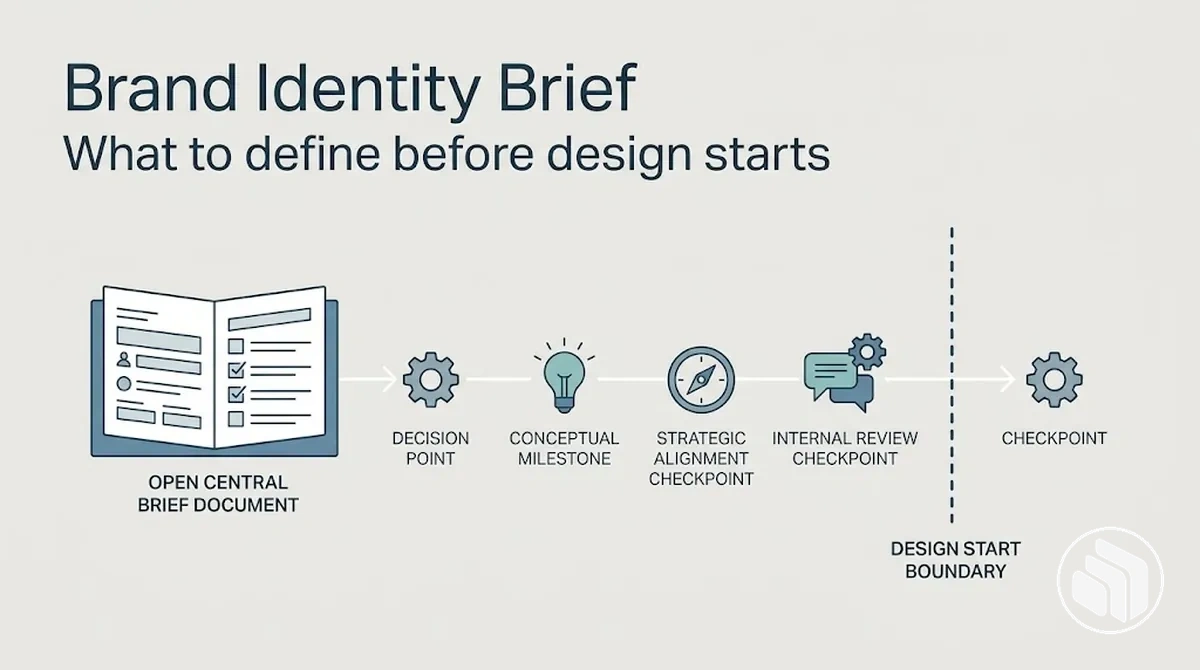
Brand identity brief decision map
Define these six linked decision areas before visual exploration. Each area should create a usable design implication; missing or contradictory inputs need clarification before they become design criteria.
- Business context and objectiveCurrent brand condition, project trigger, business goal, and intended change.
- Audience and market contextRelevant needs, expectations, behaviours, familiarity, and category conditions that affect interpretation.
- Brand directionPurpose, positioning, values, and personality stated precisely enough to guide choices.
- Desired perception and visual directionWhat the identity should signal, preserve, or avoid without choosing the finished visual solution.
- Project requirementsScope, deliverables, timeline, budget, dependencies, and retained assets that affect feasibility.
- Evaluation and approvalsHow directions will be judged, who provides feedback, who approves, and which conditions must remain consistent.
Decision-ready condition: every critical input has a clear implication for design, and the inputs do not contradict one another.
The brief links business goals to audience and positioning, then converts practical constraints into design criteria. Its depth should increase only when project size, the maturity of the existing brand, or stakeholder complexity creates more decision-relevant information; usefulness depends on specificity and shared understanding, not document length or decorative detail.
Table of Contents
What a Brand Identity Brief Needs to Clarify Before Design
A useful brand identity brief clarifies the business problem, intended audience, brand direction, project boundaries, and the design decisions the work must support.
These dimensions establish the requirements that reduce ambiguity before visual execution begins.
Strategic clarity covers the objective, intended audience, positioning, and desired direction, while practical project clarity covers scope, constraints, feasible deliverables, and decision requirements.
Defining the audience gives design decisions a clearer basis for relevance and intended perception, while defined project boundaries constrain what can realistically be delivered.
Within the broader Brand Identity Design context, the brief provides direction for later design work rather than performing that work itself.

This distinction keeps strategic direction separate from premature visual execution: the brief establishes what the identity needs to address and the criteria that later choices should satisfy, rather than selecting colours, typography, creating a mood board, or producing other visual elements.
The level of detail can increase with project scope, existing brand complexity, or the number of stakeholders involved, while the purpose remains to provide sufficiently clear direction for subsequent design decisions.
Brand Objectives and the Purpose of the Identity Project
A brand objective defines why the identity project is being commissioned and which business goal or brand outcome the work is intended to support.
The project objective should establish that purpose before visual preferences become design criteria.
The objective should connect the current condition of the brand to an intended change while acknowledging any constraint that limits or shapes the project.
For example, a differentiation objective may prioritise clearer distinction from alternatives for the intended audience, while a consistency objective may prioritise alignment across an existing identity.
This relationship gives the brief a basis for deciding which requirements deserve priority rather than treating subjective visual preferences as the project purpose.

Alignment can be evaluated by checking whether later design decisions support the stated objective under the project's actual conditions and constraints.
The appropriate evidence depends on the objective: a differentiation project may examine whether proposed directions create the intended distinction and audience perception, whereas a consistency project may examine whether decisions remain coherent with the relevant existing identity requirements.
“Make the brand look modern.” This names a visual preference but does not define the intended change.
State the specified audience, the intended perception or positioning change, and any relevant brand constraint so later directions can be evaluated against the objective.
What to Include in a Brand Identity Brief
A brand identity brief should contain the information needed to understand the brand, target audience, intended direction, and practical project constraints.
Its major component groups include business background, audience context, positioning and personality, desired perception, and project requirements such as project scope, deliverables, timeline, budget, and approvals.
These component groups organise the briefing inputs needed to interpret the project consistently and connect design decisions to relevant business and brand context.
The diagram maps the brand identity brief to its major information groups, while the component overview identifies the function each group serves.
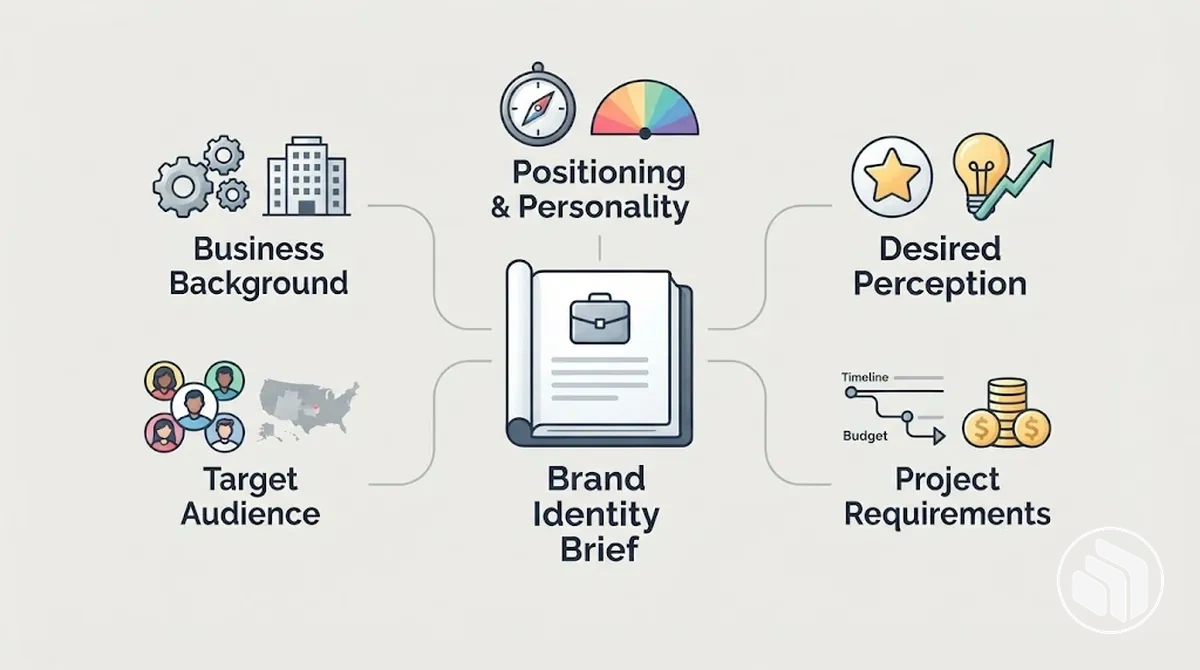
- Business background: records the relevant business context, brand history, and reason for the identity project so design decisions can respond to the situation that prompted the work.
- Target audience: clarifies the people the identity needs to address and the relevant market context, expectations, or behaviours that affect how the brand should be interpreted.
- Positioning and personality: describes how the brand intends to be situated and the characteristics it should express, giving design decisions a strategic direction rather than relying on generic visual preferences.
- Desired perception: states how the intended audience should understand or perceive the brand, providing a reference point for evaluating whether proposed directions support that intention.
- Project scope and deliverables: defines the boundaries of the identity work and the outputs expected from it, so the brief distinguishes required work from matters outside the project.
- Timeline, budget, and approvals: records practical constraints and decision responsibilities that can affect what is feasible, when deliverables are required, and how design directions are reviewed and approved.
A complete brand identity brief is not defined by document length or by including every possible field.
The appropriate depth depends on which information is necessary to make the project's design decisions traceable to its business context, intended audience, strategic direction, and practical requirements.
Business Background and Brand Context
Business and brand context in a brand identity brief is the decision-relevant background needed to understand what the identity represents and why the project exists.
It should establish the business offer, category, current brand state, relevant history, and project reason when those facts affect interpretation of the identity work.
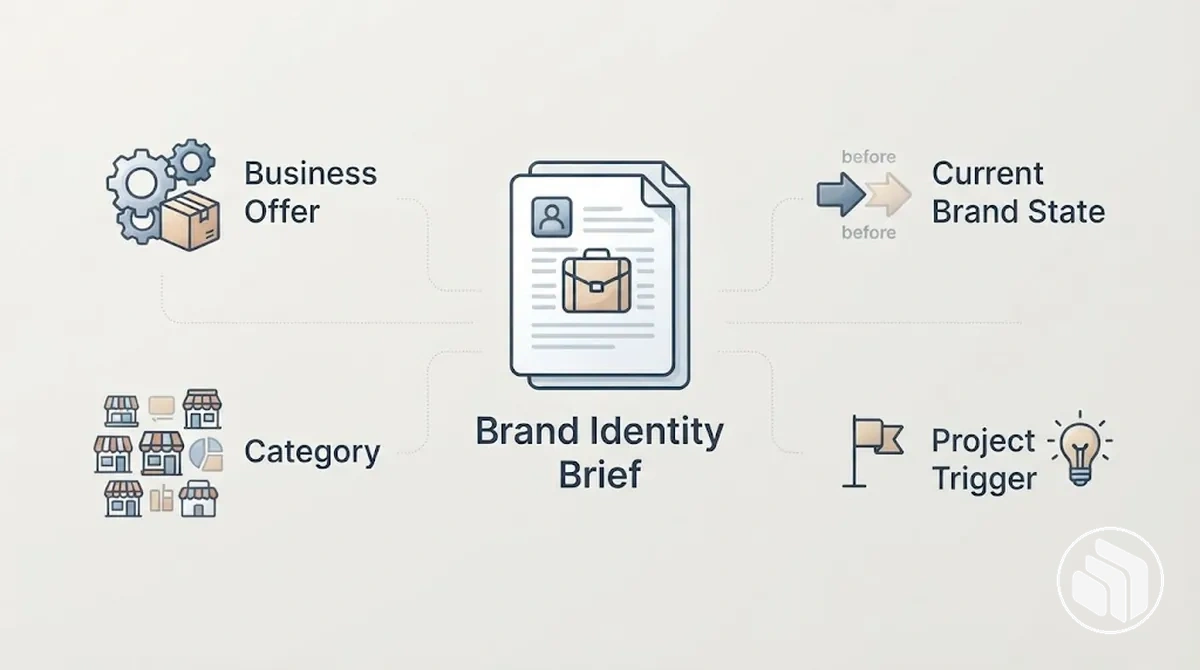
These facts contextualise the brief by showing which parts of the existing brand situation matter to design interpretation.
The business offer and category establish what the brand represents, while the current brand state identifies the existing identity conditions from which the project begins.
Relevant history belongs when it explains a constraint or continuity requirement, and the project reason belongs when a problem or opportunity helps explain why the identity is being reconsidered.
Background information that does not affect the interpretation of the identity project can remain outside the brief.
Target Audience and Market Context
The target audience information that belongs in a brand identity brief is limited to attributes that materially change how the identity should be interpreted or evaluated.
Audience needs, expectations, behaviours, familiarity, and relevant demographic or psychographic characteristics are useful when they influence design criteria; descriptive details that do not affect a design decision can be excluded.
Audience and market attributes should therefore be connected to an implication rather than recorded as isolated profile data.
The diagram shows how selected audience needs or expectations and market context can shape criteria for differentiation and design direction.
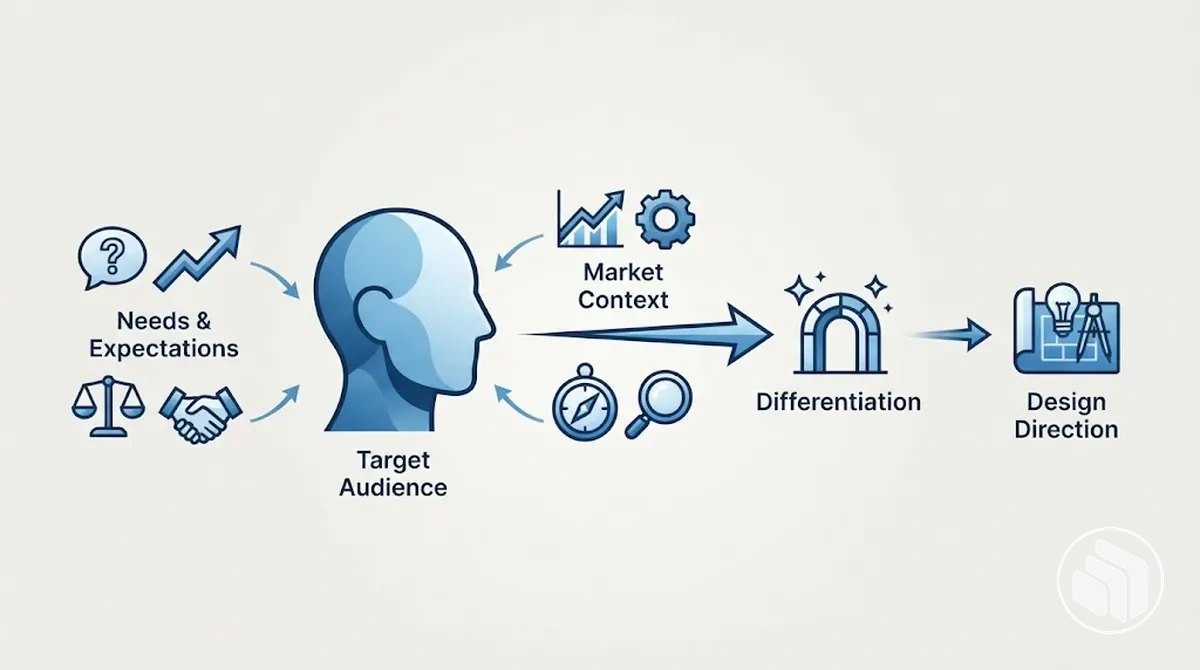
- Audience needs: include needs that change what the identity must communicate, clarify, or make easier for the intended audience to recognise.
- Expectations: include category or audience expectations when they create a relevant convention to align with or a distinction the identity needs to make clear.
- Behaviours and familiarity: record behaviours or levels of familiarity when they change how much recognition, continuity, or contextual support the identity requires.
- Demographic or psychographic characteristics: include them only when there is a defensible connection between the characteristic and a design criterion, rather than assuming a guaranteed preference from age, lifestyle, or another broad descriptor.
- Market context and differentiation: identify category conditions or relevant alternatives when they affect how the brand needs to be distinguished without turning the brief into a broad market analysis.
The significance of an attribute depends on the audience and category context.
A characteristic that changes interpretation in one market may add no useful design implication in another, so the relevance test is whether the condition meaningfully shapes how a proposed identity direction should be interpreted or evaluated.
Brand Purpose, Positioning, Values, and Personality
Brand purpose, positioning, values, and personality are distinct strategic attributes that give a brand identity brief direction without prescribing a finished visual solution.
Together, they establish connected constraints for interpreting what the brand represents, how it seeks differentiation, which behaviours should remain consistent, and what tone or visual character may be appropriate.
Each attribute contributes a different type of design implication, so the brief should state its meaning precisely enough to guide interpretation rather than treating the four terms as interchangeable.

- Brand purpose: expresses the reason the brand exists beyond describing what it sells, providing direction when that reason is relevant to what the identity needs to communicate.
- Positioning: defines how the brand is intended to be situated relative to its market or alternatives, giving differentiation a strategic basis for evaluating identity directions.
- Values: identify principles intended to guide brand behaviour; when those principles affect how the brand should act or communicate, they provide a consistency criterion for design expression.
- Personality: describes the brand character expressed through communication and behaviour, influencing tone and visual character when those traits are specific enough to guide choices.
Personality language becomes more useful when it describes observable expression rather than relying on broad adjectives.
For example, professional is generic, whereas direct, restrained, and precise in communication gives clearer behavioural meaning without prescribing particular colours, fonts, or other visual solutions.
Desired Brand Perception and Visual Direction
Desired brand perception describes the intended audience interpretation that the identity should support, while visual direction translates that intention into directional criteria for later design exploration.
It defines what a proposed direction should signal or avoid without selecting a finished visual solution, because audience interpretation can vary with brand and market context.
Perception attributes become useful when each one creates a clear design implication that can be used to evaluate possible directions.
Attributes such as distinctive, trustworthy, or accessible should therefore be included only when the brand context supports them and their intended meaning can be stated clearly.
The resulting criteria constrain evaluation while preserving flexibility in how the later visual solution is developed.
- Distinctive: sets a criterion for visual direction to support recognisable differentiation from relevant alternatives without prescribing the exact device used to achieve it.
- Trustworthy: may suggest a direction that avoids visual signals inconsistent with the credibility the brand intends to communicate, while leaving the specific execution open.
- Accessible: can set a criterion for an approachable and understandable visual character when that interpretation is relevant to the intended audience.
An abstract preference such as “make it feel premium” becomes more useful when converted into a criterion such as “the direction should signal considered quality without appearing inaccessible to the intended audience”; the design implication is then evaluative rather than an exact colour, font, or imagery prescription.
Once these directional criteria are established, later exploration can create a brand mood board without turning the brief itself into a finished visual solution.
Project Scope, Deliverables, Timeline, Budget, and Approvals
Project constraints define the practical boundaries and decision conditions of a brand identity project.
Project scope establishes what work is included, deliverables define the required outputs, and the timeline, budget, approvals, stakeholders, and dependencies establish conditions that can affect feasibility, sequencing, priorities, and decision ownership.
Making these project requirements explicit reduces the risk of mismatched expectations between the brief and the work to be produced.
Each constraint should therefore be stated with the condition that matters and its practical implication for the identity project.
| Constraint | Condition | Project implication |
|---|---|---|
| Project scope | The identity work has defined inclusions and boundaries. | Defines which requirements and activities belong within the project and which remain outside it. |
| Deliverables | Specific identity outputs are required. | Defines what the project must produce and helps align the work with the agreed project scope. |
| Timeline | A launch date, review point, or other timing dependency constrains the work. | May influence sequencing and the time available for development, review, and approval. |
| Budget | Available resources constrain the feasible scope or level of production. | May require priorities to be explicit so project scope and deliverables remain consistent with the constraint. |
| Stakeholders and approvals | Multiple stakeholders provide feedback or approval authority is distributed. | Requires clear decision ownership and an explicit approval process so responsibilities for feedback and final decisions are understood. |
| Dependencies | The identity work relies on another decision, input, deliverable, or external timing condition. | May affect sequencing or feasibility when dependent inputs are required before related work can proceed. |
Only practical constraints and requirements that materially affect the identity project's scope, deliverables, feasibility, sequencing, or decisions need to be captured in the brief.
Questions That Clarify the Brief Before Design Decisions
Useful briefing questions expose missing decisions, assumptions, and contradictions before visual work starts.
Their purpose is to resolve uncertainty that could materially affect the project's scope, direction, or evaluation criteria, rather than to collect information for its own sake.
- Expose the uncertaintyIdentify the missing decision, assumption, or contradiction that could materially affect the project.
- Clarify the conditionEstablish the context, constraint, or dependency behind that uncertainty.
- Connect the answer to a decisionShow which meaningful choice about scope, direction, or evaluation could change once the answer is known.
For example, “What should the brand feel like?” is broad, whereas “Which audience interpretation should the identity support, and what existing perception needs to change or remain consistent?” provides a clearer basis for evaluating direction.
Question volume does not substitute for relevance when additional answers would not change the brief.
The necessary clarification questions therefore depend on where uncertainty remains in the project.
The subordinate question groups can address different decision areas, but each briefing question should be retained because its answer can clarify an assumption, expose a contradiction, define scope, influence direction, or establish evaluation criteria—not simply because it is commonly included in a questionnaire.
Questions About Business Goals and Brand Differentiation
Business-goal questions should clarify the business goal and project objective the identity needs to support, the current problem that prompted the project, and the meaningful differentiation the brand may need to communicate.
The questions are useful when their answers can inform a design criterion rather than simply produce more background information.
Answers should connect the current state to the desired change and identify which distinction matters in relation to relevant competitors or alternatives.
Where differentiation is relevant, the brief should establish its basis and the implication for identity direction without assuming that every point of difference must become a visual distinction.
- Project purpose: What business goal or project objective should the identity support? The answer identifies the intended outcome against which relevant identity decisions can be evaluated.
- Current problem: What problem in the current state is the identity project intended to address? The answer clarifies the desired change and which existing condition should influence the design criterion.
- Relevant alternatives: Which competitors or alternatives matter to how the brand is currently understood? The answer establishes the comparison context needed to judge whether differentiation is relevant.
- Basis for differentiation: What meaningful point of difference should the brand communicate relative to those alternatives? The answer identifies the distinction that may need to inform positioning and identity direction without assuming visual difference for its own sake.
- Decision implication: If that distinction is important, what should a proposed identity direction signal, preserve, or avoid? The answer converts the differentiation claim into a design criterion that can be used to evaluate later directions.
Questions About the Audience and Desired Brand Experience
Audience questions should clarify who the target audience is, which expectations matter in the relevant interaction context, what existing perception may need to change or remain stable, and what intended perception should inform the desired brand experience.
These answers provide criteria for later design evaluation without assuming a guaranteed audience response.
The useful question is not simply what an audience says it prefers, but whether the answer provides relevant evidence for assessing an identity direction.
Audience preferences should therefore be interpreted in context rather than treated as literal design instructions, especially when different audience groups, situations, or levels of familiarity may affect interpretation.
- Relevant audience: Which target audience needs to interpret the identity, and what relevant need or expectation distinguishes that audience in this project? The answer clarifies whose interpretation should inform design evaluation.
- Audience expectations: What expectations are relevant to how the audience understands this type of brand or offering? The answer indicates which expectations may need to be supported, challenged, or distinguished from rather than followed automatically.
- Interaction context: In which interaction context will the audience encounter or interpret the identity? The answer helps assess whether a proposed direction remains appropriate for the situations that matter to the project.
- Existing perception: How does the intended audience currently perceive the brand, and which part of that existing perception should change or remain stable? The answer identifies whether evaluation should prioritise a perceptual shift, continuity, or a defined combination of both.
- Intended perception: What should the audience understand about the brand after encountering the identity? The answer converts the desired perception into a criterion for assessing whether a direction supports the intended meaning without claiming that it will produce a fixed response.
- Desired brand experience: What qualities should characterise the audience's experience of the brand when they are relevant to the identity? The answer helps assess whether a proposed direction is consistent with those qualities while leaving the specific visual execution open.
Questions About Existing Assets and Design Preferences
Existing assets and visual preferences should influence a brand identity brief when they represent a relevant constraint, continuity requirement, or reasoned direction rather than unsupported taste.
Each input should therefore be evaluated through its current state, the rationale for retaining or changing it, and the implication that rationale creates for the new identity.
Existing assets should be documented with enough context to distinguish elements that remain useful from elements the project may reconsider.
Constraints can limit what may change, while reference brands can indicate a quality, distinction, or direction worth discussing without becoming imitation targets.
Visual preferences deserve influence when their rationale connects to the brand context or desired perception; a stylistic preference without that rationale should not determine the identity.
- Existing asset: What is its current state, and is there a reason to retain, adapt, or change it? The rationale determines whether the asset informs continuity or creates a requirement for change.
- Constraint: Is an existing element restricted by a practical, contractual, or established brand requirement? If so, the constraint defines which aspects of the new identity have less freedom to change.
- Visual preference: What desired perception or project requirement supports the preference? A supported rationale can inform direction, while an arbitrary stylistic preference should not dictate the identity.
- Reference brand: What specific quality or distinction makes the reference relevant? The answer can inform the intended direction while keeping the new identity grounded in its own brand context rather than imitation.
For example, “we like this style” states an unsupported taste, whereas “we prefer a restrained visual character because the identity should support a more considered and credible perception” provides a rationale and a design implication without prescribing an exact colour, font, or copied reference.
How to Turn Brief Requirements Into Clear Design Criteria
Brief requirements become useful design criteria when they are translated into conditions that can guide and later evaluate design decisions rather than treated as prescribed solutions.
The method connects each requirement to its underlying objective, relevant attribute or condition, design implication, and a basis for judging alignment.
Following the sequence from requirement to evaluation keeps the rationale explicit and reduces the risk that a subjective preference becomes an arbitrary design instruction.
Each step depends on the information established in the preceding step.
- Identify the requirement: State the relevant brief input clearly, separating the actual requirement from any proposed visual response already attached to it.
- Clarify the objective: Identify why the requirement matters and what business, audience, positioning, or brand objective it is intended to support. This rationale establishes the purpose the criterion needs to serve.
- Define the relevant attribute or condition: Specify the characteristic, constraint, or contextual condition that determines what alignment means. This converts a broad objective into something that can inform design judgement.
- Translate it into a design implication: State what a suitable direction should communicate, support, preserve, distinguish, or avoid without prescribing a single design response. This implication forms the directional design criterion.
- Establish the evaluation basis: Define how proposed directions will be assessed against the criterion and its objective. Alignment is judged by whether a design response addresses the relevant condition and implication, while recognising that several different responses may satisfy the same criterion.
For example, an audience need for easier recognition can become a criterion that the identity should support clear distinction in the relevant interaction context, with the design implication that proposed directions are evaluated for recognisable differentiation rather than against one predetermined visual answer.
These criteria can then inform decisions within the broader brand identity design process while leaving the specific design response open to development and evaluation.
What a Clear Brand Identity Brief Looks Like in Practice
Consider a fictional regional meal-delivery business preparing to replace an inconsistent identity as it expands from local direct orders into a broader subscription service.
Its clear brand identity brief needs to connect that business context to an objective, target audience, positioning, brand attributes, visual direction, project constraints, and design criteria rather than simply describe preferred aesthetics.
The example below demonstrates how those approved brief dimensions can work together as decision-ready information.
Each detail states a relevant condition and an implication for later design decisions, so specificity comes from the quality and relationship of the information rather than the length of the brief.
- Context and objective: The existing identity has been used inconsistently as the service has expanded, so the objective is to establish a more coherent identity that can support the broader offer while retaining useful recognition from the current brand.
- Target audience: The identity needs to address time-conscious customers comparing convenient meal options, so the brief prioritises quick recognition and clear interpretation rather than assuming a particular stylistic preference from the audience profile alone.
- Positioning and brand attributes: The service is positioned around practical convenience with a considered, dependable personality. These attributes imply that proposed directions should support an organised and credible perception without prescribing one visual solution.
- Visual direction: The desired perception is accessible and distinctive within the relevant category, so the directional requirement is to support recognisable differentiation without making accessibility dependent on a specific colour, typeface, or visual device.
- Project constraints: The project must retain the existing business name and work across the agreed identity deliverables, so those conditions constrain which elements may change while leaving other design responses open.
- Design criteria: A proposed direction should support coherent recognition, the intended positioning, and the required degree of differentiation while respecting the stated constraints. For example, the vague request “make it feel more premium” becomes clearer when expressed as “support a considered and credible perception without making the service appear inaccessible to the target audience”.
The example is decision-ready because the objective is tied to a defined project condition, audience and brand attributes lead to explicit implications, and the visual direction can be evaluated against design criteria and project constraints.
Another project may require different information or emphasis, but the same principle applies: details are useful when they clarify a decision rather than merely make the brief longer.
Common Briefing Mistakes That Create Design Ambiguity
Briefing mistakes create ambiguity when the information in a brief does not provide a sufficiently clear basis for interpreting requirements or making design decisions.
An unclear objective, undefined audience, contradictory brand traits, unsupported preference, missing constraints, or unclear approval ownership can leave important aspects of direction unresolved.
These patterns can be diagnosed by connecting each mistake to its likely consequence, a recognition cue, and a corrective direction.
The downstream effect depends on the project context, so the purpose of the table is to identify ambiguity in the brief and clarify the missing decision rather than predict a particular design outcome.
| Mistake | Consequence | Recognition cue | Corrective direction |
|---|---|---|---|
| Unclear objective | Can create ambiguity about what the identity is expected to accomplish and which design criteria should take priority. | The objective relies on broad requests such as “make the brand look better” without identifying the intended change or business purpose. | Clarify the current condition, intended change, and project objective so later directions can be assessed against a defined purpose. |
| Undefined audience | Can leave audience relevance and intended interpretation without a clear reference point. | The brief refers to broad groups such as “everyone” or provides audience details that do not explain which needs, expectations, or contexts affect the identity. | Define the relevant target audience and the audience conditions that materially influence interpretation or design evaluation. |
| Contradictory brand traits | Can produce competing signals when several attributes imply different directions and their relationship or priority is not explained. | The brief combines traits such as restrained and expressive without clarifying what each means in context or how a conflict should be resolved. | Clarify the intended meaning, relevance, and priority of the brand traits so they provide coherent directional criteria rather than an unqualified adjective list. |
| Unsupported preference | A solution-first preference can become an arbitrary design instruction when its rationale is missing. | The brief specifies a style, colour, typeface, or reference because someone “likes it” without connecting that preference to an objective, perception, constraint, or other requirement. | Identify the rationale behind the preference and translate it into the perception or design criterion it is intended to support, leaving the specific design response open where appropriate. |
| Missing constraints | Can lead to directions that conflict with practical requirements or project boundaries that were not made explicit. | Relevant scope, required deliverables, timing conditions, retained assets, or dependencies become apparent only after design decisions have begun. | State the constraints that materially affect scope, feasibility, continuity, sequencing, or the range of acceptable design responses. |
| Unclear approval ownership | Can create inconsistent feedback or uncertainty about who has authority to make a final decision. | Multiple stakeholders provide direction, but the brief does not distinguish contributors, reviewers, and final approval ownership. | Define stakeholder roles, decision ownership, and approval authority so feedback and final decisions have an explicit decision path. |
Correction should prioritise the ambiguity that most directly prevents a relevant requirement, constraint, or decision criterion from being interpreted consistently.
How to Review a Brand Identity Brief Before Design Starts
A brand identity brief review verifies completeness, consistency, and whether the information is decision-ready before design starts.
The brief is ready when its decision-critical information is clear, non-contradictory, and usable for evaluating design decisions.
The checklist tests concrete conditions rather than whether every possible field has been completed.
Each verification should confirm that the information provides a usable implication for the project without prematurely prescribing the design solution.
Pre-design verification
- The objective is specific enough to guide decisions: Verify that the objective identifies the relevant project purpose or intended change rather than relying on a vague preference.
- The audience information has a design implication: Check that the target audience information identifies needs, expectations, behaviours, or contexts that can materially influence a design decision.
- The positioning is sufficiently clear: Verify that the intended positioning identifies the relevant market or perceptual context and provides a basis for judging whether a proposed direction supports the intended distinction.
- The brand attributes are internally consistent: Check that purpose, values, personality, and related attributes do not create unresolved contradictions and that their intended meanings provide coherent direction.
- The desired perception can inform evaluation: Verify that the intended audience perception has been translated into directional criteria that can be used to assess proposed identity directions.
- The visual direction remains directional rather than prescriptive: Check that the brief describes what the identity should signal, support, preserve, or avoid without unnecessarily fixing exact visual solutions before exploration.
- The scope and project constraints are explicit: Verify that required deliverables, relevant boundaries, timing conditions, budget constraints, retained assets, and dependencies are stated where they affect feasibility or design decisions.
- Approvals and decision ownership are clear: Check that relevant stakeholders, review responsibilities, approval authority, and final decision ownership are explicit enough to prevent uncertainty about how directions will be evaluated.
- The brief is consistent as a whole: Verify that the objective, audience, brand attributes, visual direction, scope, and approvals support rather than contradict one another, and that no unresolved gap prevents a relevant design criterion from being applied.
If unresolved contradictions or missing decision-critical information still prevent consistent interpretation, those points should be clarified before design execution begins.
Once the verification indicates that the brief provides sufficiently clear and usable direction, it can serve as an input to the brand identity design process.