
Why Brand Identity Loses Consistency
Brand identity loses consistency when shared rules, ownership, assets, and adaptation controls stop producing aligned expression across the organisation. The strongest warning pattern is recurring, unexplained divergence across outputs, teams, or touchpoints; variation can still be consistent when it is intentional, governed, and recognisably connected to the same identity system.
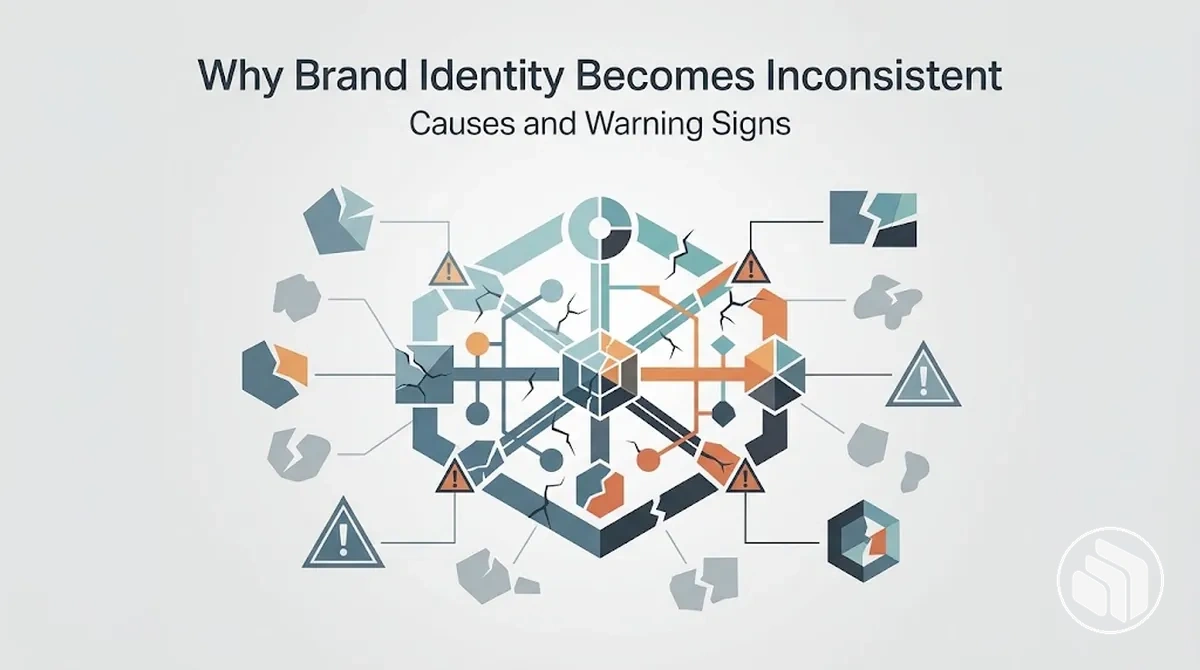
Cause → signal → verification map
Use this map to connect a recurring inconsistency signal with the system condition most worth checking. It shows plausible relationships, not proof of a single root cause.
Consistency means aligned visual, verbal, and operational expression—not identical execution in every channel.
- Rules Signal: teams make different choices from the same direction. Verify: clarity, scope, accessibility, currency, and whether permitted conditions are explicit.
- Ownership Signal: teams or agencies resolve ambiguity differently. Verify: decision rights, approval authority, responsibility, and handoff clarity.
- Assets Signal: different masters, outdated templates, local copies, or recreated assets recur. Verify: the current source, version status, naming, access, and template currency.
- Channel adaptation Signal: touchpoints stop preserving recognisable identity relationships. Verify: channel constraint, intended rationale, rule alignment, and recognisable continuity.
- Growth and change Signal: divergence increases as contributors, markets, suppliers, or output expand. Verify: onboarding, coordination, guideline currency, and whether identity controls scaled with execution.
Table of Contents
The Main Causes of Brand Identity Drift
Brand identity drift usually develops through interacting conditions rather than one isolated mistake.
Weak shared guidelines, fragmented ownership, reduced asset control, cross-channel adaptation, and organisational change can each create conditions for greater divergence.
When several conditions overlap, inconsistent execution can emerge across otherwise related brand outputs.
The underlying mechanism is a loss of alignment or control within the identity system.
When teams interpret shared guidelines differently, work from assets with uncertain version status, or adapt identity expression independently across channels, execution can become less consistent.
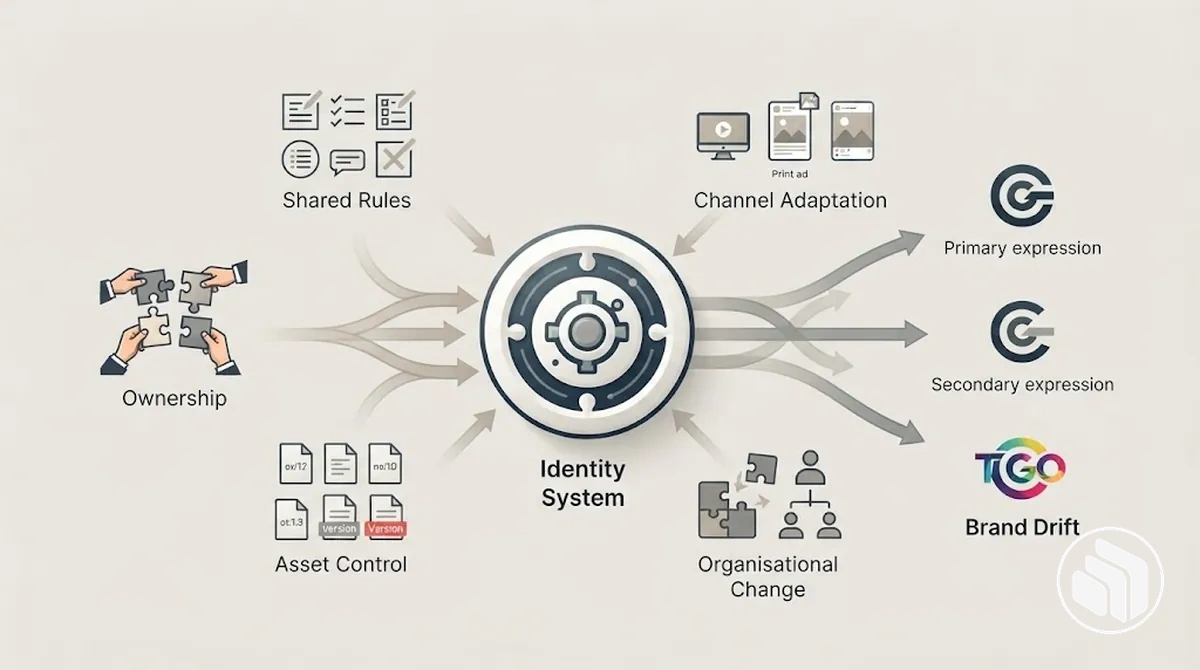
Recurring causal classes include unclear guidelines, fragmented ownership or communication, decentralised asset control, and growth or organisational change.
The diagram groups recurring upstream conditions around the identity system and shows how multiple causal mechanisms can combine to contribute to divergence.
Separate cause from signal
- Root cause
- An underlying system condition that enables brand identity drift.
- Contributing condition
- A condition that widens interpretation or weakens execution control.
- Trigger
- An event or change—such as a new channel or organisational change—that exposes an existing weakness without necessarily being its root cause.
- Downstream effect
- Inconsistent output is observable evidence of divergence, but it does not identify which upstream condition produced it.
Related brand identity design mistakes are an adjacent explanatory context rather than another cause category here.
Incomplete or Ambiguous Identity Rules
Identity rules that are incomplete, vague, outdated, inaccessible, or conflicting widen the range of plausible interpretation.
When brand guidelines leave important conditions unspecified, teams may rely on guessing or local substitution, increasing interpretation variance.
Outdated rules create similar uncertainty when their direction no longer matches the identity system currently being applied.
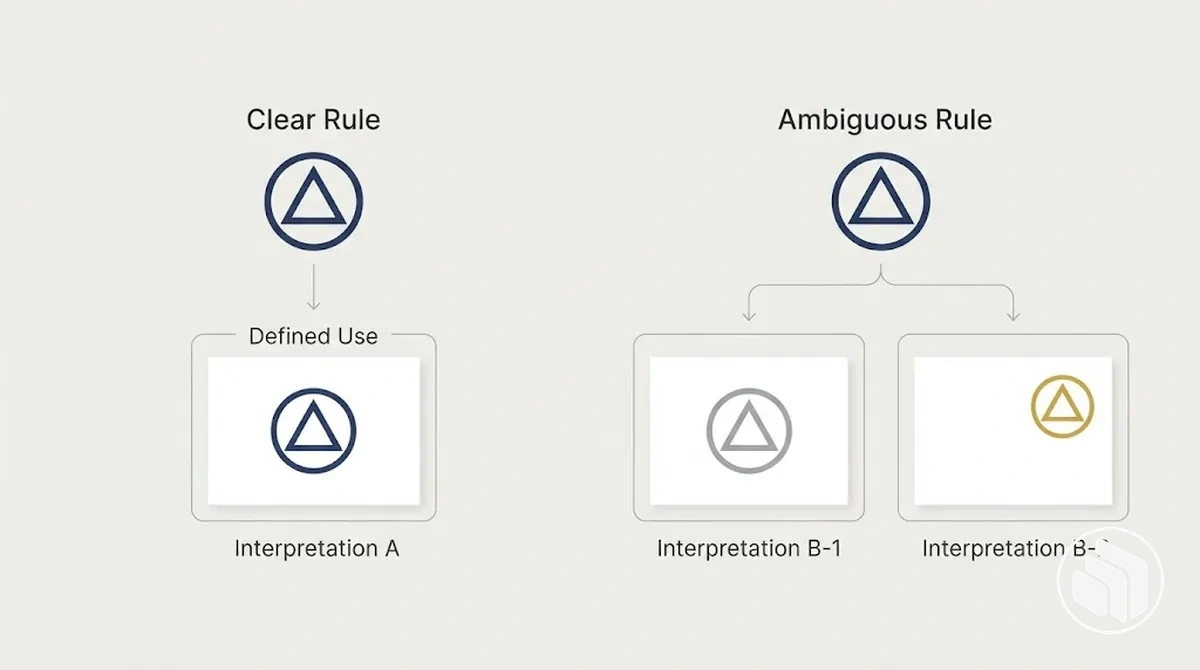
A precise rule sets a clear permitted condition, while an ambiguous rule leaves multiple plausible interpretations.
The annotated example shows how rule clarity changes the range of plausible execution and can lead to different outcomes from the same brand element.
What makes an identity rule usable
- Clarity
- The instruction is understandable and does not rely on guesswork.
- Scope
- The rule states the situations, touchpoints, or uses it is intended to cover.
- Specificity
- The permitted treatment or decision boundary is defined closely enough to guide execution.
- Accessibility
- Contributors can find and use the current guidance when making a decision.
- Currency
- The guidance matches the identity system and operating context currently in use.
Fragmented Ownership and Different Team Interpretations
Fragmented ownership can produce divergent outputs when decision rights, approval authority, or handoff responsibilities are unclear.
Teams and agencies working from the same brand identity may form different interpretations when communication does not establish who decides or resolves uncertainty.
For example, two teams given the same incomplete direction can make different local choices when neither has clear authority to settle the interpretation.
The diagram traces where shared direction can fragment as it passes through unclear decision and handoff points.

Governance conditions that keep distributed teams aligned
- Decision rights
- Contributors know which decisions they can make within their scope.
- Approval authority
- A clear owner can resolve competing interpretations and approve exceptions.
- Responsibility
- Ownership remains explicit as work moves between internal teams, agencies, or suppliers.
- Shared interpretation
- Teams apply the same underlying identity logic rather than separate local assumptions.
- Handoff quality
- Context, rationale, and current guidance travel with the work instead of being lost between contributors.
Scattered Brand Assets and Weak Version Control
Scattered brand assets and weak version control can create inconsistent outputs when contributors cannot reliably identify or access the current version.
Competing source files, outdated assets, duplicate files, and local copies can create multiple operational sources for the same identity.
Even when the intended rules remain sound, uncertainty about version status can lead different contributors to use different assets or templates.
The annotated example labels these asset states to show how competing versions can produce divergent use.

Version-control boundary
Reliable asset control
- The current source file is available and identifiable.
- Version status and naming are clear.
- Contributors can access current templates and approved assets.
Recurring version-control gap
- Current status is unclear or several masters compete.
- Outdated templates or local copies are repeatedly reused.
- Missing sources lead teams to recreate assets from local references.
Channel-Specific Adaptations That Become Disconnected
Channel constraints often require adaptation because formats, space, and platform conventions differ across touchpoints.
Adaptation becomes problematic when those changes stop preserving recognisable cues and relationships within the core identity.
Intentional variation can therefore remain coherent, while unmanaged divergence may contribute to a disconnected expression of the brand identity.
Format limits may alter layout, space constraints may reduce available elements, and platform conventions can influence presentation.
Production limits or content cadence can also shape how teams adapt identity elements for a particular channel.
These pressures do not inherently create inconsistency; the relevant issue is how far each adaptation departs from the identity relationships it is intended to preserve.
The comparison graphic shows how similar channel constraints can produce either coherent adaptation or disconnected expression.
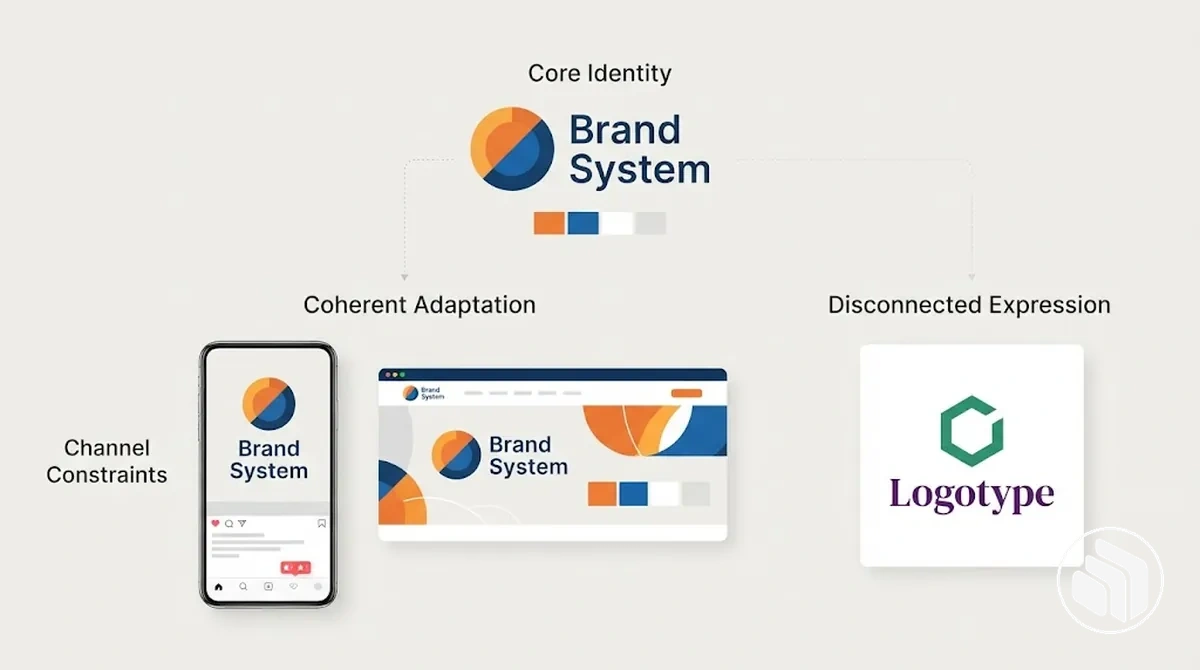
The contrast separates necessary channel adaptation from unmanaged departure: governed adaptation preserves recognisable identity cues, while disconnected adaptation changes them without a clear rule or rationale.
A channel constraint can justify a local adaptation, but a greater departure may contribute to cross-channel divergence when core identity relationships are no longer recognisable.
Where intent is unclear, the degree of disconnection cannot be determined from visual difference alone; the relevant identity rules or rationale provide the necessary context.
This causal analysis stops where local adaptation becomes unmanaged divergence and ongoing cross-channel practice begins.
Guidance on maintaining brand consistency addresses that continuing practice, while this section distinguishes necessary adaptation from disconnected execution.
Growth and Organisational Change That Outpace the Identity System
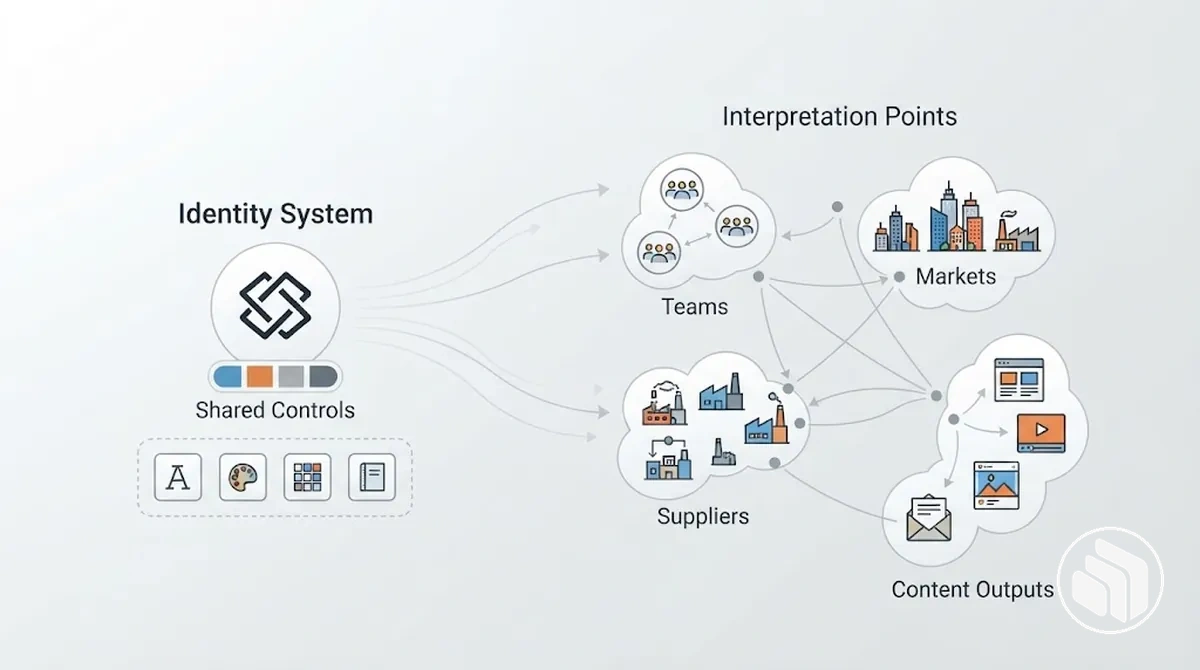
Growth and organisational change become relevant when scaling increases contributors, markets, suppliers, or content outputs faster than shared identity controls can support them.
More interpretation points can expose gaps in onboarding, coordination, and shared judgement when the identity system does not scale with the operating context.
The resulting scaling pressure may increase divergence because execution expands while identity-system capacity remains comparatively unchanged.
The diagram visualises this gap between increasing organisational complexity and lagging shared identity controls.
Warning Signs That Brand Identity Is Becoming Inconsistent
Warning signs of inconsistent brand identity are recurring, unexplained differences in identity expression rather than isolated deviations.
A signal becomes more meaningful when similar differences recur across visual elements, messaging, asset use, or multiple touchpoints.
One unusual execution may instead reflect intentional variation, so an observed difference indicates a need for verification rather than confirming inconsistency.
Interpretation depends on recurrence, spread, rule alignment, and intent.
A repeated deviation across new materials carries more diagnostic weight than an isolated difference when it conflicts with established rules and lacks traceable intent.
The following signals move from concrete visual and asset cues toward broader patterns, while identifying what still needs verification.
Signal strength: what deserves verification
- Isolated visual deviation: one difference in visual elements is a weak signal on its own; verify its rule alignment and whether an intentional decision explains the variation.
- Repeated visual deviation: the same unexplained difference recurring across new materials may indicate inconsistent execution; verify its frequency, spread, and intended rationale.
- Conflicting asset use: recurring use of different asset versions or recreated elements may suggest inconsistent asset use; verify which versions are current and whether the differences were intentionally authorised.
- Variation across several touchpoints: differences in visual elements or messaging across touchpoints may indicate a wider pattern when recognisable relationships no longer align; verify whether channel-specific variation is intentional.
- Repeated pattern without traceable intent: similar unexplained deviations across materials or touchpoints provide a stronger signal than an isolated anomaly; verify whether an established rule or documented decision accounts for the pattern.
These warning signs indicate a need for verification rather than establishing one underlying cause.
A brand identity audit marks the transition from observing signals to formally verifying their extent, context, and alignment with the identity system.
Core Visual Elements Vary Without a Clear Rationale
Unexplained variation in core visual elements is a stronger warning sign when no approved rule, contextual need, or rationale explains it.
Differences in logo treatment, colour, typography, imagery, or layout are observable, but difference alone does not establish inconsistency.
An approved alternate treatment can remain aligned with the identity system when its use follows a defined condition.
Diagnostic weight increases when variation is repeatable, lacks a traceable rationale, or departs from established rule alignment.
An approved variation has a defined reason or usage condition, while an improvised deviation lacks that connection.
The following cues group each visual element by its observed variation and the condition that still needs checking, helping interpret the signal before assigning any root cause.
Visual cues to verify
- Logo treatment: recurring changes in placement, form, or treatment may indicate unexplained deviation; check whether an approved alternative or contextual rule accounts for them.
- Colour: repeated use of different colour treatments may suggest weak rule alignment; check whether the variation follows an intentional, defined usage condition.
- Typography: recurring type choices that depart from established treatments may be a signal; check whether the alternative is approved and applied for a traceable rationale.
- Imagery: repeated shifts in image treatment or visual character may warrant interpretation; check whether the difference reflects an intentional contextual need or an improvised change.
- Layout: recurring structural differences may carry more diagnostic weight when they do not match an approved repeatable pattern; check whether a defined layout condition explains the variation.
The Same Brand Appears Different Across Touchpoints
Brand identity across touchpoints becomes diagnostically meaningful when differences weaken recognisable continuity, not merely because formats differ.
Website, social media, email, sales material, packaging, or physical environments can use different expressions while retaining connected visual cues and messaging.
Cross-channel variation may indicate inconsistency when those connections become contradictory or difficult to trace to the same core identity.
Coherent adaptation changes brand expression for its context while preserving recognisable continuity in relevant visual cues or messaging.
A disconnected expression departs far enough that core cues become contradictory across touchpoints, although the difference still requires interpretation in context.
The examples below compare touchpoint expressions by whether relevant identity cues remain recognisable or become contradictory, distinguishing coherent channel adaptation from contradictory identity cues.
Cross-channel comparison
- Website and social media: different layouts can remain coherent when recognisable visual cues and messaging persist; sharply contradictory treatments may indicate cross-touchpoint disconnection.
- Email and sales material: format-specific adaptation can preserve consistency when core identity cues remain connected; unrelated visual expression or messaging warrants checking whether the variation is intentional.
- Packaging and physical environments: different production contexts can support distinct expressions while retaining recognisable continuity; contradictory cues may suggest the brand identity is becoming disconnected across touchpoints.
Teams Recreate Brand Assets or Use Different Versions
Repeated efforts to recreate brand assets or simultaneous use of different versions are stronger signals than one isolated outdated file.
Rebuilt logos, conflicting templates, local copies, or repeated requests for source files may indicate that shared asset control needs checking.
A single obsolete attachment remains weak evidence when the behaviour does not recur across teams or outputs.
Diagnostic strength increases with frequency, spread across teams, the version state of outdated files, and recurrence across outputs.
Repeated use of conflicting master files by several teams carries more weight than one accidental use of an older version.
The cues below move from weaker to stronger signals by considering recurrence and team spread alongside the observed asset-use behaviour.
The key distinction is whether the problem remains isolated or repeatedly appears across asset use.
From weaker to stronger version-control signal
- One outdated file: isolated use of an obsolete attachment is a weak signal when the same version problem does not recur elsewhere.
- Local copies: duplicate files held locally warrant more attention when teams repeatedly use different versions instead of the same current source files.
- Conflicting templates: different templates appearing across recurring outputs may indicate a broader version-use problem when their master-file status cannot be reconciled.
- Recreated assets: teams that repeatedly rebuild assets or request source files provide a stronger signal when the behaviour recurs across outputs.
- Different master files across teams: several teams repeatedly producing from conflicting versions is a stronger system-level signal and warrants checking shared asset control.
New Materials No Longer Resemble the Established Identity System
New materials become a potential drift signal when recurring departures no longer preserve established visual or verbal relationships.
A different visual expression or verbal expression is not inconsistent simply because it is new.
Recurrence of unplanned departures from the established identity system carries more diagnostic weight than one novel treatment.
Diagnosis depends on similarity to approved patterns, the frequency of departures, consistency among new outputs, and whether the change was formally intended.
Coordinated evolution vs. brand drift
Coordinated evolution
An intended change can remain consistent when recent outputs preserve coherent identity relationships and the change is governed across the system.
Potential brand drift
Drift becomes more plausible when departures recur without intended change and new outputs increasingly diverge from approved patterns.
What Different Inconsistency Patterns Usually Indicate
Inconsistency patterns change diagnostic meaning according to their recurrence, spread, and persistence rather than the visibility of one deviation.
A local anomaly confined to one output may suggest a limited exception, while broader repeated variation makes a system-level gap more plausible.
Pattern distribution strengthens an interpretation of scope, but it does not identify a definitive root cause.
Breadth across teams or touchpoints shows how widely a pattern is distributed, while recurrence shows whether similar deviations continue to appear.
Persistence over time adds diagnostic weight when divergence continues rather than remaining an isolated event.
Relationship to approved rules also matters because repeated unexplained departures are more consistent with brand drift than governed variation.
The following dimensions show how recurrence, spread, and time course change diagnostic weight while still requiring contextual confirmation.
What changes diagnostic weight
- Recurrence: repeated variation makes a one-off explanation less plausible and may indicate a shared gap; confirm whether approved rules or intentional variation account for the pattern.
- Spread: similar deviations across several teams or touchpoints make a system-level gap more plausible than a local anomaly; the exact cause still requires verification.
- Time course: persistent divergence across successive outputs provides stronger evidence of broader brand drift than a temporary deviation; confirm whether an approved change explains the persistence.
A local anomaly and broader brand drift can therefore produce similar visible deviations while differing in recurrence, distribution, and persistence.
Interpretation should reflect the accumulated pattern evidence while preserving uncertainty where several causes remain plausible.
Repeated Variation Across Touchpoints Suggests a System-Level Gap
Repeated variation of the same type across multiple touchpoints makes a shared system gap more plausible than a single execution error.
The interpretation becomes stronger when the recurring deviation appears across otherwise separate contexts rather than remaining confined to one output.
This cross-touchpoint breadth suggests that contributors may be responding to a shared upstream condition, although it does not identify one plausible cause with certainty.
Factors that strengthen a shared-system interpretation
- Recurrence
- The same type of deviation appears repeatedly rather than once.
- Breadth
- The pattern spans several touchpoints or otherwise separate contexts.
- Contributor independence
- Different contributors arrive at similar departures instead of one person repeating one local mistake.
- Rule alignment
- A shared-system gap becomes more plausible when the recurring variation is not supported by the applicable rules or approved assets.
Several upstream mechanisms can produce the same repeated pattern, so the exact cause remains uncertain without further evidence.
Gradual Unplanned Changes Indicate Brand Identity Drift
Brand identity drift is cumulative divergence produced by gradual change that remains unplanned rather than one abrupt difference.
An isolated update does not establish drift because a brand identity can change through deliberate coordinated evolution.
Unplanned change becomes more diagnostically meaningful when small departures from the baseline expression recur and progressively increase distance from the established system.
The sequence below organises that accumulation over time rather than prescribing actions.
How unmanaged drift accumulates
- Baseline expression: the established system provides the reference point for interpreting whether later changes preserve recognised identity relationships.
- Minor unplanned deviation: a small departure appears without clear intent or approval status, but one deviation alone provides limited evidence of drift.
- Repeated normalisation: similar departures recur and become part of ongoing expression, making cumulative divergence more plausible when they remain unapproved or unintended.
- Recognisable divergence: repeated departures accumulate far enough from the baseline expression that the overall pattern may indicate brand identity drift rather than an isolated variation.
Interpretation depends on the direction of gradual change, recurrence, approval status, and cumulative distance from the established system.
Repeated departures moving consistently away from the baseline support a stronger drift interpretation when they lack coordinated intent or approval.
Changes that are intentionally approved and preserve coherent identity relationships remain coordinated evolution rather than unmanaged brand identity drift.
When Cross-Channel Variation Is Intentional Rather Than Inconsistent
Intentional cross-channel variation can remain coherent when it is rule-based, appropriate to channel constraints, recognisably connected to the core identity, and repeatable.
Different channels do not require identical execution because format and context can justify different expressions of the same identity system.
The distinction depends on whether the variation follows an intentional adaptation logic rather than appearing as an ad hoc deviation.
The criteria below evaluate coherence rather than visual sameness.
Each criterion considers whether channel-specific variation remains connected to the identity system, with acceptable flexibility depending on the relevant channel constraints and governing rules.
No single criterion establishes the decision on its own.
Coherence criteria for intentional variation
- Documented or clear intent: the variation has an identifiable purpose connected to a channel constraint or defined use, supporting an interpretation of intentional variation rather than unplanned change.
- Preserved core identity cues: relevant visual or verbal cues remain recognisably connected across channels, supporting continuity even when their expression changes.
- Coherent adaptation logic: similar channel constraints lead to adaptations that follow a consistent rationale, making governed variation more plausible than unrelated deviation.
- Appropriate approval or governance: the variation aligns with the applicable approval process, guidelines, or decision authority, strengthening the interpretation that the difference is intentional rather than ad hoc.
- Repeatability: contributors can apply the same adaptation logic under comparable conditions, supporting a rule-based pattern rather than one-off interpretation.
These criteria work together: clear intent is more persuasive when core identity cues remain recognisable, adaptation logic is coherent, approval is appropriate, and comparable conditions produce repeatable outcomes.
Apply the distinction
Governed variation
A channel constraint leads to a purposeful adaptation that preserves recognisable identity relationships and follows an approved or repeatable rule.
Ad hoc deviation
The same element changes without a traceable rationale or consistent rule, making inconsistency more plausible when the other coherence criteria are also absent.
Once the evidence supports the latter interpretation, fixing inconsistent brand identity becomes a separate corrective context rather than part of this evaluation.