
Brand Identity and Visual Identity: How Their Scope and Roles Differ
Brand identity is the broader system of intended cues and expression through which an organisation presents its identity; visual identity is the visible design layer within that system. Under this working taxonomy, brand identity can encompass conceptual or symbolic, verbal, and visual expression, while visual identity focuses on design cues such as logo, colour, typography, and imagery. Terminology varies between practitioners, so the distinction is best understood by scope and role rather than by a universal component count.
Brand identity vs visual identity at a glance
The key difference is scope: brand identity is the broader identity system, while visual identity is the part of that system expressed through visible design.
Broader system
Brand identity
- Brand identity
- Provides the broader intended cues and characteristics that can be expressed conceptually, verbally and visually.
- Visual identity
- Makes part of those cues visible through a coherent design system and its recurring visual elements.
- Branding
- Describes the ongoing activity or process of shaping, applying and expressing the brand; it is not the same thing as either identity layer.
Table of Contents
Visual Identity as Part of the Broader Brand Identity
Visual identity is treated here as the visible design layer within the broader brand identity.
It is part of the broader system rather than a separate or equivalent identity concept.
Brand identity can encompass conceptual expression, verbal expression, and visual expression, while visual identity focuses on visible design cues such as logo, colour, typography, and imagery.
Within the broader Brand Identity Design context, professional naming conventions may classify these categories differently, so this whole-to-part relationship is a working taxonomy rather than a universal fixed hierarchy.

For example, a logo belongs to visual identity because it is a visible design element, while visual identity itself sits within the broader brand identity under this terminology.
The relationship is therefore one of inclusion and scope, not a required sequence for creating a brand.
What Brand Identity and Visual Identity Each Include
Brand identity components can include visual expression as well as broader verbal, symbolic, or conceptual expression, while visual identity components belong specifically to the visible design layer.
This overlap means that logo, colour, typography, and imagery can appear within brand identity as well as visual identity without making the two scopes identical.
The comparison groups components by class rather than treating any one framework as a universal inventory.
This makes the overlap in visual expression clear while separating component classes that extend beyond the visual layer.
| Component class | Brand identity | Visual identity | Why the distinction matters |
|---|---|---|---|
| Conceptual or symbolic expression | May include defining ideas, values, or symbolic meaning associated with the intended identity. | Not inherently a visual component class, although visual cues can express symbolic meaning. | The broader identity system can contain meaning that is not limited to visible design. |
| Verbal expression | May include a name, voice, messaging, and other verbal expression. | Not normally part of the visual layer itself. | Brand identity can extend into language as well as visual expression. |
| Visual expression | Includes the visual component class because visual identity sits within the broader identity scope. | Includes visible design cues such as logo, colour, typography, imagery, and icons. | Shared visual components create overlap, but the broader and visual scopes remain different. |
Professional frameworks group and name these component classes differently, so no universal component count is assumed here.
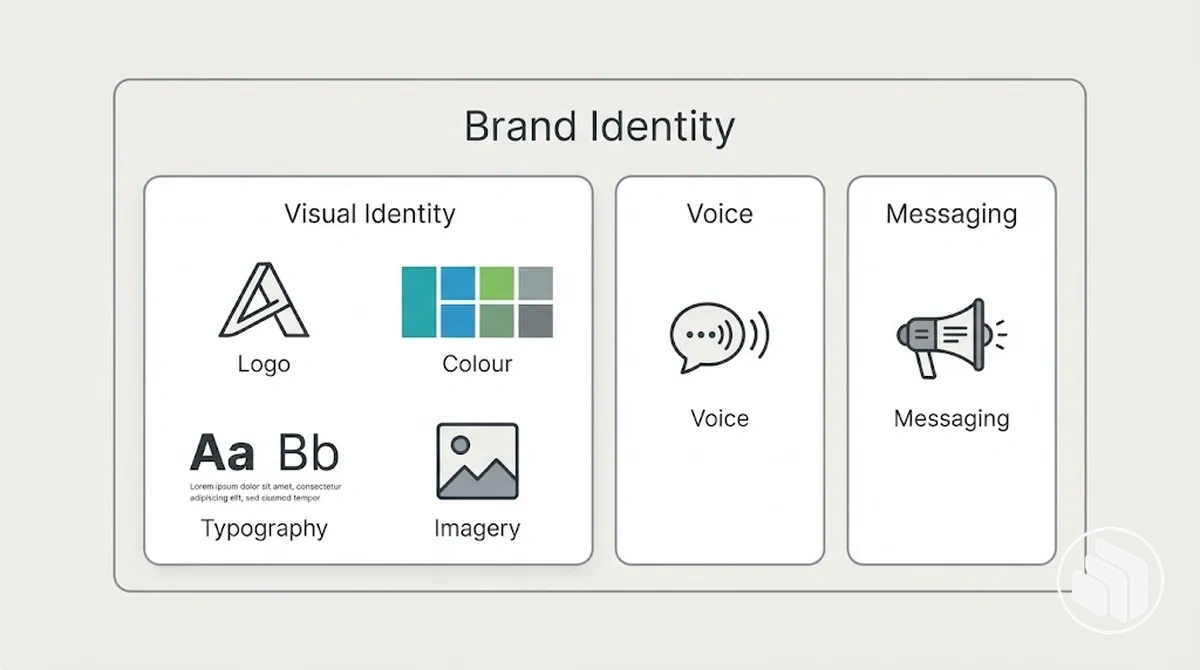
The image spatially groups the broader component classes and the visual subset without turning them into a fixed numbered framework.
Brand Identity Components
Brand identity components can combine conceptual or symbolic expression, verbal expression, and visual expression under the working taxonomy used here.
These component classes contribute different functions to the broader identity system, and the diagram groups their relationships while showing visual identity within the visual branch.
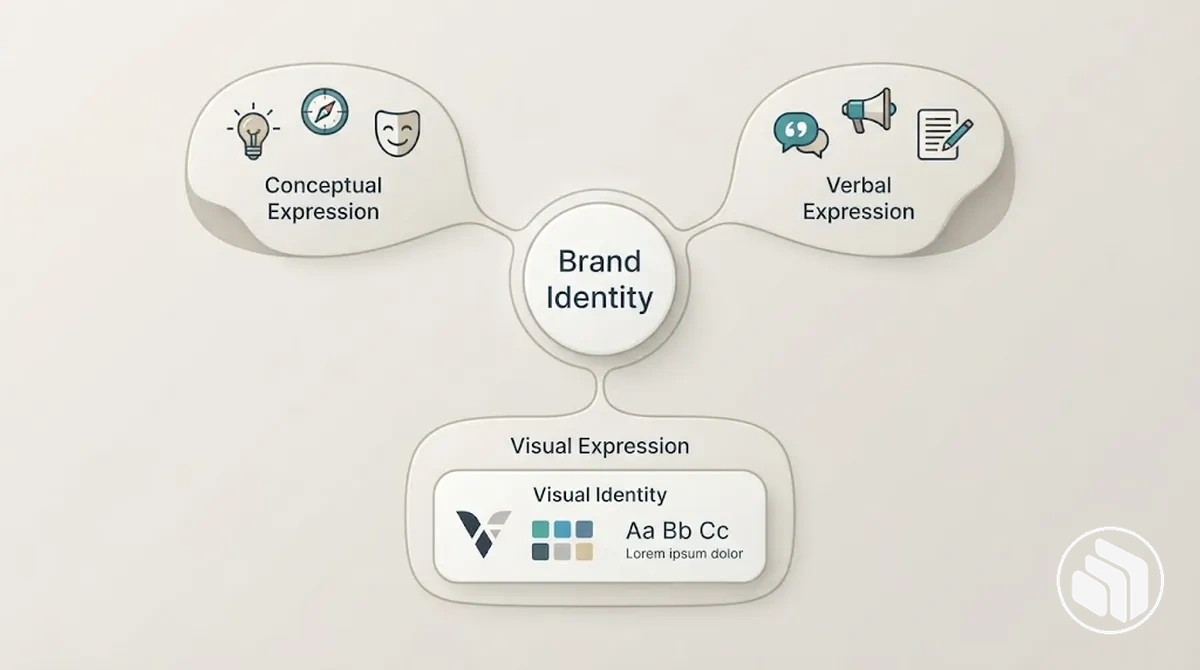
- Conceptual or symbolic expression: Values and personality can express the intended meaning and character associated with the brand.
- Verbal expression: Voice and messaging communicate brand identity through language and support its verbal expression.
- Visual expression: Visual identity expresses brand identity through visible components such as logo, colour, and typography.
Exact taxonomies may group these components differently, so no universal component count is assumed here.
Together, conceptual or symbolic, verbal, and visual expression show how brand identity can encompass both nonvisual and visual forms of expression.
Visual Identity Components
Visual identity commonly includes a logo, colour palette, typography, and imagery, while supporting elements such as icons, patterns, layout conventions, or motion vary by the visual system and context.
Together, these visual components provide recurring design cues that support recognition and consistency across visual expressions.
The annotated example groups the core visual elements and selected supporting elements within one visual system, showing how they work together without treating any fixed number of components as universal.
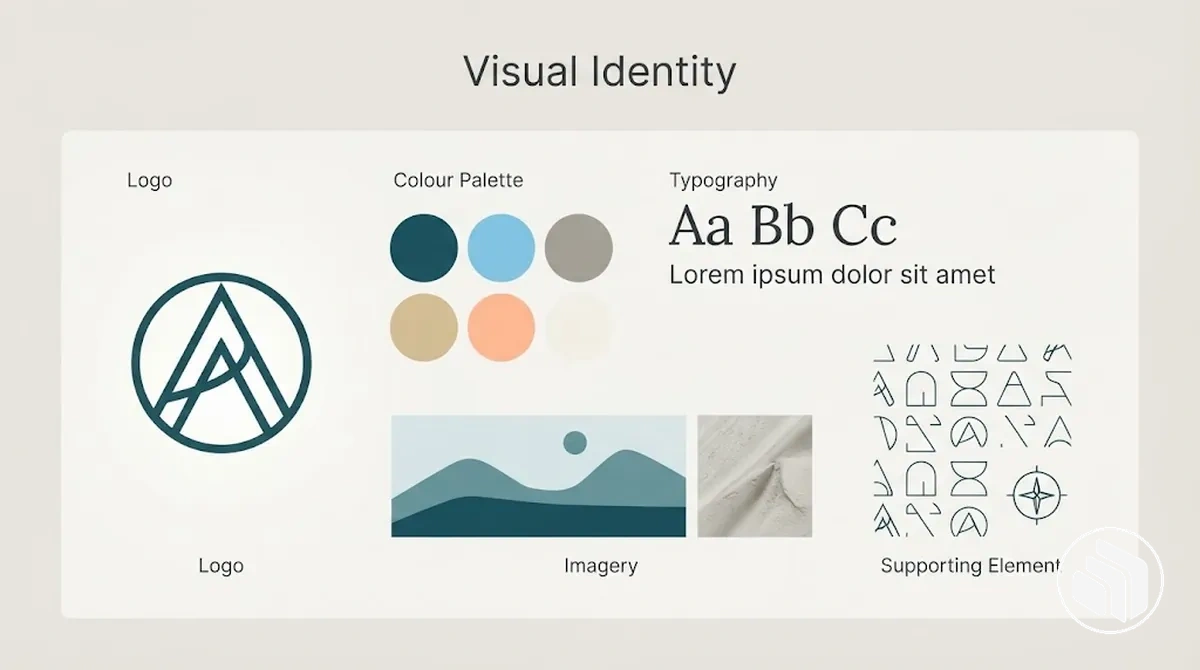
- Logo: Provides a recurring visual identifier that can signal the brand across applications.
- Colour palette: Establishes a defined set of brand colours that supports colour consistency across visual expressions.
- Typography: Gives written content a recognisable textual appearance through the type system used within the visual identity.
- Imagery: Uses a recurring image style, such as photography or illustration treatment, to support coherent visual expression.
- Supporting elements: Icons, patterns, layout conventions, or motion can extend the visual identity when they are relevant to the system and its applications.
How Brand Identity and Visual Identity Play Different Roles
Brand identity and visual identity can be compared by their purpose, scope of expression, typical outputs, and consistency function.
These shared criteria distinguish the broader role of intended identity cues from the role of making part of that identity visible through design.
| Dimension | Brand identity | Visual identity | Practical implication |
|---|---|---|---|
| Purpose | Provides broader intended cues and meaning through which the organisation expresses its identity. | Makes part of that identity visible through design. | The two roles support coherent brand expression at different scopes. |
| Scope of expression | Can encompass conceptual, verbal, and visual expression. | Focuses on visual expression. | An identity decision does not need to be visual, while a visual-identity decision concerns visible design. |
| Typical outputs | Produces or informs identity cues that may appear across verbal and visual expression. | Produces visible design outputs used to express the identity. | Some brand identity outputs are not visible design assets, whereas visual identity outputs are. |
| Consistency function | Provides intended cues that can remain coherent across different forms of expression. | Supports consistency in how those cues are expressed visually. | Visual consistency can support the broader identity without representing its entire consistency function. |
Brand identity provides the broader set of intended cues and meanings across its scope of expression, while visual identity makes part of those cues visible through design.
Their roles therefore differ in function and scope without requiring brand identity to be treated as always strategic or visual identity as always tactical.
Both can support coherent expression, but at different levels of the identity system.
If an organisation changes its visual system while some broader identity cues remain stable, its visual expression can change without every underlying identity decision changing.
The comparison graphic demonstrates this practical role contrast by connecting broader intended expression with visible design expression while keeping the two roles distinct.
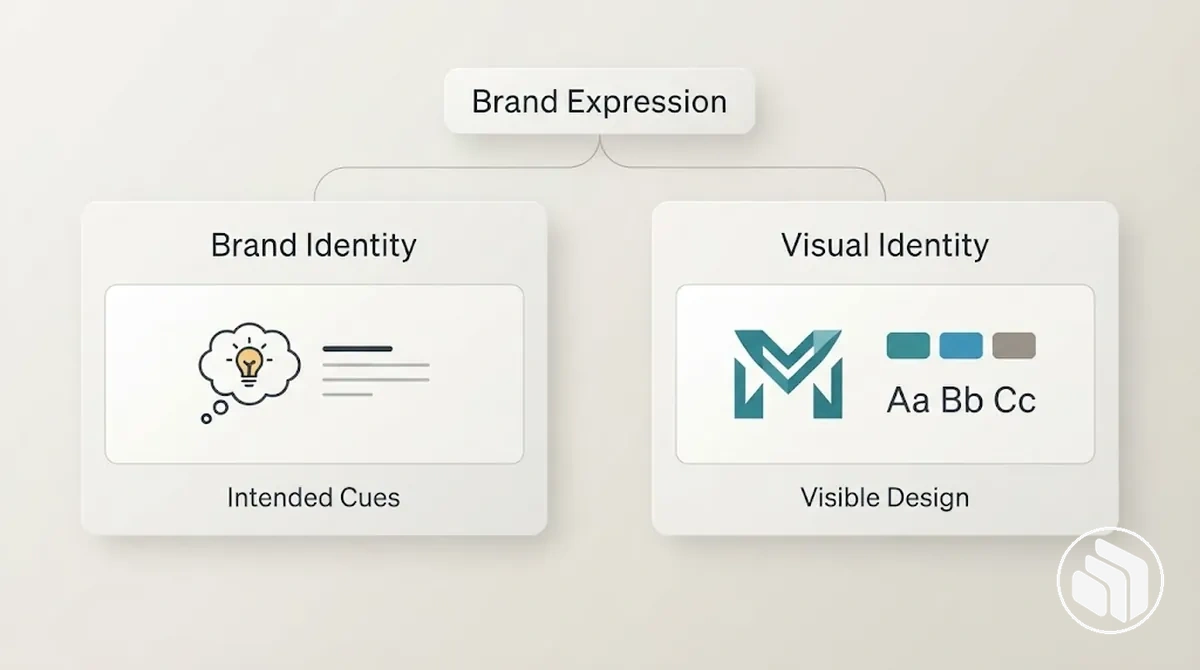
Understanding these role differences is distinct from the separate process of creating a brand identity, which involves its own decisions and sequence.
The comparison here establishes the functional boundary without turning that distinction into creation guidance.
How Branding Differs from Brand Identity and Visual Identity
Branding is treated here as an activity or process, brand identity as the broader identity system, and visual identity as the visible design expression within that system.
The three concepts are related but not interchangeable: branding concerns actions, brand identity concerns identity cues and characteristics, and visual identity concerns how part of those cues appears through design.
The distinction becomes clearer when each concept is compared by what it is, its primary role, and its typical expression.
These criteria separate process, identity system, and visual expression without treating this terminology as universally fixed across practitioners.
| Concept | What it is | Primary role | Typical expression |
|---|---|---|---|
| Branding | An ongoing activity or process. | Uses actions and communication to shape and express the brand. | Applications and communication activities through which the brand is presented. |
| Brand identity | An identity system of intended cues and characteristics. | Provides the broader cues and meaning the brand presents. | Verbal and visual expression through which the intended identity is presented. |
| Visual identity | The visible design expression within the identity system. | Makes part of the brand identity perceivable through design. | Design assets such as logo, colour, typography, and imagery. |
Branding describes activity, while brand identity describes the identity system those activities can express and visual identity describes its visible design layer.
The graphic separates process, system, and visual expression within a shared brand-expression context rather than presenting them as a mandatory sequence.
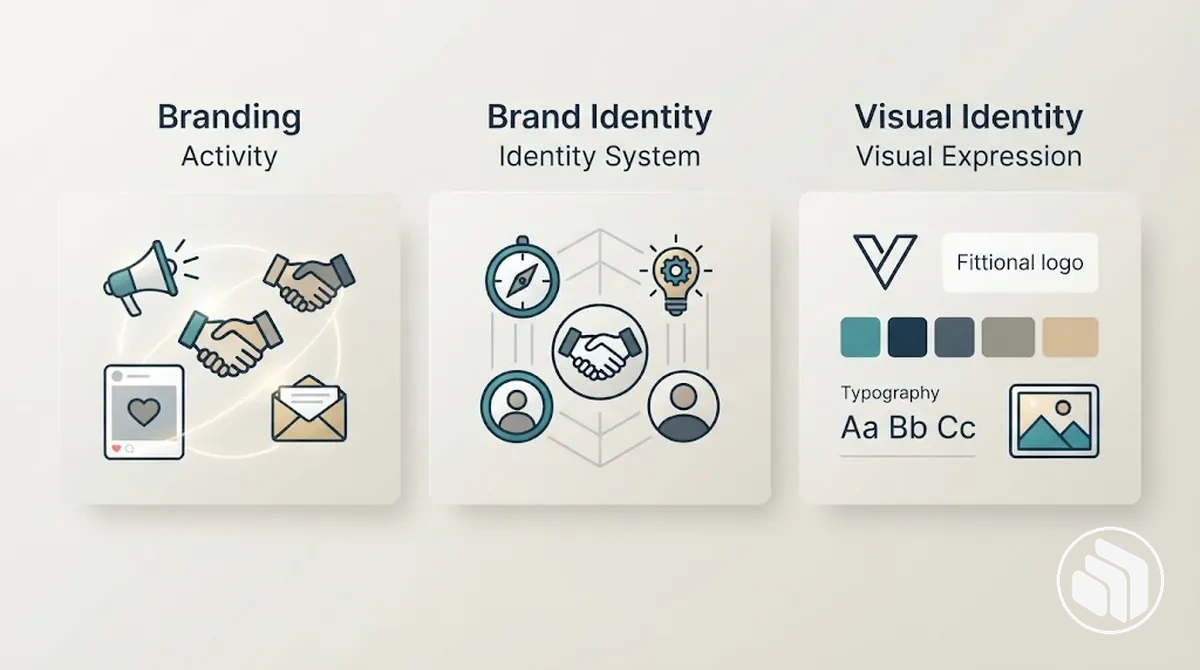
For example, an organisation might carry out a branding activity that applies an established identity across communications while using its logo, colour, typography, and imagery as design assets.
In that scenario, the activity is branding, the identity system supplies the intended cues, and the visual identity supplies the visible expression.
This process-system-visual-expression distinction is a working clarification because practitioners may use the terminology differently.