
Brand Refresh vs Rebrand: Choosing the Right Scope of Brand Change
Use a brand refresh when the brand’s positioning and strategic foundation still fit and the main problem is how that brand is expressed. Consider rebrand-level change when the positioning, proposition, audience, market focus, or other foundations no longer represent the business; the size of the visual change alone does not determine the scope.

Brand change scope decision guide
Use the three conditions below to interpret the likely scope. This is a decision aid, not a score: strategic fit is the primary boundary, while expression and recognition refine what should change or be retained.
How to read the result: answer all three questions. A refresh is supported by continuing strategic fit plus an expression-level problem; a rebrand becomes relevant when the strategic foundation no longer fits. Mixed evidence should be audited before committing to scope.
Brand refresh and rebrand are different scopes of change rather than fixed checklists; the comparison below shows what each scope typically retains, adjusts, or reconsiders.
Table of Contents
How Brand Refreshes and Rebrands Differ in Scope
A brand refresh and a rebrand can be compared across the same dimensions by asking what is retained, what is adjusted, and what is reconsidered.
A brand refresh usually works within an existing strategic foundation, while a rebrand can broaden the scope to reconsider both strategy and brand identity when the existing direction no longer fits.
The comparison includes visual identity, messaging, positioning, naming, audience or market assumptions, and organisational change.
Visual elements such as logos, colour, typography, and imagery may be refined without reopening the underlying positioning, while changes to audience, market direction, or organisational identity can require broader reconsideration.
These elements sit within the wider Brand Identity Design context, but their degree of change determines the scope here rather than defining a creation process.
A substantial visual modernisation can therefore remain a refresh when the strategic foundation is retained, whereas a merger or new positioning may expand the scope into a rebrand.
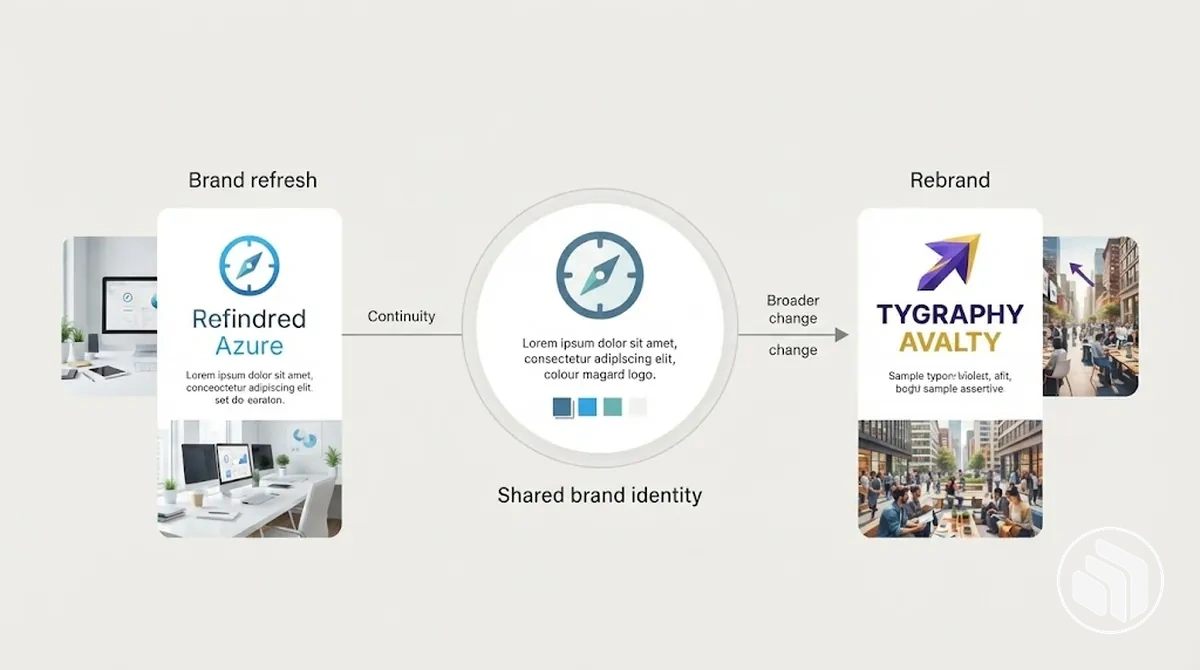
The image illustrates relative scope from the same starting brand identity: the refresh path retains recognisable core cues, while the rebrand path shows how broader change can extend across strategy and identity.
| Dimension | Brand refresh | Rebrand | Decision implication |
|---|---|---|---|
| Visual identity | Retains recognisable core cues while adjusting elements such as the logo, colour, typography, or imagery. | May reconsider the visual identity more broadly to express a changed strategic foundation. | Visual evolution within an otherwise relevant brand direction points toward refresh scope; strategic change can justify broader identity change. |
| Messaging | Refines how an existing proposition and brand direction are expressed. | May reconsider messaging when the proposition or strategic direction has changed. | The scope broadens when the underlying message must change rather than its expression alone. |
| Positioning | Typically retains positioning that still represents the business and its place in the market. | Can reconsider positioning when the existing market position no longer reflects the business. | Reopening positioning indicates strategic scope beyond visual refinement. |
| Naming | Usually retains the existing name while other identity elements evolve. | May reconsider naming when deeper strategic or organisational change makes the existing name unsuitable. | A name change can form part of a rebrand, but it is not required in every rebrand. |
| Audience and market assumptions | Retains audience and market assumptions that remain strategically relevant. | May reconsider the audience, market focus, or both when the business has shifted materially. | Changed audience or market assumptions can extend the required scope into the strategic foundation. |
| Organisational change | Can accommodate an evolved expression when the organisation's underlying brand direction remains relevant. | Can reconsider strategy and identity when organisational change, such as a merger, alters what the brand needs to represent. | The scope depends on whether organisational change alters the strategic foundation, not on organisational change alone. |
The pattern is a difference in degree and depth, not a rule that every refresh is minor or every rebrand replaces the entire identity.
A refresh can be substantial while retaining the underlying brand direction, and a rebrand can selectively retain elements that still support the reconsidered strategic foundation.
Brand Refresh: Evolving the Existing Brand Identity
A brand refresh is an evolution of an existing brand identity that modernises or sharpens its expression without replacing the core strategic foundation.
The brand refresh preserves sufficient continuity in strategy and positioning for the updated identity to maintain recognition as the same brand.
A brand refresh may refine the visual identity through changes to the logo, colour, typography, or imagery, and it may adjust messaging where the existing positioning remains valid.
The degree of refinement can be substantial, but continuity and recognition remain the boundary: the brand identity evolves while the core strategic direction remains sufficiently valid.
The image demonstrates this relationship by showing a recognisable core identity before and after restrained changes to its visual expression.
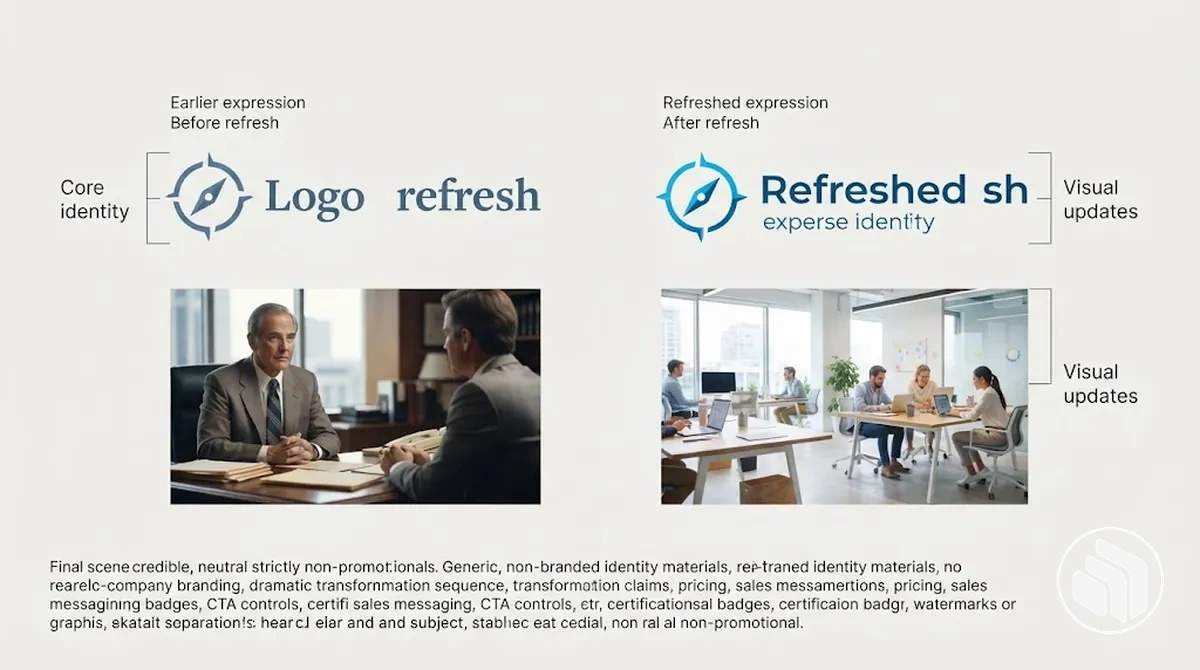
For example, a business may still have a relevant strategy and positioning while its visual identity no longer reflects the intended expression; updating typography, colour, imagery, or logo details can modernise that expression while retaining the established direction.
Once that definition and continuity boundary are clear, the adjacent guidance on how to refresh a brand identity addresses the implementation context rather than changing what a brand refresh means.
Rebrand: Reconsidering the Brand Foundation and Identity
A rebrand is a deeper reconsideration of a brand's strategic foundation and brand identity when continuity with the current brand would no longer represent the business accurately.
A rebrand can reopen the positioning and proposition that shape the brand, rather than treating the required change as a matter of identity expression alone.
A rebrand may reconsider positioning, audience or market focus, proposition or messaging, naming where applicable, and the resulting visual identity and identity system.
Which attributes change depends on where the brand no longer fits the business: a changed proposition may require different messaging and positioning, while a changed audience or market may require broader strategic reconsideration.
Naming can change when relevant, but a rebrand does not require a new name, a complete visual reset, or every strategic and identity element to change.
The diagram separates the strategic foundation from identity expression to show how several layers may be reconsidered without implying that all layers must change.
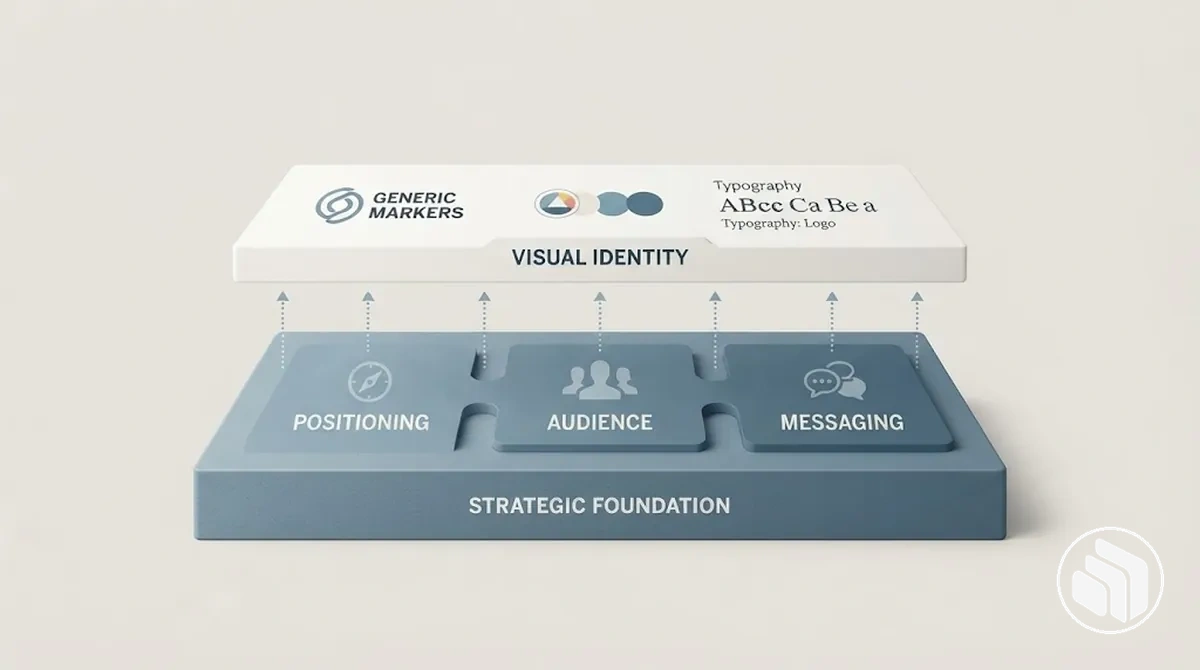
For example, a merger may leave the current positioning and proposition unable to represent the combined business accurately, making reconsideration of messaging, audience, and brand identity relevant.
The breadth of that rebrand remains conditional on which parts of the strategic foundation and identity no longer fit the business.
Time, Resources, and Change Risk
The time, resources, and change risk associated with the scope of brand change generally expand as more strategic decisions, assets, stakeholders, and touchpoints become involved.
A narrower refresh may require less coordination than a broader rebrand, but neither scope has a fixed timeline, resource demand, or level of disruption because the actual burden varies with organisational and implementation conditions.
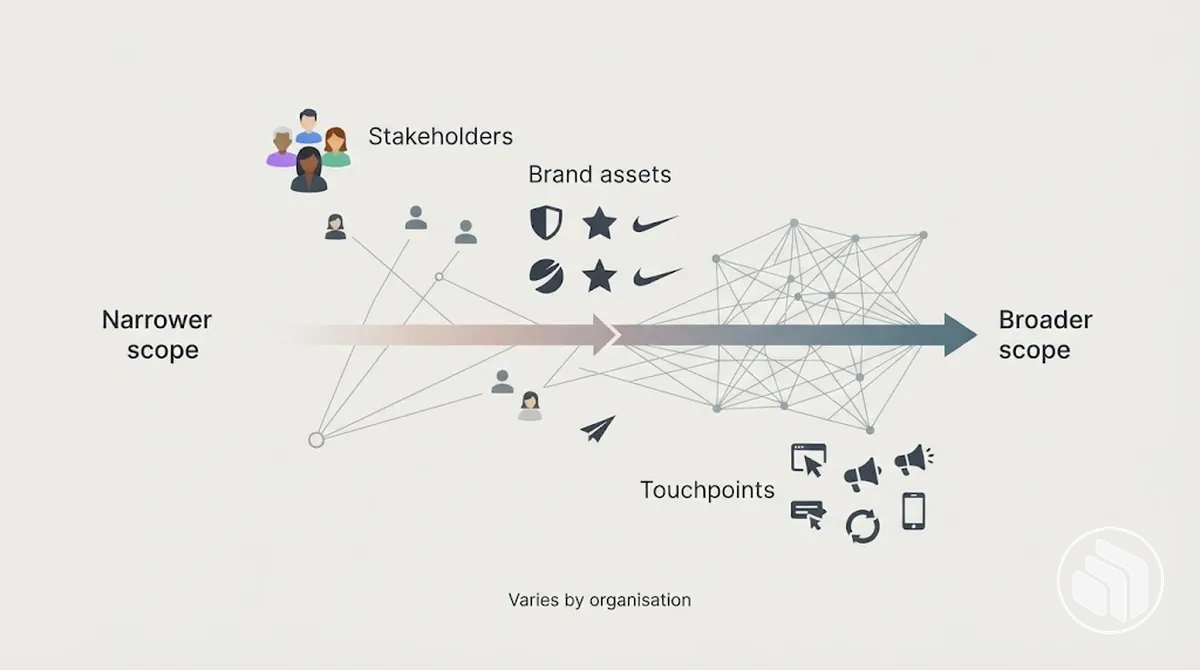
The diagram represents relative coordination burden rather than a fixed benchmark: broader scope can involve more stakeholder alignment, asset changes, and touchpoint coordination, while the actual burden varies by organisation.
| Factor | Refresh tendency | Rebrand tendency | Why it varies |
|---|---|---|---|
| Time | Tends to involve fewer strategic decisions when the existing direction remains relevant. | May require more time when strategic questions and identity decisions both need resolution. | Timing varies with decision scope, approvals, asset volume, and rollout dependencies. |
| Organisational effort/resources | May concentrate resources on selected identity and messaging changes. | Can increase resource demand when broader strategic and identity work involves more teams or assets. | Resource demand varies with organisational scale, stakeholder involvement, and the breadth of asset changes. |
| Coordination | May involve a smaller group of stakeholders when fewer parts of the brand are affected. | Tends to require broader stakeholder alignment when strategic and identity decisions cross functions. | Coordination varies with stakeholder count, approval requirements, and organisational structure. |
| Rollout complexity | Can be more contained when changes affect a limited set of assets and touchpoints. | May involve more rollout dependencies when changes extend across many assets, channels, or organisational touchpoints. | Implementation complexity varies with asset volume, touchpoint count, sequencing dependencies, and rollout choices. |
| Recognition/change risk | Can retain more familiar identity cues when the scope is concentrated on refinement. | May create greater exposure to recognition loss or inconsistency when more familiar cues and touchpoints change. | Change risk varies with what changes, how consistently it is implemented, and how much recognisable continuity remains. |
Organisational scale and touchpoint count can change the operational pattern even when the strategic choice between scopes is clear.
Stakeholder alignment, asset changes, and rollout dependencies tend to increase coordination as more teams, channels, and identity applications are affected.
For example, an organisation with many teams, channels, and brand assets may face greater implementation complexity because more stakeholders and touchpoints require alignment, while an organisation with fewer dependencies may implement a similar scope with less coordination.
Criteria for Choosing the Right Level of Brand Change
The decision criteria for brand change should be evaluated as a pattern across several conditions rather than treating one symptom as a guaranteed answer.
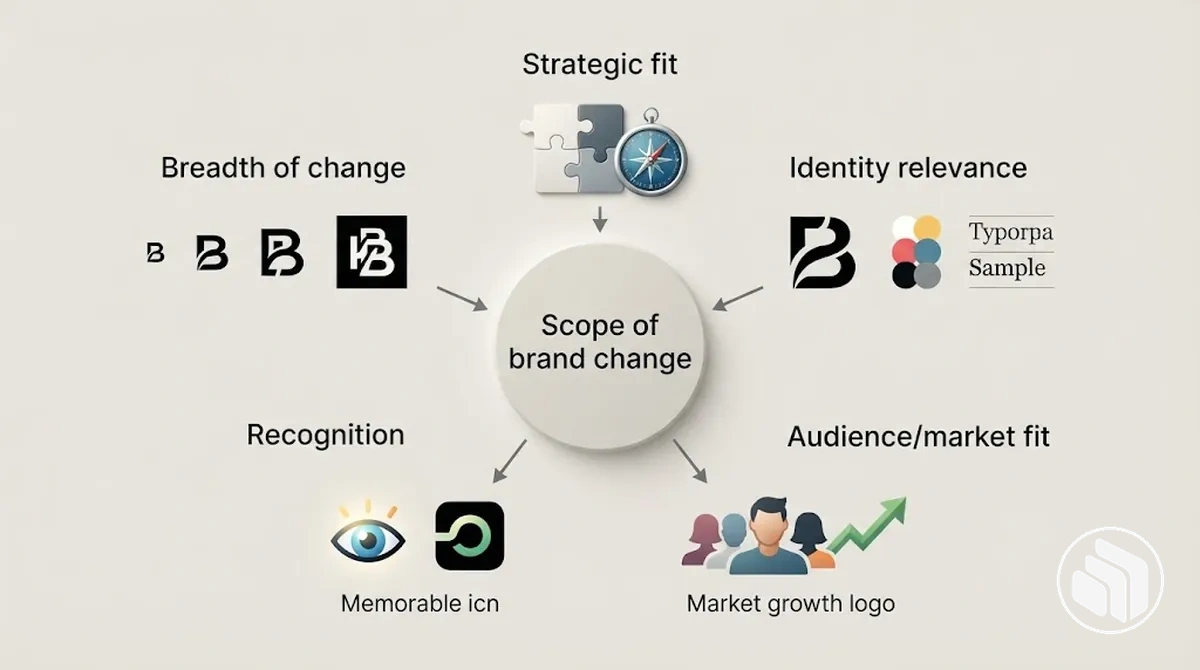
Strategic fit, the relevance of the current identity, audience or market mismatch, recognition, and the required scope of change can each support a refresh-level or rebrand-level implication, but their combined evidence is more informative than any single factor.
The diagram organises these evidence categories around the scope of brand change, showing that several criteria inform the decision without assigning weights or producing an automatic verdict.
Expression-level misfit may support a refresh when the underlying strategy remains relevant, whereas foundational misfit in positioning, proposition, audience, or market direction can point toward a rebrand; the table makes each criterion, observed condition, and implication explicit.
| Criterion | Condition to examine | Refresh-leaning implication | Rebrand-leaning implication |
|---|---|---|---|
| Strategic fit | Whether the existing positioning and proposition still represent the business and its intended direction. | Continued strategic fit may support updating how the established direction is expressed. | A material mismatch between the existing strategy and the business may point toward reconsidering the strategic foundation. |
| Current identity relevance | Whether the current identity still expresses the intended brand character and strategic direction effectively. | An identity that is recognisable and strategically relevant but visually or verbally dated may support a refresh. | An identity that no longer represents the required strategic direction may support broader reconsideration. |
| Audience/market fit | Whether the current positioning and identity remain appropriate for the intended audience and market context. | Continued audience and market fit with an expression-level mismatch may support a refresh. | A substantial audience mismatch or market mismatch that affects positioning or proposition may point toward a rebrand. |
| Recognition value | Whether existing recognition and distinctive identity cues remain relevant and useful to continuity. | Meaningful recognition attached to strategically relevant identity cues may weigh in favour of retaining and refining them. | Recognition alone may not justify continuity when the recognised identity represents a strategic direction that no longer fits. |
| Breadth of required change | Whether the required changes are concentrated in expression or extend into positioning, proposition, audience, market assumptions, or other strategic foundations. | Changes concentrated mainly in identity expression may support refresh-level scope. | Changes spanning strategic foundations and identity expression may point toward rebrand-level scope. |
Mixed evidence should be interpreted by examining how the conditions relate rather than forcing them into a rigid result.
For example, strong recognition may support continuity while a serious audience mismatch points toward deeper strategic change, so neither signal should determine the scope alone.
When the current brand state is unclear or its signals conflict, audit your brand identity before committing to scope so strategic fit, identity relevance, recognition, and audience or market fit can be assessed together.
The resulting decision remains conditional on the overall pattern of strategic fit, identity relevance, market or audience fit, recognition, and required scope.
How Much of the Existing Brand Still Fits
Evaluate which attributes of the existing brand still fit the current business and remain relevant to customers before deciding how much change is needed.
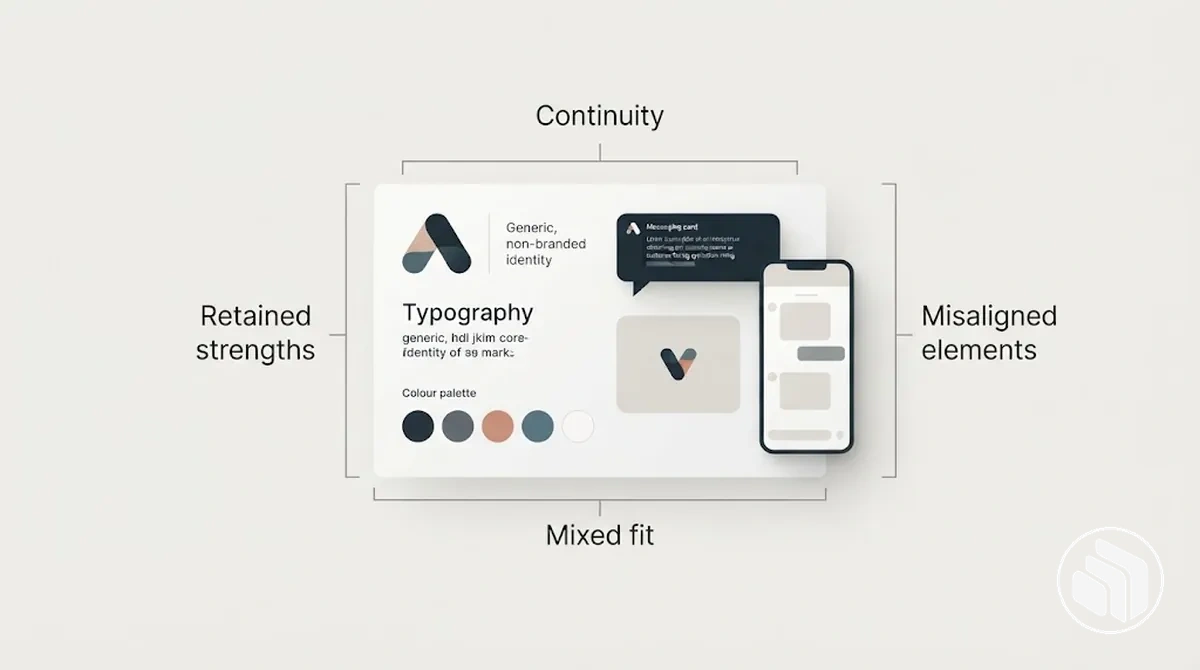
Strategic fit and continuity depend on present relevance rather than age alone, so an older identity can still contain retained strengths while other elements are misaligned.
The image demonstrates this mixed state by showing recognisable brand elements that remain aligned alongside elements that no longer fit.
- Strategic fit: examine whether the existing brand still represents the current positioning and proposition; continued fit may support continuity, while foundational misalignment may support broader change.
- Recognisable assets: identify identity cues that customers can still recognise and that remain relevant to the business; retained value may support keeping those assets even when surrounding expression changes.
- Messaging: assess whether the current messaging still expresses the proposition accurately; expression that feels dated can be refined, while messaging built around a materially changed proposition points toward deeper misalignment.
- Audience relevance: examine whether the existing identity and messaging remain relevant to the customers the business now serves; partial mismatch may support targeted change, while broader mismatch can increase the required scope.
- Overall identity coherence: consider whether retained strengths and misaligned elements can still function as one coherent identity; widespread misalignment across strategic and expressive elements may support a broader change than isolated issues.
Retained strengths and misalignment can coexist within the same brand, and no single element produces an automatic verdict.
A brand with strong recognition and strategic fit but dated visual expression may support a refresh that maintains recognisable assets and continuity, while a brand whose underlying proposition has materially changed may support a rebrand because the existing messaging and identity no longer represent the business accurately.
Whether the Problem Is Mainly Visual or Strategic
Determine whether the visible problem is mainly an expression-level problem in the visual identity or a signal of a deeper strategic problem.
The key distinction is strategic fit: visible symptoms are indicative rather than conclusive, so the underlying positioning, audience, market role, and offer still need to fit the business before the problem can be interpreted as mainly visual.
Key distinction
Expression-level problem
- Typical signal
- The visual identity looks dated or inconsistent.
- Condition
- The positioning, audience, market role, and offer still remain relevant.
- Scope implication
- Refinement can remain at refresh level because the strategic foundation still fits.
Strategic problem
- Typical signal
- The business has changed its positioning, audience, market role, or offer.
- Condition
- The current brand no longer communicates what the business represents.
- Scope implication
- The mismatch can require rebrand-level reconsideration beyond visual expression.
The same visible symptom can imply a different scope under different strategic conditions. The differentiating criterion is whether the underlying strategy still fits, not the visual signal by itself.
A boundary case occurs when the visual identity appears dated while the business has also changed its offer or audience, but it is not yet clear whether the existing positioning remains relevant.
In that situation, strategic uncertainty requires checking before classifying the scope, because the visible problem alone does not establish whether the underlying issue is mainly expression-level or strategic.
How Much Brand Recognition Should Be Preserved
Brand recognition should be preserved when it remains positive, distinctive, relevant, and aligned with the current business.
When recognition has preservation value
- Preserve
- Familiar cues still help customers recognise the brand and carry positive, accurate associations that remain relevant.
- Reconsider
- Recognition is tied to harmful, misleading, or no-longer-relevant associations that the business should not continue to reinforce.
- Do not confuse
- Recognisability with strategic fit. A distinctive asset can be familiar yet still be unsuitable for the business’s current positioning or direction.
The preservation decision therefore depends on whether recognisable cues still carry useful relevance or reinforce associations the business no longer wants to represent.
A refresh may preserve distinctive assets and other recognisable cues when existing brand recognition still has positive value, while a rebrand may intentionally break from associations that have become harmful, misleading, or strategically unsuitable.
Carrying retained cues consistently across touchpoints belongs to the adjacent topic of brand identity consistency; the decision here is whether those cues merit preservation in the first place.
Signs That Point Toward a Refresh or a Rebrand
Warning signs indicate where to investigate, but they do not independently determine whether a brand needs a refresh or a rebrand.
Each signal requires interpretation in the context of strategic fit, with the central question being whether the underlying brand foundation still fits the business.
Expression-level warning signs, such as a dated or inconsistent visual identity, may point toward refinement when the underlying positioning, audience relationship, and market fit remain relevant.
Signals connected to changes in the business, positioning, audience, or market fit may point toward a deeper issue when the existing brand foundation no longer represents the current direction.
The differentiating criterion is therefore not the surface symptom itself but whether the strategy beneath the expression still fits.
This keeps the interpretation conditional rather than treating any individual signal as a verdict.
For example, a brand that looks outdated may have a dated expression while its positioning and audience relationship remain relevant, which may point toward a refresh.
The same outdated appearance can have a different implication when the business has materially changed its positioning or market role, because the visible symptom then sits alongside a brand foundation that may no longer fit.
Refresh Signals: The Brand Still Works but the Identity Has Aged
Refresh-level signals can appear when the business and positioning remain aligned but the identity expression has aged, drifted, or become less distinctive.
In this situation, strategic fit and continuity still have value, while the observable issues are concentrated in how the brand is expressed.
- Outdated visual cues: A dated logo treatment, typography, colour use, or other visual cues may indicate that the identity expression needs updating when the underlying brand direction remains relevant.
- Inconsistent presentation: Visual drift across brand materials can suggest an expression-level issue when the business, positioning, and core identity remain aligned.
- Messaging drift: Minor differences in how an otherwise relevant proposition is expressed may point toward refinement when the underlying positioning has not materially changed.
- Reduced distinctiveness: An identity that has become less distinctive in its expression may support preserving recognisable cues while refining how they are presented.
- Mismatch with current quality: An identity that no longer reflects the current quality of the business may indicate a refresh-level issue when the business itself and its positioning still fit.
No single dated or inconsistent element is sufficient to classify the situation as a refresh case; the interpretation depends on the stable strategic foundation and the continuing value of continuity.
If the apparent visual problem accompanies a deeper change in positioning, audience fit, or what the business represents, the issue should be treated as a possible strategic mismatch rather than assumed to be an expression-level refresh signal.
Rebrand Signals: The Brand No Longer Fits the Business, Market, or Audience
Rebrand-level signals can appear when the existing brand foundation no longer represents what the business has become, how it is positioned, or whom it serves.
A material business change, market shift, or audience mismatch can point toward a rebrand when the resulting strategic mismatch extends beyond identity expression.
- Business change — merger or organisational change: A merger may justify reconsidering the brand foundation when the combined organisation has a materially different identity, offer, or purpose that the existing brand no longer represents.
- Business change — substantially changed offer: An offer that has materially changed what the business provides or how it creates relevance for customers can point toward deeper change when the existing positioning no longer fits.
- Market/positioning change: A market shift or deliberate change in competitive positioning may exceed refresh-level scope when the current brand expresses a market role the business no longer occupies.
- Audience change: A persistent audience mismatch can support rebrand-level consideration when the brand was built around assumptions about whom it serves that are no longer relevant to the intended audience.
- Audience/association change: Existing associations can become a strategic constraint when they materially obstruct the identity or positioning the organisation now needs to represent, which may justify reconsidering the brand foundation.
Ordinary growth or expansion can remain within the existing brand when the offer, positioning, audience relationship, and brand foundation still fit the business.
By contrast, expansion that materially changes the offer, intended audience, or positioning can create a foundational mismatch significant enough to justify rebrand-level consideration.
Examples of Refresh-Level and Rebrand-Level Changes
Refresh-level and rebrand-level changes are classified by the depth of change and what remains stable, not by how dramatic the redesign looks.
The examples compare each starting condition, the change made, what remained stable, and whether the strategic foundation is preserved or changes materially.
| Scenario | Starting condition | What changed | What remained stable | Why it fits |
|---|---|---|---|---|
| Hypothetical visual modernisation | The positioning, audience, and proposition still fit, but the visual expression appears dated. | The logo treatment, typography, colour use, and imagery are refined. | The strategic foundation, positioning, audience, and core proposition remain stable. | Refresh-level: the change updates visual expression while preserving the underlying strategy. |
| Hypothetical messaging refinement | The offer and positioning remain relevant, but messaging has drifted and no longer expresses the proposition consistently. | Core messages and verbal expression are clarified around the existing proposition. | The audience, positioning, proposition, and strategic foundation remain stable. | Refresh-level: the change refines how an intact strategy is expressed rather than replacing the strategy. |
| Hypothetical repositioning | The existing visual identity may still be recognisable, but the business now competes through a materially different proposition and market position. | The positioning, proposition, messaging, and resulting identity expression are reconsidered. | Some recognisable identity elements may remain where they still support the changed direction. | Rebrand-level: the classification follows the material change in positioning and proposition, even if some visual elements remain stable. |
| Hypothetical audience shift | The existing identity was built around an audience relationship that no longer represents whom the business intends to serve. | The audience assumptions and positioning change materially, with the identity adjusted to represent the new strategic direction. | Elements such as the existing name or selected distinctive assets may remain if they still fit the changed foundation. | Rebrand-level: the audience and strategic foundation have changed, so the scope extends beyond expression-level refinement. |
These scenarios illustrate the established classification logic rather than create new decision rules.
Similar-looking visual changes can fall into different categories because the decisive distinction is whether positioning, audience, proposition, and the broader strategic foundation remain stable or change materially.