
How to Refresh a Brand Identity Without Starting Over
A brand identity refresh should modernise only the parts of an established identity that have a defined problem while preserving recognition cues and brand meaning that still work. Decide what to preserve, refine, or replace, coordinate the affected visual and verbal elements, then validate the complete system on representative touchpoints before wider rollout.
Brand refresh control model
Use the sequence to keep change proportional to the problem and prevent a selective refresh from turning into an unnecessary rebuild.
- Set the change boundaryDiagnose the specific problem. Preserve assets that still fit and carry useful recognition; refine useful cues with dated or inconsistent execution; replace only when preserving or refining would not solve the defined problem.
- Coordinate the identity systemUpdate only the visual and verbal elements that are in scope, then check how logo, color, typography, imagery, supporting graphics, messaging, and tone work together.
- Validate and roll outTest the combined system on representative touchpoints, correct material recognition or coherence problems, approve the refined system, stage deployment, and verify legacy replacement.
- Refine from real-world useAct on repeated, contextual evidence after launch: trace the issue to an adjustable variable, make the smallest relevant change, and retest against comparable applications.
Decision rule: prefer the smallest justified change that resolves the identified problem while preserving useful recognition and system coherence.
Table of Contents
Plan the Refresh Around What Must Stay and What Must Change
A brand refresh plan defines the refresh objective, the evidence used to assess the current brand identity, and the scope of acceptable change before design work starts.
The plan should identify the business or communication problem being addressed, the brand equity worth protecting, and the success criteria that will later verify whether the intended change has been implemented.
These boundaries turn a broad intention to update the identity into decisions about what to preserve, refine, or replace.
The evidence base should distinguish assets that are working from those that feel dated or no longer fit the intended positioning.
Recognition matters because a familiar or distinctive cue can retain value even when its treatment needs refinement, while the refresh objective determines whether that cue still supports the current identity.
Practical constraints also shape scope: rollout across existing touchpoints may limit how much can change at once or require retained assets to remain compatible during transition.
For example, an outdated treatment with strong recognition may be refined rather than replaced, while an element that no longer supports the intended positioning may justify a larger change.
The planning criteria organize the evidence used to set the refresh boundary and determine where change is justified.
Each decision should connect the asset's current role and recognition value to the refresh objective and practical constraints.
Scope decisions
- Preserve: retain an asset when it still supports the current brand identity, carries useful recognition or brand equity, and does not conflict with the refresh objective.
- Refine: adjust an asset when its recognition value remains useful but its current expression is dated, inconsistent, or insufficiently aligned with the communication need.
- Replace: consider replacement when evidence indicates that retaining or refining the asset would not address the defined problem.
- Constrain: set the scope around practical rollout requirements so planned changes remain workable alongside necessary retained assets and touchpoints.
The diagram organizes retained brand equity and targeted changes within the refresh scope, showing how existing assets can be preserved, refined, or replaced according to their current fit and recognition value.

These preserve, refine, and replace decisions establish the change boundary and provide a scope that can be checked against the refresh objective, constraints, and success criteria before execution.
If the required change extends beyond selective identity refinement and calls for broader strategic change, the brand refresh versus rebrand decision becomes relevant rather than stretching the refresh scope beyond its intended role.
Preserve Brand Assets That Still Carry Recognition
Recognizable brand assets deserve consideration for preservation when they still contribute recognition, distinctiveness, and useful brand equity while maintaining strategic fit with the current identity.
Familiarity can signal accumulated recognition value, but it does not make an asset permanently suitable.
The retention decision should therefore assess what the asset currently communicates and whether its distinctive cues still support the intended brand meaning.
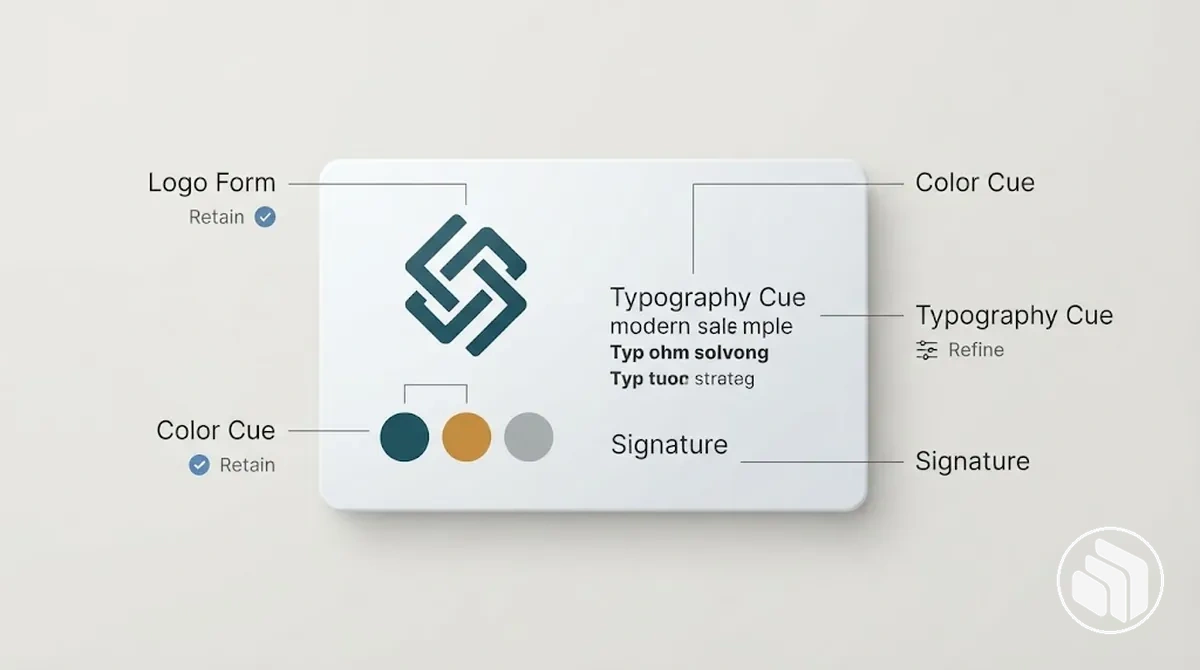
An annotated example can make these recognition cues visible before alteration by showing how a familiar logo form, color association, typography cue, or verbal or visual signature contributes to continuity.
These cues can then be evaluated as candidates to retain or carefully refine rather than treated as automatically fixed.
Recognition checks
- Recognition value: consider retaining an established asset when familiarity still helps audiences identify the brand; if recognition remains useful but the execution is dated, refinement may preserve the recognition cue while addressing its current state.
- Distinctiveness: preserve or carefully refine a cue when it still differentiates the identity in a relevant way; replacement becomes more reasonable when the cue no longer contributes meaningful distinction.
- Strategic fit: retain an asset when its established meaning still supports the intended positioning; refine or replace it when its current expression conflicts with what the brand needs to communicate.
- Consistency of use: consider continuity when an asset is used coherently across relevant touchpoints, while inconsistent application may indicate a need to refine how the asset is expressed rather than discard the underlying cue.
For example, a recognizable logo cue may warrant retention when its familiar form still signals the brand, even if surrounding styling is refined; by contrast, a familiar verbal signature may warrant replacement when its meaning no longer fits the intended positioning.
Each decision should connect the asset's current state and recognition contribution to a retain, refine, or replace implication rather than treating familiarity as proof of permanent strategic value.
Age alone is not sufficient evidence that an established asset should be replaced.
Define the Specific Problems the Refresh Must Solve
A refresh problem should be defined as an observable condition that the brand identity needs to address, not as a vague goal to make the brand look better.
An outdated expression, inconsistency across touchpoints, weak coherence, reduced distinctiveness, or a mismatch with intended positioning can signal a problem state, but each observation needs evidence before its cause or refresh scope is assumed.
The useful question is which affected attribute the evidence reveals and how narrowly the refresh can respond to that condition.
Evidence should come from observable touchpoints or documented audience response where available: for example, the same identity appearing with conflicting typography, colours, or visual treatments across a website and other materials can reveal inconsistent application and weakened coherence.
These observations should be separated from assumed causes because the visible symptom alone does not establish why it occurred.
A brand identity audit can provide the broader diagnostic process when the evidence needs to be examined systematically before the refresh scope is fixed.
The problem-to-impact split below keeps each observed condition connected to an affected attribute and a bounded scope implication.
Problem → attribute → scope implication
- Outdated appearance: when current styling no longer fits the intended positioning, the affected attribute is the identity's current expression, suggesting that the refresh scope may focus on selected visual or verbal treatments rather than assuming the underlying identity must change.
- Inconsistent application: when the same identity is presented differently across touchpoints, the affected attributes are consistency and coherence, suggesting a scope focused on aligning application where the inconsistency is observed.
- Weak coherence: when visual or verbal elements do not work together as a recognizable system, the affected attribute is coherence, indicating that the refresh scope may need to address how those elements relate rather than treating each one as an isolated problem.
- Reduced distinctiveness: when identity cues no longer create a clear enough distinction in the relevant context, distinctiveness is the affected attribute, suggesting that selected cues may need reconsideration while other recognizable elements remain outside the change scope.
- Positioning mismatch: when the current expression communicates a meaning that no longer aligns with intended positioning, the affected attribute is strategic fit, suggesting a refresh scope focused on the expressions responsible for that mismatch.
The annotated example labels observable problem states across hypothetical touchpoints, separating what is visible from possible causes that still require diagnosis.
Conflicting treatments across hypothetical website and print touchpoints, for example, can provide evidence of inconsistency, but they do not by themselves establish whether the cause is unclear guidance, fragmented execution, or another condition.
An observed symptom should define what needs investigation and which refresh objective may be relevant rather than serve as confirmation of its cause.

Refresh the Identity System in a Controlled Sequence
A brand refresh sequence works best when the scope is confirmed before recognition cues or supporting identity elements are changed.
The approved objective, evidence, and constraints define which parts of the identity are in scope and which should remain stable.
High-salience recognition cues can then be protected while selected changes to the visual identity or messaging are coordinated within that boundary.
Visual and verbal elements operate as parts of the same identity system, so isolated changes can create inconsistency when their dependencies are ignored.
Selected changes involving the logo, color, typography, imagery, or messaging should therefore be coordinated so the combined expression remains coherent without implying that every component requires an update.
The sequence below organizes scope confirmation, recognition protection, coordinated updates, testing, rollout, and verification so conflicting changes can be identified before implementation.
The visual reinforces the order and dependencies among these stages without adding component-level instructions or extra stages.

Controlled sequence
- Confirm scope: confirm the refresh objective, supporting evidence, and constraints so the work remains limited to identity elements with a defined reason to change.
- Protect recognition cues: protect recognition cues that remain valuable so selected updates do not unnecessarily disrupt continuity.
- Coordinate selected updates: coordinate the visual identity and messaging elements that are in scope so the changes work together rather than create contradictions across the system.
- Test the combined system: test the selected changes together across relevant applications to identify coherence or consistency issues before rollout.
- Prepare rollout: prepare the approved changes for staged or coordinated rollout across the touchpoints included in the refresh scope.
- Verify adoption: verify that the approved changes are applied consistently during rollout while components that do not require change remain stable.
Refine the Logo Without Losing Recognition Cues
Logo refinement should preserve each recognition cue that still contributes to familiarity unless evidence supports changing it.
The logo's silhouette, proportions, distinctive form, wordmark characteristics, or established color relationships may carry more recognition value than minor execution details, so their current contribution should guide how far refinement goes.
Simplification, spacing adjustments, or detail reduction can modernize execution when they retain useful recognition-bearing features.
In a hypothetical before-and-after example, the silhouette and wordmark character remain recognizable while excess detail and spacing are refined, making continuity visible without implying that the same changes suit every logo.

Retain: keep a silhouette, distinctive form, proportions, wordmark characteristic, or color relationship stable when it remains a meaningful recognition cue.
Refine: adjust spacing, detail, proportions, or simplification when the feature still contributes recognition but its current execution needs a restrained update.
Change: allow a greater degree of change when evidence indicates that the feature contributes little useful recognition or no longer fits the intended identity, while other valuable cues provide continuity.
Test the refined logo as a combined mark rather than judging each adjustment in isolation, because several individually restrained changes can alter the overall familiar form.
The continuity check is whether the permitted changes address the identified condition while recognition-bearing features that still matter remain visibly connected to the established logo.
Modernize Color and Typography as a Coordinated System
The color palette and typography should be refreshed as a coordinated system because together they shape visual hierarchy, tone, legibility, and recognition across brand touchpoints.
Color relationships establish primary and supporting roles, while font roles distinguish headings, body text, and other levels of information.
Refinements should therefore address how these elements interact rather than treating a new color or type choice as an isolated aesthetic update.
Familiar cues can remain stable where they still contribute recognition while weaker relationships are refined for greater coherence.
The separate criteria below evaluate the current state of each system before the proposed refinements converge into one visual hierarchy.
For color, recognition depends on which primary or supporting relationships remain familiar, palette roles determine how those colors function, and contrast should be evaluated in the touchpoints where foreground and background combinations actually appear.
For typography, retained type characteristics can support continuity, while font roles and hierarchy should distinguish information levels and legibility should be evaluated at the sizes and applications where the type is used.
Any refinement should therefore address an identified weakness in the current state while keeping useful recognition cues explicit.
The two groups organize those separate criteria so their decisions can converge into one coherent visual hierarchy.
Coordinate the two systems
Color system
- Color recognition: retain a primary color or established relationship when it remains a useful recognition cue; refine supporting colors when their current state weakens the intended hierarchy or tone.
- Palette roles: keep primary and supporting color roles explicit so each refinement clarifies their functions rather than introducing unrelated colors without a defined role.
- Contrast and touchpoint fit: evaluate foreground and background relationships in the applications where they will appear, and adjust them when the current pairing makes information harder to distinguish; visual inspection alone does not establish universal accessibility.
Typography system
- Typographic recognition: retain recognizable type characteristics when they still support continuity, while refining details that no longer fit the intended expression.
- Font roles and hierarchy: keep heading, body, and supporting font roles distinct enough to communicate information levels consistently rather than changing typefaces without a defined hierarchical purpose.
- Legibility and system fit: evaluate typography at the sizes and touchpoints where it is used, then refine spacing, weight, or role relationships when the current treatment reduces clarity or conflicts with the color hierarchy.
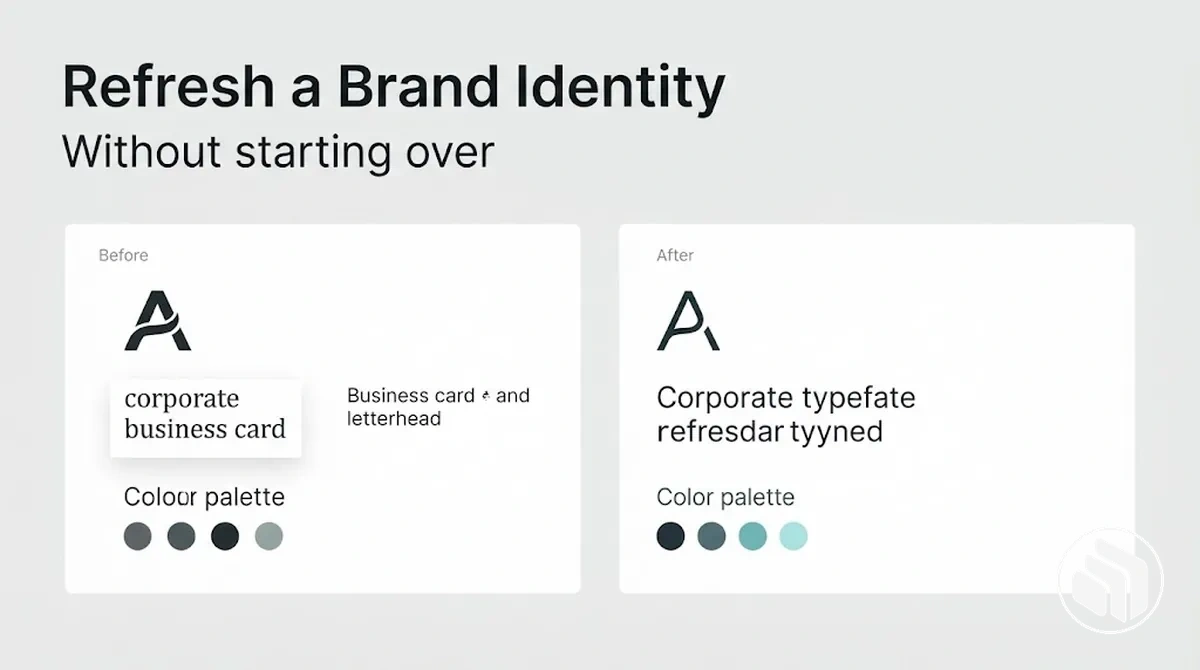
A coordinated before-and-after comparison can show the same hypothetical brand retaining a familiar primary color while refining supporting palette roles and typographic hierarchy, making the interaction between color, type, hierarchy, and continuity visible.
These changes should respond to the existing identity and its identified weaknesses rather than treating current design trends as sufficient reason for substitution.

Align Imagery and Supporting Visual Elements With the New Direction
Imagery and supporting visuals should align with the refreshed identity through compatible rules for subject matter, composition, treatment, and tone rather than through identical styling in every application.
Photography, illustration, iconography, and other graphic elements can vary by function, but their visual style should remain consistent with the recognition cues retained elsewhere in the identity.
The practical aim is to identify where a current visual category feels dated or inconsistent, define a more suitable rule for that category, and coordinate the result with the refreshed direction.
The categories below separate those decisions without turning them into independent visual strategies.
Visual categories to coordinate
- Photography: when subject matter, composition, or treatment varies in ways that weaken visual continuity, define a clearer image style for those attributes so photography supports the intended tone and remains compatible with retained recognition cues.
- Illustration: when line work, shape language, detail, or treatment reflects an older direction or conflicts across applications, refine those shared characteristics so illustration reinforces the same visual character without needing to imitate photography.
- Iconography: when icons use conflicting forms, weights, or levels of detail, establish a consistent treatment for the relevant set so iconography coordinates with the broader visual style rather than introducing a separate graphic language.
- Supporting graphic elements: when patterns, shapes, or other graphic elements feel disconnected from the refreshed identity, refine their composition and treatment so they support the same tone and visual continuity without competing with primary identity cues.
For example, a hypothetical brand could retain familiar subject matter and a recognizable compositional cue in its photography while shifting from inconsistent image treatments to a more coherent treatment, then bring illustration and iconography into alignment through compatible levels of detail and graphic character.
The updated rules can make the visual expression feel more current when they address the identified dated or inconsistent state while maintaining recognizable connections to the established identity.
Suitable treatment depends on the brand and touchpoint, so consistency means coordinating visual relationships rather than making every category look identical.
Supporting visuals should reinforce, not redefine, the refreshed identity.
Align Messaging and Tone With the Refreshed Identity
Messaging and tone of voice should evolve only enough to support the refreshed identity and current communication needs while maintaining retained brand meaning.
The verbal identity can be refined when current wording feels dated, unclear, inconsistent, or no longer matches the intended tone, but the degree of change should remain proportional to the refresh scope.
Voice characteristics, terminology, and each key message should therefore be evaluated for clarity and consistency before wording is changed.
A limited refinement updates verbal expression without assuming that the underlying positioning or mission also needs to change.
Messaging should keep the meaning of each key message stable when that meaning remains relevant, while refining wording that obscures the intended point or introduces unnecessary complexity.
Tone of voice should maintain recognizable voice characteristics where they still fit, with adjustments focused on inconsistent formality, dated phrasing, or other identified differences between the current wording and the intended verbal identity.
Terminology should remain consistent for the same concepts across relevant touchpoints unless a specific term has become inaccurate or unclear, and any new wording should still align with retained brand meaning.
Example: limited verbal refinement
Before
“We endeavour to provide innovative solutions for the evolving requirements of our customers”
After
“We create practical solutions for changing customer needs”
Validate and Roll Out the Refreshed Brand Identity
Validation and rollout should test the refreshed brand identity as a complete system before legacy execution is replaced broadly.
Validation checks whether the selected changes work together across representative touchpoints, while rollout controls how approved assets replace older versions.
Internal approval can authorize progression, but it does not by itself demonstrate that the refreshed system works consistently in practical applications.
Broad deployment should therefore follow representative testing and any necessary adjustment.
A pilot can apply the refreshed identity to a limited set of representative touchpoints, such as a website page, presentation, and printed item, so system-level issues can be observed before wider deployment.
Unlike a broad rollout, this limited application makes it easier to identify conflicts in execution while the scope for correction is still contained.
Approval evidence should include the reviewed pilot applications and resolution of material issues found during the test rather than relying on stakeholder preference alone.
The sequence below organizes validation and deployment so each stage has a clear condition for progression.
Validation gates
- Test: apply the refreshed system to representative touchpoints and review the combined execution for material problems that would affect broader use; progress when the pilot provides sufficient practical evidence to identify issues requiring correction.
- Adjust: correct issues revealed by the pilot without reopening elements outside the approved refresh scope; progress when identified material issues have been addressed and the revised applications can be reviewed as a coherent system.
- Approve: approve the refined system for rollout when the representative applications support the intended refresh direction and no unresolved issue identified during validation requires further adjustment; approval authorizes deployment rather than proving future acceptance.
- Stage rollout: deploy approved assets in a controlled sequence and coordinate asset replacement so legacy assets are replaced on the touchpoints included in each rollout stage; progress when the current approved assets are in place before extending deployment.
- Verify adoption: check deployed touchpoints to confirm that approved assets are being used and that unintended legacy execution has not persisted where replacement was required.
Post-launch observation should continue after staged rollout because practical use can reveal implementation issues that were not visible in the pilot.
Any issue found at this stage should be traced to the affected execution and refined within the approved scope rather than automatically reopening the entire refresh.
Adoption verification confirms whether the approved identity has replaced legacy execution where intended, while ongoing brand identity consistency becomes the separate maintenance concern once rollout is complete.
This keeps validation and deployment focused on transition rather than expanding them into ongoing cross-channel governance.
Test the Refreshed Identity for Recognition and Coherence
Refreshed identity validation should test whether the identity remains recognizable and internally coherent across representative applications, not whether one person simply prefers the new execution.
Recognition should remain connected to retained cues such as familiar logo characteristics, while coherence depends on color, typography, imagery, and messaging continuing to function as parts of the same identity system.
Testing several relevant applications can reveal whether those relationships remain stable when the refreshed elements appear in different contexts.
One touchpoint or one stakeholder's reaction is therefore insufficient evidence of overall recognition or coherence.
Feedback should be interpreted by looking for patterns across representative users or contexts rather than treating every reaction as equivalent evidence.
An initial novelty response may reflect unfamiliarity with a changed execution, so it should not by itself be interpreted as lost recognition or improved clarity.
Repeated difficulty identifying retained cues across applications can warrant adjustment, while repeated observations that the system is easier to interpret can support a conclusion of improved clarity without establishing a universal result.
The checklist organizes recognition cues and system-coherence checks across representative applications so observed states can be tied to a specific validation implication.
Recognition and coherence checklist
- Recognition — retained cues: verify that the retained identity cues intended to provide continuity are still identifiable across representative applications; repeated loss of those cues indicates that the refresh may require adjustment.
- Recognition — logo recognizability: verify that the refreshed logo retains the familiar characteristics selected for continuity; difficulty recognizing those characteristics across contexts suggests that the degree of change should be reviewed.
- Coherence — color and typography: verify that color relationships and typography work together consistently across applications; conflicting roles or hierarchy indicate a system-coherence issue rather than a preference difference.
- Coherence — imagery: verify that imagery supports the intended visual direction and remains compatible with the logo, color, and typography; recurring visual conflict suggests that the imagery treatment needs refinement.
- Coherence — messaging: verify that messaging and tone align with the refreshed visual expression while retaining the intended brand meaning; repeated mismatch between verbal and visual expression warrants adjustment.
- Coherence — whole system: verify that the logo, color, typography, imagery, and messaging appear to belong to one identity system across representative applications; recurring disconnects between elements indicate that further coordination is needed.
Validation supports progression when recognition and coherence remain evident across representative applications and feedback does not reveal recurring material conflicts; isolated novelty or preference reactions should be interpreted in context rather than treated as definitive evidence.
Retire Legacy Assets as the Refresh Rolls Out
Legacy assets should be inventoried and retired according to their current use, replacement status, and the risk of leaving outdated execution active during rollout.
Each legacy asset should be tied to its current use location so the replacement can be confirmed before access is restricted or the asset is retired.
Assets that remain easy to reuse despite having an approved replacement carry a greater risk of unintended old-and-new execution than assets retained temporarily for a defined operational reason.
Retirement should therefore follow verified replacement rather than an indiscriminate purge of old material.
A temporary mixed state can be acceptable when a physical, distributed, or dependent asset cannot be replaced at the same time as its digital counterpart and its transition period is explicitly controlled.
For example, an updated presentation template may replace an old file immediately while already distributed printed collateral remains in use until its planned replacement point.
The overlap becomes unmanaged inconsistency when obsolete files remain accessible for new work, their replacement status is unclear, or no retirement action has been assigned.
The sequence below moves each legacy asset from identified use through prioritized replacement to verified retirement while keeping temporary exceptions explicit.
Legacy asset retirement path
- Inventory: record each relevant legacy asset and its current use location so outdated templates, website files, social graphics, presentation materials, or printed collateral are not left active simply because their location was overlooked.
- Prioritize: assess replacement status and the risk of continued use, giving earlier attention to legacy assets that are still actively used, widely accessible, or likely to create conflicting identity execution during rollout.
- Replace: put the approved refreshed asset into its intended use location and confirm that it can perform the required role before the corresponding legacy asset is retired.
- Restrict or retire: apply access control to obsolete files that could otherwise be reused, or retire them when they no longer serve a valid transition need; where temporary retention is necessary, keep the reason and replacement status explicit.
- Verify: check the affected use locations after replacement to confirm that the refreshed assets are active, obsolete versions are no longer available for unintended new use, and any remaining legacy materials are limited to a defined transition period.
Some physical or already distributed legacy assets may require a practical transition period because immediate replacement is not feasible.
In those cases, the temporary overlap should have a defined retirement condition and remain distinguishable from unmanaged use of obsolete assets.
Common Mistakes That Weaken a Brand Refresh
Brand refresh mistakes weaken an established identity when changes reduce continuity, distinctiveness, or system coherence without sufficient rationale.
A mistake can put useful brand equity at risk when a recognition cue is altered without a clear reason or when a change follows trends without considering whether the result still fits the established identity.
The consequence depends on what changes, how strongly that element supports recognition, and how consistently the refreshed system is executed.
A refresh therefore requires correction when a change creates an identifiable conflict between intended modernization and the continuity the identity still needs to preserve.
Correction pattern
- Identify the mistakeName the specific change or execution problem.
- Trace the consequenceDetermine whether continuity, distinctiveness, recognition, or coherence has been weakened.
- Check the affected cueIdentify the recognition cue or system relationship involved.
- Apply a bounded correctionCorrect the affected relationship without reopening unrelated identity decisions.
Where the issue affects consistency across multiple identity elements, the correction should restore system coherence rather than treat the visible symptom as an isolated problem.
Where the issue concerns imitation or trends, the relevant question is whether the change weakens distinctiveness or fit rather than whether the trend itself is inherently unsuitable.
This pattern keeps corrective decisions tied to evidence and rationale while leaving the specific refresh mistakes to the following sections.
Changing Recognizable Brand Equity Without a Clear Reason
Changing recognizable brand equity without a defined problem, rationale, or supporting evidence can weaken continuity by removing a familiar cue that still contributes to recognition.
The mistake is not change itself, because an established feature may warrant refinement or replacement when its current performance or strategic fit no longer supports the identity.
Key distinction
Evidence-backed change
A defined problem supplies a reason to alter a recognition-bearing asset. The degree of change should stay proportional to the evidence supporting that need.
Novelty-only change
Change for novelty alone provides no clear basis for accepting a potential loss of useful continuity or brand equity.
For each recognizable asset, first identify the reason for the proposed change and whether evidence supports or opposes that rationale in its current use.
If the asset still contributes recognition and has suitable strategic fit, discarding it without another defined need may reduce continuity, whereas evidence of a genuine mismatch can justify refinement or a greater degree of change.
The corrective direction should match that evidence: retain a useful familiar cue when no material problem is identified, refine it when its core recognition value remains useful but its execution needs modernization, or replace it when the evidence supports a more fundamental change.
For example, if a familiar logo form still provides continuity but its fine details reproduce poorly in current applications, simplifying those details while retaining the recognizable form can address the execution problem without discarding the cue itself.
In that scenario, refinement responds to an identified condition, while replacing the familiar form merely for novelty would introduce change without the same rationale.
Following Trends That Break Continuity With the Existing Identity
How to use trends
Use a trend as contextual input
A current aesthetic can inform the refresh when it reinforces relevant brand characteristics and remains compatible with established recognition cues.
Do not make the trend the decision rule
A trend weakens the refresh when fashion replaces fit with the existing identity, breaks continuity, or reduces distinctiveness.
A trend-led refresh choice should first be tested for fit with the existing identity, then considered for its likely relevance beyond the immediate context in which it appears current.
Because the lifespan of a stylistic trend cannot be assumed in advance, the decision should focus on whether the treatment supports recognition and distinctiveness even if its broader popularity changes.
A trend that fits existing cues can support continuity, whereas one that overrides them may make the refreshed expression less recognizably connected to the established identity.
For example, a popular type treatment could be adapted to retain familiar typographic characteristics rather than adopted unchanged, allowing the trend to inform the refresh without becoming its decision rule.
The implication is to use trends selectively when their fit supports the identity, not as a substitute for brand-specific rationale.
Updating Individual Elements Without System Coherence
Brand identity system coherence can weaken when individual elements are updated independently, even when each changed element appears well designed on its own.
A new logo, color, typography, imagery, or messaging treatment interacts with related elements, so its effect depends partly on cross-element fit rather than isolated quality.
Ignoring that dependency can introduce inconsistency in tone, hierarchy, or recognition without meaning that every difference is a problem.
The relevant mistake is making an isolated change without checking how it affects the coordinated system.
Refine the Refresh After Real-World Use
Post-launch brand refresh optimization should respond to repeated evidence from real-world use rather than restart the refresh after an isolated reaction.
The implemented refreshed identity provides the baseline against which an observed signal in recognition, consistency, legibility, or touchpoint-specific friction can be evaluated.
Further refinement is warranted when a recurring issue can be connected to a specific variable that can be adjusted without unnecessarily reopening settled identity decisions.
Feedback therefore becomes useful when its context and repetition help distinguish an actionable issue from a single preference or unfamiliarity response.
Real-world refinement loop
- Establish the baselineUse the implemented refreshed identity as the reference state.
- Confirm a repeated signalLook for the same recognition, consistency, legibility, or touchpoint-specific issue across comparable contexts. Stakeholder or audience feedback is useful when it describes a recurring condition in a specific context; an isolated preference or comment is not enough.
- Trace the adjustable variableConnect the repeated issue to the most plausible variable, such as type size, weight, spacing, or contrast when the problem is a recurring text-legibility issue.
- Make a limited change and retestChange only the relevant variable, then review the same kinds of applications and observations to see whether the issue becomes less evident while recognition and consistency remain intact.
- Interpret the repeated evidenceRetain the adjustment when it resolves the identified issue without creating a material conflict elsewhere; refine again when the problem persists or shifts.
Interpretation should consider repeated contexts rather than treating one favourable or unfavourable result as proof of overall performance.
A limited adjustment that improves clarity in the affected applications while preserving the refreshed identity can be retained, whereas a change that shifts the problem or introduces new inconsistency may require further refinement of the same variable.
Post-launch refinement should therefore use measurement to stabilize the refreshed identity around demonstrated real-world needs, not turn optimization into continuous redesign.